SMS Marketing
Attentive vs Postscript: Which SMS Platform Wins in 2026?

Sammy Tran

Attentive and Postscript are the two leading SMS platforms for DTC brands, and the right choice depends on scale. Attentive suits larger brands that want enterprise list-growth tooling and managed support; Postscript is Shopify-native with growth tools priced for emerging and mid-size brands. We manage revenue programs on both. Here is the honest comparison.
Most comparisons of these two are written by one of the two — Attentive’s own comparison page ranks top three for this search — or by competing SMS apps. We are neither. BMO is a retention agency that runs SMS programs for DTC brands on whichever platform fits, so our incentive is the program working, not the logo on the invoice. What follows is what we actually see in accounts.
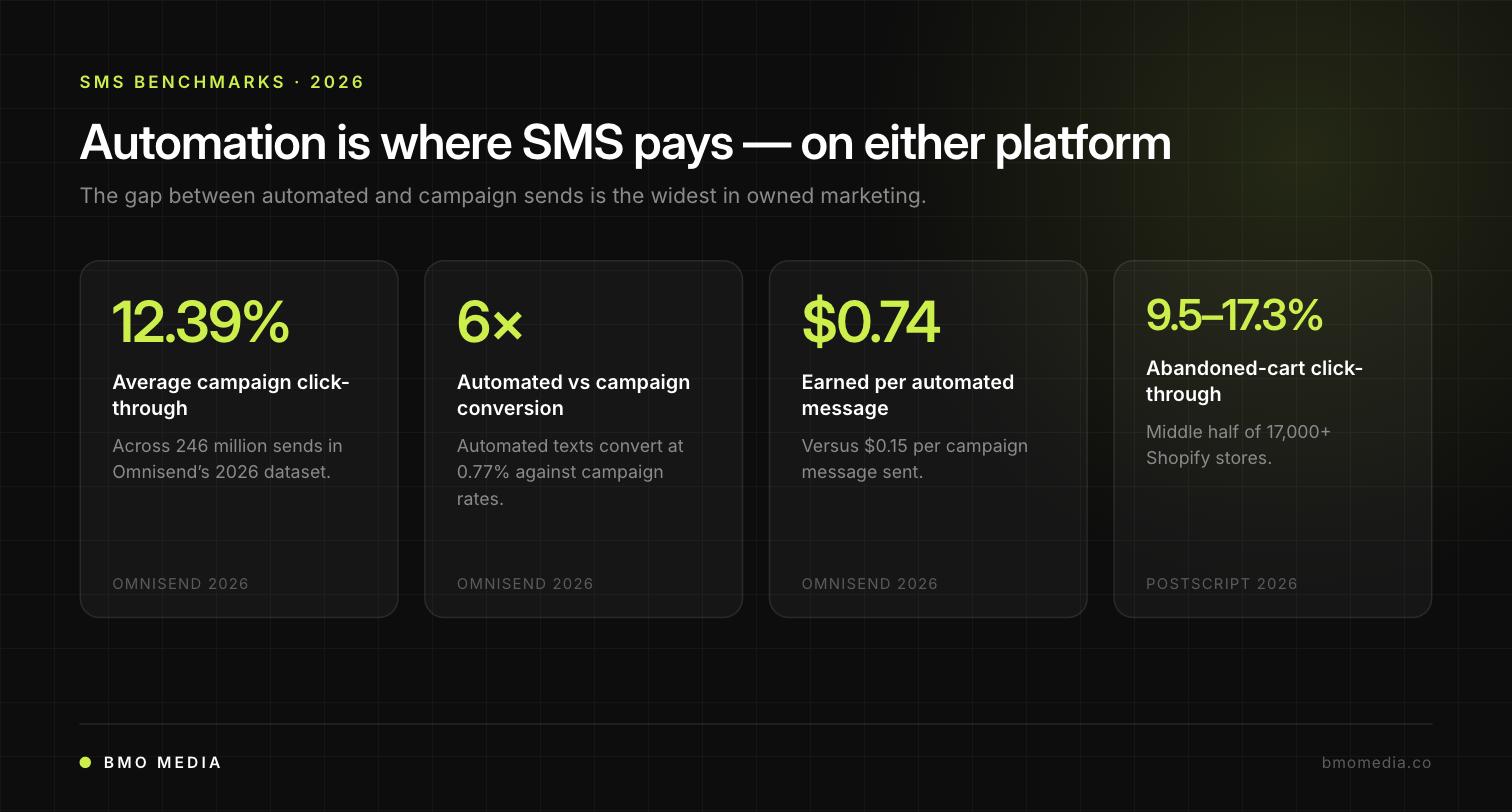
The channel itself has earned the decision. Omnisend’s 2026 dataset puts average SMS campaign click-through at 12.39% across 246 million sends, with automated texts converting at 0.77% — six times campaign rates — and earning $0.74 per message against $0.15 for campaigns. Postscript’s own 2026 benchmarks across 17,000+ Shopify stores show abandoned-cart texts clicking between 9.5% and 17.3% for the middle half of stores. Whoever you pick, automation is where SMS pays.
Running Black Friday on either platform? Use our Black Friday SMS send schedule alongside the comparison below.
Dimension | Attentive | Postscript |
|---|---|---|
Best for | Mid-market to enterprise DTC | Shopify-native emerging to mid-size brands |
Pricing model | Custom contracts, typically annual | Usage-based tiers, Shopify-aligned |
List growth | Patented two-tap style sign-up units, extensive identity network | Popups, keywords, checkout opt-in tuned for Shopify |
Flows/automation | Deep journeys, AI copy tools | Full flow suite, AI features, SMS Sales add-on (human agents) |
Ecosystem | Broad martech integrations | Deepest Shopify integration |
Support model | Managed white-glove tiers | Self-serve up through managed options |
Pricing models: contract vs usage
The structural difference shows up on the invoice before it shows up anywhere else. Attentive typically sells custom annual contracts scoped to carrier fees, volume, and support tier — enterprise procurement, enterprise leverage. Postscript prices in published usage-based tiers that scale with sends and subscribers, which is why it reads cheaper at emerging-brand volume. Neither is “cheaper” at every size: at high volume, negotiated Attentive contracts can beat list pricing; at low volume, paying enterprise minimums is dead weight. Model your cost per subscriber per month at your actual send cadence before deciding — carrier fees apply on both and surprise everyone once.
List growth: where Attentive presses its advantage
Attentive built its reputation on acquisition units — the two-tap style mobile sign-up flow it has litigated to protect — and on an identity network that improves match rates for larger brands. Postscript counters with Shopify-tuned popups, keyword opt-ins, and checkout collection that are simpler to deploy well.
What we can add from our own accounts: list growth is more program than platform. When we launched SMS for Darc Sport on Attentive, the list hit 41,000 subscribers within two months — nearly doubling the brand’s owned audience — but the drivers were drop-day mechanics and offer design as much as the sign-up unit. The platform sets the ceiling; the program decides where under it you land. Our tactics are in SMS list growth.
Flows and automation: where the money is on both
Both platforms run the full automation set — welcome, abandoned cart, browse, post-purchase, win-back — and both have shipped AI copy and targeting features. Postscript’s distinctive add-on is SMS Sales, human agents closing conversationally in the thread. Attentive’s depth shows in journey branching and segmentation at large list sizes.
The revenue math favors automation everywhere: Omnisend’s 2026 data has automated SMS out-earning campaigns roughly 5× per message. Our Darc Sport program on Attentive saw SMS revenue rise 29.8% in two months, with automation sequences driving an 80% increase in revenue from automated sends and campaigns earning $7.89 per message sent — against Postscript’s published mid-band of $3.52–$10.95 per abandoned-cart message. Well-run programs on either platform live in the same band. Badly run ones underperform on both.
Deliverability and compliance
Both platforms handle TCPA consent capture, quiet hours, and carrier compliance competently — this is table stakes, not a differentiator. The real compliance risk sits in program design: imported lists without SMS-specific consent, missing purchase-flow disclosures, and quiet-hours violations from timezone-naive sends. Whoever runs your program (platform, agency, or in-house) needs a written consent map before the first campaign. Our checklist is in SMS marketing best practices.
The Klaviyo SMS question
If you already run Klaviyo email, Klaviyo SMS promises one segmentation brain across both channels — a real advantage for lean teams. The dedicated platforms counter with deeper SMS-specific tooling: acquisition units, conversational selling, carrier relationships. Our working rule: single-channel simplicity favors Klaviyo SMS until SMS becomes a top-three revenue channel; at that point dedicated tooling usually earns its second invoice. Whichever way you go, email and SMS must be orchestrated, not parallel — the split of jobs between them matters more than the vendor.
What the lawsuit changed in 2026
Buyers keep asking about the legal fight, so here is the neutral version. Attentive sued Postscript in 2023 for patent infringement over its two-tap sign-up technology (TechCrunch covered the filing). In late 2025, a Delaware federal court ruled that Postscript did not infringe Attentive’s patents, and Postscript has been loud about the vindication since. Practical takeaway for buyers: the ruling removed a cloud over Postscript’s acquisition tooling, and both platforms continue building aggressively. Choose on fit, not on litigation risk.
Migration reality
Switching is easier than teams fear and slower than vendors imply. Subscriber consent transfers when documented properly; flow logic, segments, and integrations rebuild by hand. Budget four to six weeks for a clean cutover with revenue overlap, and time it away from Q4. If you are switching primarily over invoice friction, renegotiate first — both vendors move at renewal.
Which to choose, by brand profile
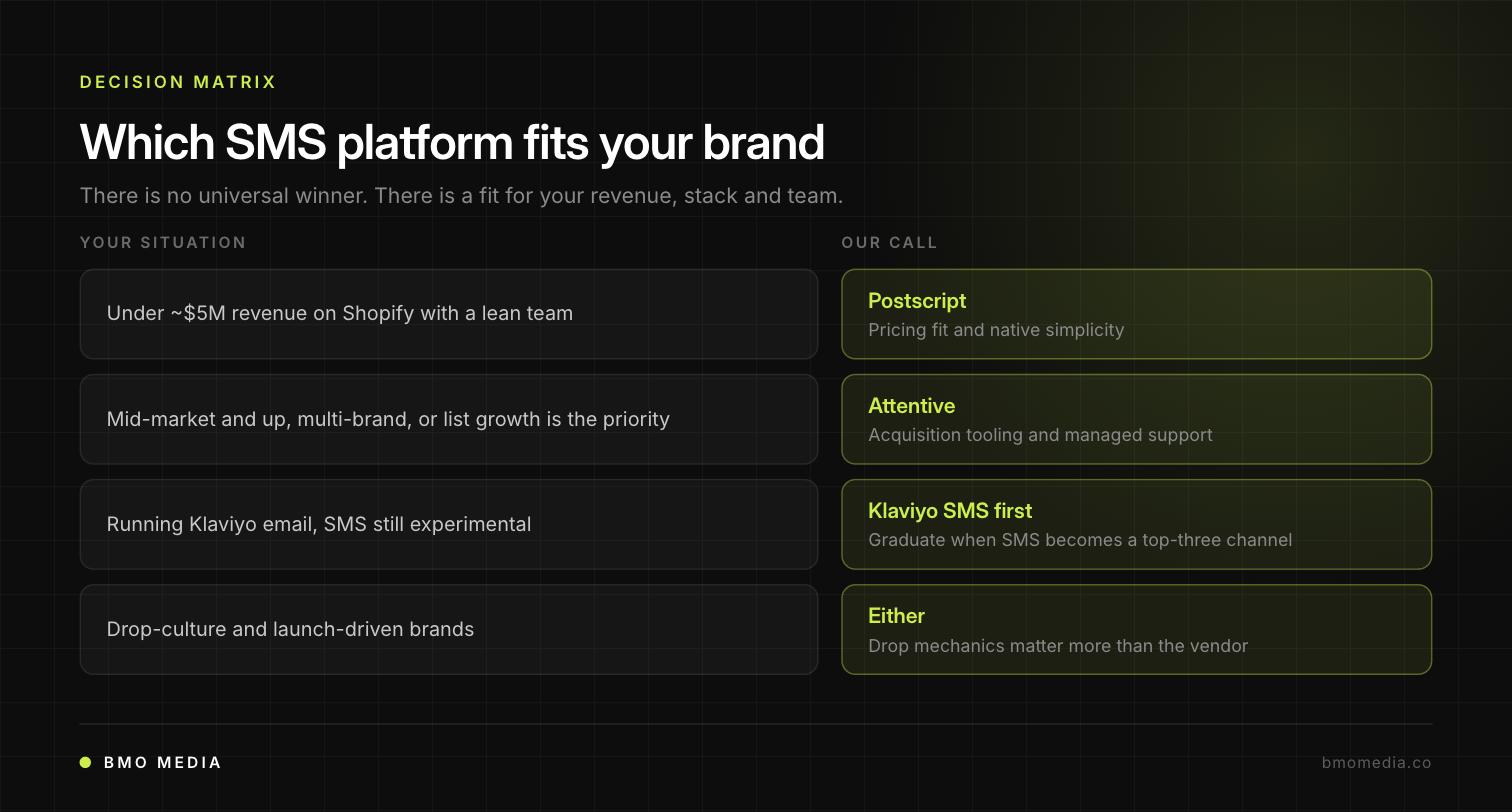
Under roughly $5M revenue on Shopify with a lean team: Postscript, for pricing fit and native simplicity. Mid-market and up, multi-brand, or list growth as the priority: Attentive, for acquisition tooling and managed support. Running Klaviyo email with SMS still experimental: test Klaviyo SMS first, graduate to a dedicated platform when SMS earns a top-three channel slot. Drop-culture and launch-driven brands: either platform works — the drop mechanics matter more than the vendor, which is exactly what our Darc Sport program showed on Attentive.
We build and run SMS programs on both platforms. See how we run SMS.
What we see managing both
Three patterns from the accounts we operate. One: platform switching fixes invoices, not performance — programs underperform for reasons that migrate with them. Two: the brands winning on SMS treat it as a flow channel with occasional campaigns, not a megaphone; the benchmark gap between automated and campaign sends is the widest in owned marketing. Three: consent quality beats list size — a smaller list with clean, recent, SMS-specific opt-ins out-earns a big imported one every time, and it keeps you out of TCPA trouble.
Get the next one
New DTC retention teardowns and benchmarks, straight to your inbox.
Frequently asked questions
Is Attentive or Postscript cheaper?
At emerging-brand volume, usually Postscript (usage-based tiers). At enterprise volume, negotiated Attentive contracts can win. Model cost per subscriber at your send cadence; carrier fees apply on both.
What happened with the Attentive vs Postscript lawsuit?
Attentive sued Postscript in 2023 over sign-up patents; a Delaware federal court ruled in late 2025 that Postscript did not infringe. Both platforms are unaffected operationally.
Can Klaviyo SMS replace Attentive or Postscript?
For lean teams where SMS is secondary, yes — unified segmentation is worth real money. Once SMS is a top-three revenue channel, dedicated platforms usually justify themselves.
Deciding between the two right now?
Book a 20-minute call — we will map your volume and stack to the cheaper-per-dollar-earned option, no pitch attached.
Share on
Enjoyed this read?
See how a tailored retention strategy could work for your brand.
Interested in working with us?
Request a complimentary audit and start building a stronger lifecycle foundation today.
Join the team
The retention brief
One email a month. Benchmarks, teardowns and what is actually working in DTC lifecycle right now.
Interested in working with us?
Request a complimentary audit and start building a stronger lifecycle foundation today.
Join the team
The retention brief
One email a month. Benchmarks, teardowns and what is actually working in DTC lifecycle right now.
Interested in working with us?
Request a complimentary audit and start building a stronger lifecycle foundation today.
Join the team
The retention brief
One email a month. Benchmarks, teardowns and what is actually working in DTC lifecycle right now.