SMS Marketing
Black Friday SMS Marketing: 24 Templates and a Send Schedule
Sammy Tran

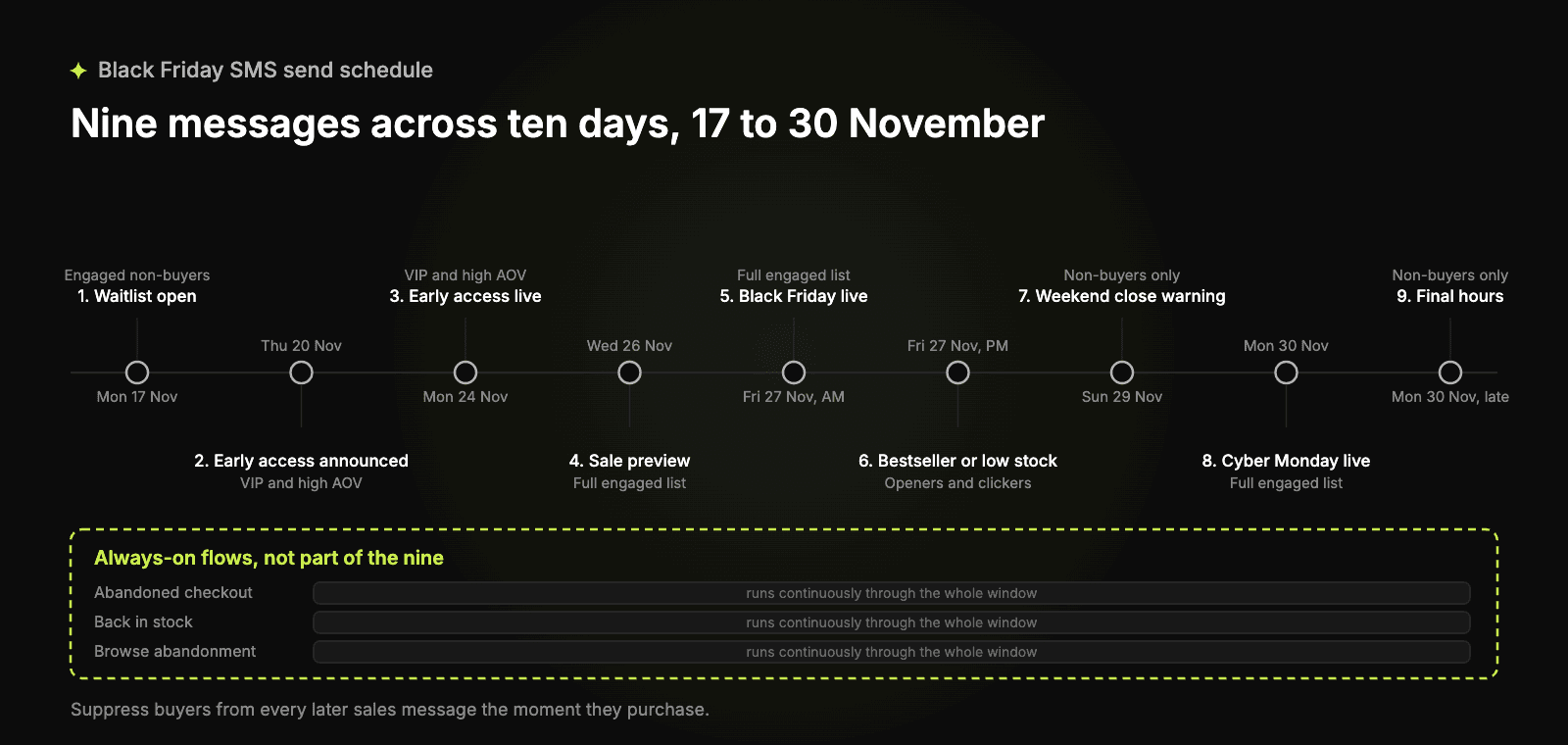
Black Friday SMS works when the schedule is decided before the copy. Nine messages across ten days, each tied to a specific moment rather than a daily slot, will outperform fifteen sent because the calendar said so. Below are 24 templates grouped by moment, the schedule that uses them, and the consent rules that decide whether you can send at all.
Want this run for you over BFCM? Black Friday SMS done for you.
Why SMS carries more of BFCM than it used to
Email still does the volume. SMS does the timing.
Postscript's 2026 benchmark data, drawn from more than 17,000 Shopify stores, put abandoned-cart SMS click-through between 9.5% and 17.3%, with earnings per message between $3.52 and $10.95 and subscriber lifetime value ranging from $25 to $553. Omnisend's 2026 figures put SMS campaign click-through at 12.39%, and automated SMS conversion at 0.77% against 0.12% for one-off campaigns, at $0.74 revenue per message versus $0.15.
Two things follow. First, the automated messages outperform the broadcasts by roughly six times on conversion, which means your cart and back-in-stock triggers matter more than your Black Friday blast. Second, the spread in those ranges is enormous, and the difference between the bottom and the top of the range is almost entirely list quality and timing rather than copy.
The timing advantage is what makes SMS worth the cost during BFCM specifically. Shopify's 2025 BFCM peaked at $5.1 million in sales per minute at 12:01 PM EST on Black Friday (Shopify investor press release, 2 December 2025). In a window that compressed, a channel read within three minutes behaves differently from one read within three hours. That is the whole case for SMS at Black Friday, and it is also why over-sending destroys it: the channel only keeps its urgency if you do not spend it.
The send schedule: nine messages across ten days
Day | Message | Audience | Purpose |
|---|---|---|---|
Nov 17, Mon | 1. Waitlist open | Engaged non-buyers | Capture intent early |
Nov 20, Thu | 2. Early access announcement | VIP and high AOV | Reward, spread load |
Nov 24, Mon | 3. Early access live | VIP and high AOV | Sell before the noise |
Nov 26, Wed | 4. Sale preview | Full engaged list | Set expectation |
Nov 27, Fri AM | 5. Black Friday live | Full engaged list | Peak send |
Nov 27, Fri PM | 6. Bestseller or low stock | Openers and clickers only | Second bite, not a resend |
Nov 29, Sun | 7. Weekend close warning | Non-buyers only | Deadline |
Nov 30, Mon | 8. Cyber Monday live | Full engaged list | Second peak |
Nov 30, Mon late | 9. Final hours | Non-buyers only | Close |
Alongside those nine, three automated flows run continuously and are not part of the count: abandoned checkout, back-in-stock, and browse abandonment. Those are the messages that earn the numbers quoted above.
Suppress buyers from every subsequent sales message the moment they purchase. Nothing burns an SMS list faster than telling a customer the sale ends tonight six hours after they bought.
24 Black Friday SMS templates
Replace bracketed fields. Keep messages under 160 characters where possible, because a second segment doubles cost across your whole list. Character counts are shown for the base version before your brand name and opt-out are appended.
Waitlist and pre-sale
1. [Brand]: Our Black Friday list opens first. Tap to get early access before everyone else. [link] Reply STOP to opt out. (108)
2. [Brand]: Last year our best sellers went in 40 minutes. Join the early list so you don't miss them. [link] (94)
3. [Brand]: Want first look at Black Friday? Save your spot, no purchase needed. [link] (74)
4. [Brand]: Early access opens Monday. You're on the list. Nothing to do yet, we'll text you. (82)
Early access
5. [Brand]: Early access is live. [X]% off before public launch. Your link: [link] (72)
6. [Brand]: You get 48 hours before everyone else. Shop now: [link] (56)
7. [Brand]: [Product] is already moving in early access. [X] left at this price. [link] (76)
8. [Brand]: Early access ends tonight. Public sale starts Friday at the same price, but the stock won't. [link] (100)
Black Friday launch
9. [Brand]: Black Friday is live. [X]% off sitewide. [link] (48)
10. [Brand]: It's on. [X]% off everything, no code needed. [link] (53)
11. [Brand]: Black Friday, [X]% off. Free shipping over $[Y]. Ends Sunday. [link] (69)
12. [Brand]: Your cart from last week is [X]% off right now. [link] (54)
Cart and browse recovery
13. [Brand]: You left [product] behind. It's [X]% off until Sunday. [link] (61)
14. [Brand]: Still thinking about [product]? Stock is low and the sale ends Sunday. [link] (78)
15. [Brand]: Your cart is saved but the Black Friday price isn't. [link] (60)
Cyber Monday
16. [Brand]: Cyber Monday is live. [X]% off, today only. [link] (51)
17. [Brand]: Missed Black Friday? Cyber Monday is your second chance. [X]% off: [link] (74)
18. [Brand]: Today only: [X]% off [category]. Back to full price tomorrow. [link] (69)
19. [Brand]: Cyber Monday ends at midnight. Anything in your cart goes back up. [link] (73)
Closing and urgency
20. [Brand]: 6 hours left. [X]% off ends at midnight. [link] (48)
21. [Brand]: Final hours. This is the last text you'll get about it. [link] (62)
22. [Brand]: Sale ends tonight. [Product] is nearly gone. [link] (51)
Post-sale
23. [Brand]: Thanks for shopping with us. Your order is confirmed and we'll text tracking soon. (83)
24. [Brand]: Sale's over but you're on the VIP list now. First look at everything we drop next. (83)
Two notes on using them. Never send template 21 unless it is true, because a brand that says "last text" and then sends two more has taught its list to ignore urgency permanently. And templates 12, 13, 14 and 15 belong in flows rather than in campaigns, which is where the six-times conversion advantage sits.
Compliance: the rules that decide whether you can send at all
SMS is a consent channel, and the penalties are per message rather than per campaign. Four constraints matter most at BFCM.
Express written consent is required before the first marketing message. A checkbox at checkout that is pre-ticked, or an email address swapped for a phone number without a separate opt-in, does not qualify. Two-tap opt-in is the standard because it produces an auditable record.
Quiet hours apply. Marketing messages outside roughly 8am to 9pm in the recipient's local time zone create exposure. Black Friday tempts brands into midnight sends. Schedule by recipient time zone, not by your own.
Opt-out must work on every message and be honored immediately. STOP handling is table stakes and platform-level, but confirm it is firing before the season rather than during it.
Volume spikes attract carrier filtering. Carriers throttle unfamiliar senders that suddenly multiply volume, exactly as mailbox providers do. Ramp sending across November rather than going from two messages a month to nine in ten days.
This is a summary for planning, not legal advice. Confirm your specific setup with counsel, particularly if you send to multiple states or outside the US, because requirements differ by jurisdiction and change.
See how we run SMS programs.
Choosing an SMS platform for BFCM
Platform | Strength at BFCM | Honest limitation |
|---|---|---|
Attentive | List growth tooling and compliance at scale | Separate from your email data |
Postscript | Shopify-native, strong cart recovery | SMS only |
Klaviyo SMS | Shares profile data with your email program | Fewer SMS-specific growth tools |
Omnisend | Simple, affordable on smaller lists | Less depth at volume |
Sinch | Enterprise scale and global reach | Heavier to implement |
Community | Conversational and creator-led brands | Not built for discount retail |
Emotive | Two-way conversational selling | Smaller ecosystem |
Voxie | Conversational automation | Less common in DTC |
BMO Media | Running SMS alongside email as one program | We are an agency, not a platform |
If you are choosing between the two most common DTC options, we compared them in detail in Attentive vs Postscript. Whichever you pick, do not migrate platforms in October. Run the season on what is already installed and tested.
What building Darc Sport's list actually took
Darc Sport sells drops to a high-intent audience, and SMS carries the minutes around a launch in a way email cannot. The constraint was never copy. It was having a list large enough and consented properly enough to matter when a drop went live.
The program added 41,000 SMS subscribers in two months. That came from compliant two-tap opt-in running continuously across the site rather than from a campaign, from capturing phone numbers at the post-purchase moment when willingness is highest, and from cross-capturing SMS consent from the existing email list.
The lesson for BFCM is timing. That list existed before the peak moment arrived. A brand starting SMS consent collection in November has a channel it cannot use this year, and the honest recommendation in that case is to run email-only for the season and start collecting consent in January.
There is a second lesson in that number which is easy to miss. 41,000 subscribers in two months is not a growth hack, it is a capture rate applied to existing traffic for sixty days without interruption. Most brands run list-growth as a campaign: a giveaway in October, a pop-up refresh in November, then nothing. Continuous capture at a modest rate beats intermittent capture at a high one, because the compounding happens in the weeks nobody is paying attention to.
It also means the honest planning question for SMS is not "what should we send" but "how many consented subscribers will exist on 27 November". Work backwards from that number. If the answer is under a few thousand for a mid-size DTC brand, the channel will not move your BFCM result this year regardless of how good the nine messages are, and the effort is better spent on email segmentation.
For the full method, see our SMS list growth guide.
What to measure after
Four numbers, and none of them is open rate, which SMS does not meaningfully report.
Revenue per message, split between campaigns and flows. If flows are not outperforming campaigns by several times on conversion, your triggers are misconfigured rather than your copy being weak.
Opt-out rate per send. A single message above 2% has damaged the asset. Cumulative opt-out across the season above 5% means the schedule was too heavy and next year needs fewer messages, not better ones.
Cost per message against revenue per message. SMS has a real marginal cost, unlike email. A send that produced revenue but lost money on the segment is a send you should not repeat.
Second-order rate for BFCM SMS buyers at 30 and 60 days. This is the number that tells you whether the channel acquired customers or bought one-time transactions.
Two comparisons make those numbers useful rather than merely present. Compare each send against the same send last year rather than against the send before it, because BFCM messages are not comparable to a Tuesday campaign and never will be. And compare revenue per message across segments within the same send, which is what isolates audience quality from copy quality. A message that earned $4.10 per recipient on VIPs and $0.30 on the full list did not have a copy problem.
Do not judge any of it in the first week. Give the cohort 30 days before you read the second-order numbers, and 60 before you change the program. The temptation on the Monday after Cyber Monday is to rewrite next year's plan from a weekend of data, and that is how brands end up cutting the flows that were quietly doing the work.
FAQ
How many SMS messages should I send during Black Friday?
Nine campaign messages across ten days is a workable ceiling for most DTC brands, plus continuously running cart, browse and back-in-stock flows. The segmentation matters more than the count: nine well-cut sends beat fifteen sent to everyone.
What time should I send Black Friday SMS?
Inside 8am to 9pm in the recipient's local time zone. Schedule by recipient time zone rather than your own, and avoid the midnight send that Black Friday tempts brands into.
Is SMS or email better for Black Friday?
Email does the volume, SMS does the timing. SMS earns its cost on time-limited moments such as launch, low stock and closing hours. Running both without coordinating suppression is worse than running either alone.
What opt-out rate is normal for Black Friday SMS?
Under 2% per message. Above that, the send was too broad or too frequent. Cumulative season opt-out above 5% means the schedule needs cutting next year.
Can I text customers who gave me their email address?
No. SMS requires separate express written consent. An email subscriber is not an SMS subscriber, and treating them as one creates real financial exposure.
Get the next one
New DTC retention teardowns and benchmarks, straight to your inbox.
Frequently asked questions
How many SMS messages should I send during Black Friday?
Nine campaign messages across ten days is a workable ceiling for most DTC brands, plus continuously running cart, browse and back-in-stock flows. The segmentation matters more than the count: nine well-cut sends beat fifteen sent to everyone.
What time should I send Black Friday SMS?
Inside 8am to 9pm in the recipient's local time zone. Schedule by recipient time zone rather than your own, and avoid the midnight send that Black Friday tempts brands into.
Is SMS or email better for Black Friday?
Email does the volume, SMS does the timing. SMS earns its cost on time-limited moments such as launch, low stock and closing hours. Running both without coordinating suppression is worse than running either alone.
Request a complimentary BFCM readiness audit
Share on
Enjoyed this read?
See how a tailored retention strategy could work for your brand.
Interested in working with us?
Request a complimentary audit and start building a stronger lifecycle foundation today.
Join the team
The retention brief
One email a month. Benchmarks, teardowns and what is actually working in DTC lifecycle right now.
Interested in working with us?
Request a complimentary audit and start building a stronger lifecycle foundation today.
Join the team
The retention brief
One email a month. Benchmarks, teardowns and what is actually working in DTC lifecycle right now.
Interested in working with us?
Request a complimentary audit and start building a stronger lifecycle foundation today.
Join the team
The retention brief
One email a month. Benchmarks, teardowns and what is actually working in DTC lifecycle right now.