Email Marketing
Holiday Email Marketing: The Full Q4 Calendar From October to January

Sammy Tran

Holiday email marketing works as four phases, not one weekend. October warms and grows the list. November sells the peak. December sells gifting against shipping cutoffs. January reactivates. Adobe Analytics put Cyber Week at $44.2 billion of a $257.8 billion US online season, about 17%. The other 83% is the calendar below.
Most holiday email advice stops at Cyber Monday. That is where the case studies end, where the agency retainers get renewed, and where the team stops looking at the dashboard. It is also where roughly half the season's revenue is still sitting unspent.
This post gives the send calendar for all four phases: what October is for, how November should be sequenced, what December actually needs once the discount is over, and why January is the cheapest revenue in the quarter. December and January get the most space here because they get the least attention everywhere else.
Why the Q4 email calendar has four phases, not one weekend
The case for a four-phase calendar is arithmetic, and Adobe published both halves of it.
Adobe recorded $257.8 billion in US online spend between November 1 and December 31, up 6.8% year over year, with 25 separate days clearing $4 billion. In a separate release, Adobe put November 1 through December 1 at $137.4 billion and Cyber Week alone at $44.2 billion. Subtract those and the shape of the season becomes obvious.
Phase of the season | US online spend | Share of season | Source |
November 1 to the day before Thanksgiving | $93.2 billion | 36.2% | Derived: Adobe's $137.4B minus $44.2B Cyber Week |
Cyber Week (Thanksgiving to Cyber Monday) | $44.2 billion | 17.1% | Adobe Analytics, reported December 2025 |
December 2 to December 31 | $120.4 billion | 46.7% | Derived: Adobe's $257.8B minus $137.4B |
Season total | $257.8 billion | 100% | Adobe Analytics, reported January 2026 |
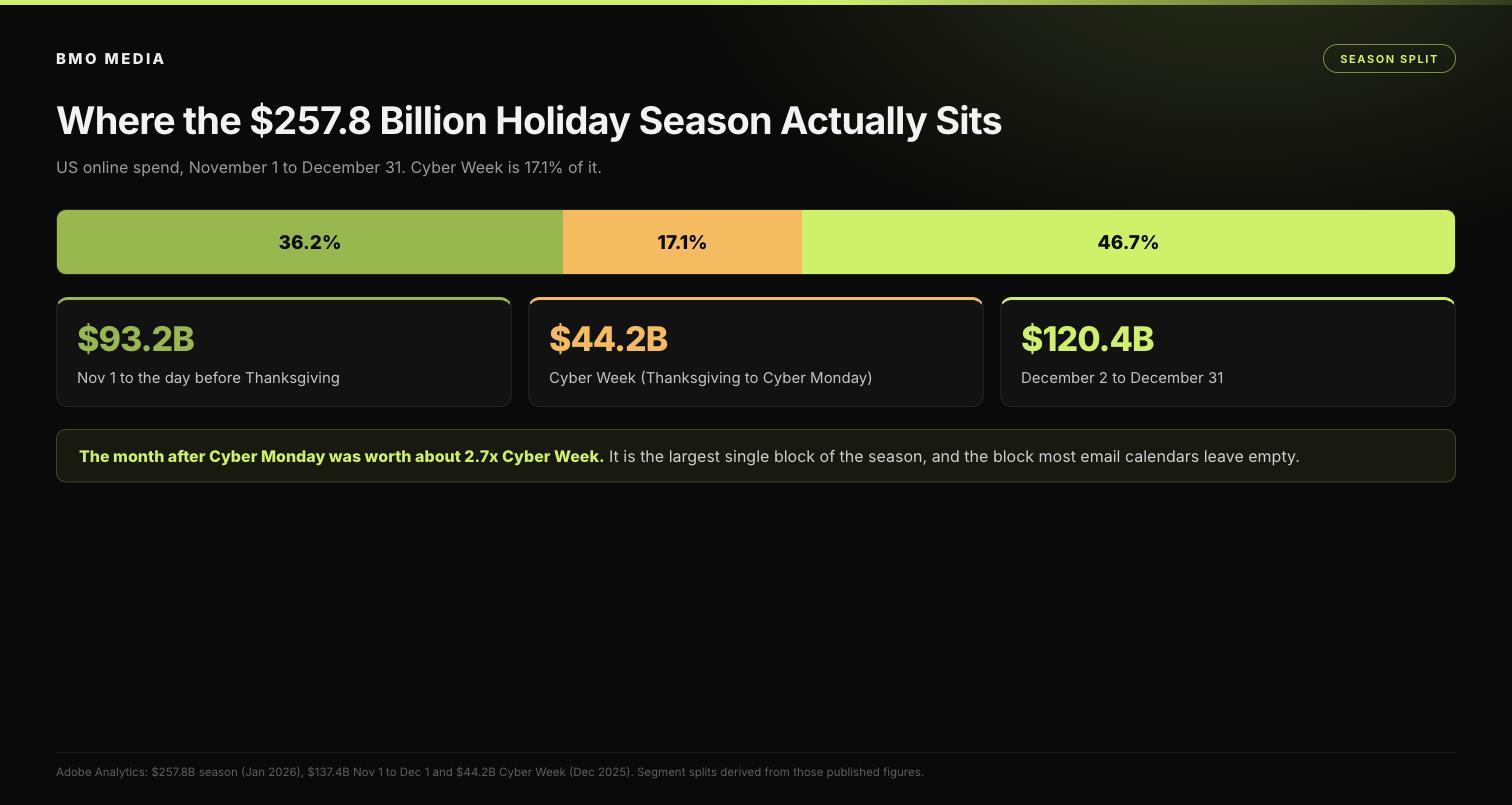
Read the third row twice. The month after Cyber Monday was worth about 2.7 times Cyber Week. Not a rounding error, and not a long tail. It is the largest single block of the season, and it is the block most email calendars leave empty.
Consumer behavior data says the same thing from the other direction. The National Retail Federation found that 42% of shoppers planned to start browsing and buying before November, 63% planned to shop over Thanksgiving weekend, and 60% expected to still be finishing in December. Those groups overlap heavily, which is the point. The same customer shops in October, buys on Black Friday, panics on December 18, and returns something on January 6. A calendar built for one weekend only speaks to them once.
October sits outside Adobe's measured holiday window entirely, which is why it rarely appears in season recaps. It still decides how November performs, because the list you send to in late November is the list you built in October.
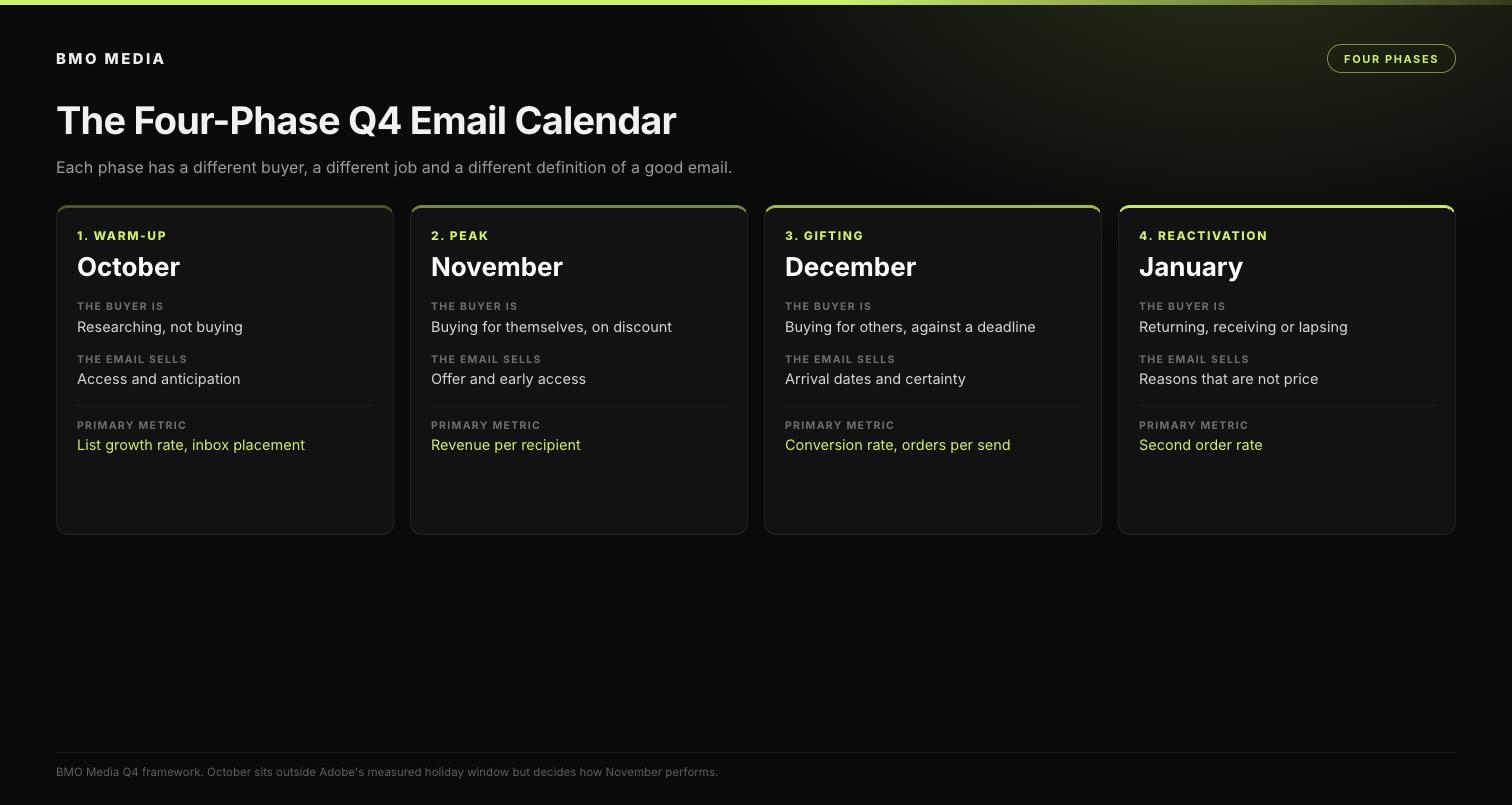
That gives four phases, each with a different job, a different buyer and a different definition of a good email.
Phase | Month | The buyer is | The email sells | Primary metric |
1. Warm-up | October | Researching, not buying | Access and anticipation | List growth rate, inbox placement |
2. Peak | November | Buying for themselves, on discount | Offer and early access | Revenue per recipient |
3. Gifting | December | Buying for others, against a deadline | Arrival dates and certainty | Conversion rate, orders per send |
4. Reactivation | January | Returning, receiving or lapsing | Reasons that are not price | Second order rate |
What to send in October: warm the list before the discount window opens
October is infrastructure, not revenue. The job is to arrive at November with a bigger list, a warmer sending reputation, and automations that will not quote last week's price during a sale.
Four workstreams matter, and none of them are campaigns.
Grow the list against a real incentive. Early access to the Black Friday offer converts better than a flat 10% welcome discount, and it costs no margin. Capture the signup as a segment, not a tag, so November can address it directly.
Ramp send volume deliberately. If your normal monthly volume is 40,000 and Cyber Monday alone will be 400,000, that jump has to be built across October and early November. Mailbox providers throttle on engagement history, and a tenfold spike from a quiet domain is the clearest possible signal of a list problem. Our guide to email deliverability for DTC brands covers the authentication and complaint-rate thresholds this depends on.
Make the automations sale-aware before the sale. Omnisend measured automated emails generating $3.41 per send against $0.155 for campaigns across 2025, from a dataset of more than 20 billion campaign emails and 470 million automated sends across 27,000 brands. Automations are the highest-yield asset you own, and during a promotion they are also the most likely to be wrong, because most flows quote a static price.
Test rendering while there is time to fix it. Litmus put Apple at 62.26% of opens and Gmail at 27.03% as of July 2026. Nearly 90% of your audience reads in two environments. Test both in light and dark mode in October, not on Black Friday morning.
October week | Primary job | Sends to engaged file | What you are building |
Oct 1 to 11 | List growth and hygiene | 2 to 3 value sends | Early access signup live, unengaged segment defined |
Oct 12 to 18 | Volume ramp begins | 3 sends | Reputation warm-up, preference center refresh |
Oct 19 to 25 | Segmentation build | 3 sends | VIP and LTV tiers cut, suppression list frozen |
Oct 26 to 31 | Flow QA and offer lock | 3 sends, 1 teaser | Sale-aware logic tested, templates rendered and approved |
The teaser in the final week is the only overtly promotional message in the month. It announces that early access exists and tells people how to get on it. Everything before it earns the right to send that one.
What to send in November: sell the peak without compressing it
November is the only phase most brands plan properly, and the most common mistake inside it is compression: stacking every message into a 96-hour window and calling the resulting fatigue urgency.
The data does not reward compression. Klaviyo reported email and SMS driving 42% of total customer revenue across BFCM 2025, rising to 43% on peak days, from 22.7 billion messages and $3.8 billion in attributed value. Klaviyo also recorded Cyber Sunday as the fastest growing day of the weekend at 14% year over year, ahead of Cyber Monday at 11% and Black Friday at 10%. Demand is spreading across the window, not concentrating.
Shopify put BFCM 2025 merchant sales at $14.6 billion, up 27% year over year, with an average cart price of $114.70 across 81 million buyers. That cart figure is a useful calibration for offer design. If your average order value is well below it, lead with a price ceiling. If it is well above, lead with the dollar saving rather than the percentage.
November week | Cohort focus | Primary message | Channel weight |
Nov 1 to 8 | Full engaged file | Gift guide, category edits, no discount | |
Nov 9 to 15 | VIP and top LTV | Early access invitation and date | Email plus SMS to opted-in VIPs |
Nov 16 to 22 | Early access live | Offer opens for VIP tier only | Email leads, SMS for the open |
Nov 23 to 25 | Full engaged file | Sale preview, shipping dates published | |
Nov 26 to 30 | Segmented by engagement recency | Peak sends, 1 to 3 per cohort | SMS on time-critical moments, email on merchandising |
Dec 1 to 2 | Openers who did not buy | Extension or narrowed offer | Email, single SMS |
Two rules keep November from damaging the rest of the quarter. Send in engagement order, so your best cohort goes first and sets the reputation signal the larger sends inherit. And suppress the 365-day unengaged entirely, because their non-engagement is the input that decides whether everyone else lands in the primary tab. For the full peak-week sequencing, see our Black Friday marketing strategy and the Q4 retention playbook for BFCM.
Not sure your flows will survive the sale? Most December revenue leaks from automations quoting the wrong price, not from campaigns. Request a free retention audit and we will pressure-test your flow logic and cadence caps against this calendar before October.
What to send in December: gifting, shipping cutoffs and the last-minute buyer
December is the largest phase of the season and the emptiest calendar. Adobe's figures put December 2 to 31 at $120.4 billion, and Salesforce recorded the final two weeks of December growing 12% year over year globally and 9% in the US.
The buyer has changed completely. In November they were buying for themselves at a discount. In December they are buying for someone else against a deadline, and the deadline is the message. Salesforce found buy online pickup in store reaching nearly 1 in 5 orders across the season and climbing to 1 in 3 in the final five days before Christmas, peaking at 35% of all online orders on December 22. Adobe measured 66.5% of Christmas Day spend on mobile.
Deadline anxiety is also where carts die. Baymard Institute puts documented average cart abandonment at 70.22% across 50 studies, with extra costs at 40% and slow delivery at 20% the top two reasons given at checkout. In December those two objections are the same objection. Publish the arrival date, not the shipping speed.
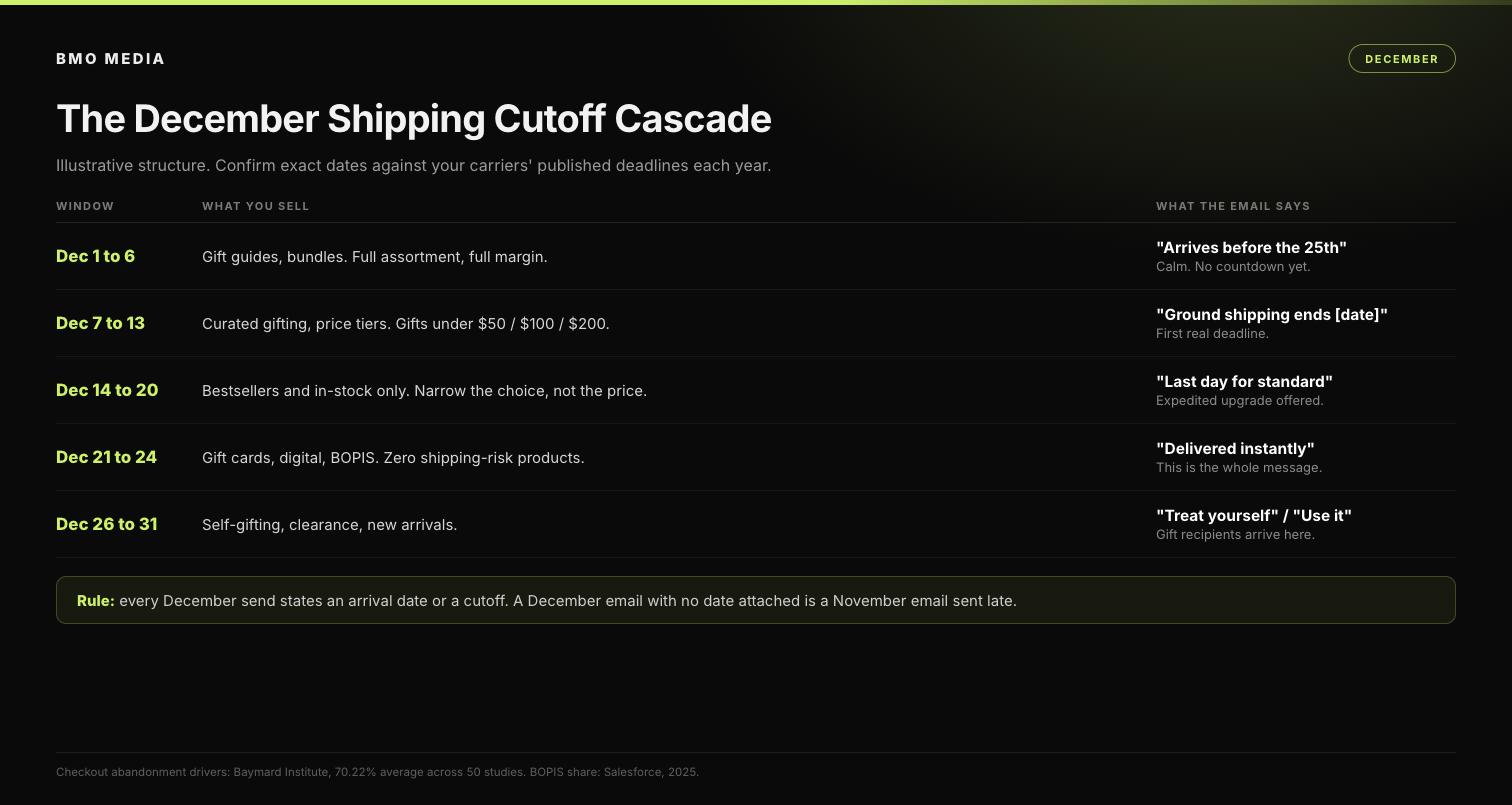
December week | Segment focus | Message | Metric that matters |
Dec 1 to 6 | Full engaged file, non-buyers | Gift guide by recipient type | Click to product page |
Dec 7 to 13 | Browsers and cart abandoners | Price-tiered gifting, ground cutoff named | Revenue per recipient |
Dec 14 to 20 | Full engaged file | In-stock bestsellers, expedited upgrade | Conversion rate |
Dec 21 to 24 | Late browsers, local radius | Gift cards, digital delivery, store pickup | Orders per send |
Dec 26 to 31 | Everyone, including new buyers | Self-gifting, onboarding, product education | Second order rate |
The December 26 to 31 window is the one almost nobody builds. The list is quiet, inbox competition has collapsed, and two valuable audiences are active at once: people spending gift cards, and people who received your product as a gift and have never bought from you. Both are worth a dedicated send.
What to send in January: reactivation, returns and the gift recipient
January is treated as a dead month. It is the cheapest revenue in the quarter, because acquisition costs are low, inbox competition is minimal, and your list is the largest it has been all year.
Three audiences exist in January, and they need different emails.
Returners. Salesforce recorded $181 billion in global returns between November 1 and December 31, representing 14% of all purchases and up 10% year over year. A return is a service interaction with a customer who already has your product in hand. Treat the returns flow as a retention asset: confirm fast, offer exchange before refund, and follow up with a fit or usage recommendation rather than silence.
Gift recipients. These are people who now own your product and have zero purchase history with you. They are not lapsed and they are not cold. They are a first-time customer who skipped the acquisition step. Send a genuine onboarding sequence: how to use it, how to care for it, what pairs with it, and only then an offer. This is where a loyalty program or a subscription offer converts unusually well, because the product experience is fresh and the price objection has already been paid by someone else.
The November discount cohort. These people bought once at a discount. Whether that was profitable depends entirely on whether they buy again. Second order rate is the metric, and January is when you move it.
January week | Audience | Message | Do not send |
Jan 1 to 10 | Gift recipients and new buyers | Onboarding, product education, registration | Discounts |
Jan 11 to 17 | November discount cohort | Second purchase at full price, replenishment | A deeper discount than November |
Jan 18 to 24 | Lapsed 91 to 365 days | Reactivation with a reason that is not price | High-frequency sequences |
Jan 25 to 31 | Unengaged 365 days plus | Final sunset sequence, then suppress | Anything after the sunset |
January is also when deliverability gets repaired. Peak-season volume leaves most senders with a widened unengaged segment and an elevated complaint rate. Run the sunset sequence, remove what does not respond, and enter February with a smaller and healthier file. Our customer retention strategies guide covers the reactivation logic in more depth.
How many emails to send in each phase without burning the list
Cadence is where four-phase calendars fail. More phases can mean more sends, and more sends applied uniformly is how complaint rates climb.
The rule is that cadence scales with engagement recency, not with the calendar. A 30-day engaged buyer and a 300-day lapsed subscriber should never receive the same number of messages in November, regardless of how good the offer is.
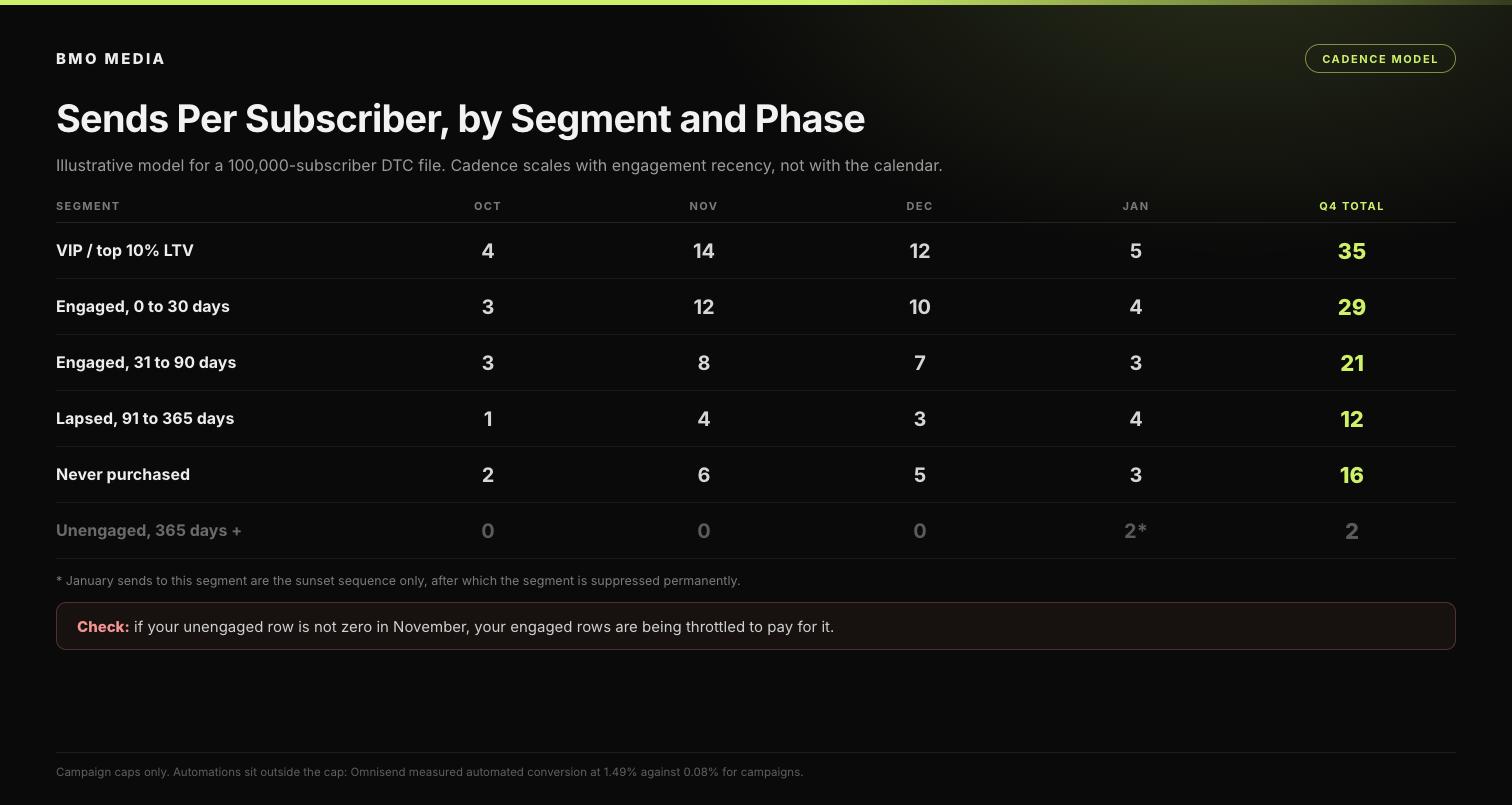
Three constraints hold the model together. Suppress on purchase within 24 hours, so nobody receives a promotional send for something they just bought. Cap total weekly touches per subscriber across email and SMS together, not per channel, because the customer experiences one cadence and not two. And keep automations outside the campaign cap, since Omnisend measured automated conversion at 1.49% against 0.08% for campaigns, which means flow sends are earning their place in the inbox in a way broadcasts are not.
Before you decide how hard to push any segment, it helps to know what a subscriber is actually worth. Our customer lifetime value calculator will tell you what a January reactivation is worth against a November acquisition, which is usually the argument that settles the cadence debate internally.
What a four-phase Q4 produced for one brand
We ran Q4 2025 for Spoonful of Comfort, and the headline number is the quarter, not the weekend. Q4 finished up 25% year over year across the full quarter.
The BFCM numbers inside it were strong. Email and SMS attributed revenue grew 196.9% year over year during BFCM, owned channels accounted for 46.1% of total BFCM revenue, and email plus SMS were attributed 64.91% of Cyber Monday revenue. But the whole-quarter figure is the one that matters, because it is the one that proves the season rather than the weekend carried the result.
Four decisions produced it, and all four are calendar decisions rather than creative ones. We extended the promotional window instead of compressing it into artificial urgency, which gave the offer somewhere to go in December. We ran early access before Black Friday for the highest-value segment, pulling revenue forward from buyers who would have converted at full margin anyway. We distributed messaging across weeks rather than stacking it into the weekend, which held complaint rates flat while volume rose. And we used AI segmentation with sale-aware automation, so flows quoted live pricing and suppressed recent purchasers throughout. The full Spoonful of Comfort case study has the rest of the program detail.
The pattern repeats across accounts. For Centr, engagement ran 2.5 times higher year over year during key sale periods, CRM-attributed revenue passed $1.9 million during BFCM, and trial-to-paid conversions lifted 20%. For Darc Sport, we grew the SMS list to 41,000 subscribers in two months, increased SMS revenue 29.8% at $7.89 per campaign message, grew the email list 18%, and held campaign click rates consistently in the 90th percentile, with Klaviyo automations producing 30% of total email revenue. That last figure is the four-phase argument in miniature: a third of email revenue arriving from sends nobody scheduled.
Frequently asked questions
When should I start holiday email marketing? October, with list growth and volume ramp rather than promotion. NRF found 42% of shoppers planned to begin browsing and buying before November, so an October presence is not early. The harder constraint is deliverability: a tenfold volume increase in late November from a domain that was quiet all autumn is what triggers throttling, and it cannot be fixed on the day.
How many emails should I send during the holiday season? Between roughly 12 and 35 across the quarter depending on segment, not a single number applied to the whole list. VIP and recently engaged cohorts can absorb the high end. Lapsed subscribers should receive a fraction of it, and the 365-day unengaged should receive nothing until a January sunset sequence. Uniform cadence across a file is the most common cause of Q4 complaint spikes.
Is December worth sending to after Cyber Monday? It is the largest phase of the season. Adobe's published figures put December 2 to 31 at roughly $120.4 billion against $44.2 billion for Cyber Week, and Salesforce measured the final two weeks of December growing 12% year over year globally. The message changes from discount to deadline, but the demand is larger, not smaller.
What should holiday emails say once the sale is over? Arrival dates. Every December send should state a shipping cutoff or a delivery guarantee, because Baymard identifies extra costs at 40% and slow delivery at 20% as the top checkout abandonment reasons, and in December those are the same concern. Once shipping cutoffs pass, pivot to gift cards, digital products and store pickup, which carry no delivery risk at all.
What is the best holiday email marketing example to copy? Copy the structure rather than the creative. The repeatable pattern is early access for a high-value segment before the public sale, an extended promotional window instead of a compressed one, sale-aware automations that quote live pricing, and a December calendar built on shipping deadlines. That structure produced a 25% year-over-year quarter for Spoonful of Comfort without a deeper discount than the previous year.
Should I email in January or wait until February? January, and for three different audiences. Gift recipients need onboarding, the November discount cohort needs a second-purchase reason at full price, and the unengaged need a sunset sequence so your February file is clean. Salesforce recorded returns at 14% of all holiday purchases, which makes the returns flow itself one of the highest-contact retention moments of the year.
Get your Q4 email calendar reviewed before October
The difference between a good Q4 and a 25% year is rarely the offer. It is whether December and January were on the calendar at all, and whether the flows were built to handle a sale before the sale started.
BMO Media runs retention programs for DTC ecommerce brands across email, SMS, loyalty, reviews, push and subscriptions. Book a free retention audit and we will map your current Q4 plan against this four-phase calendar and show you where the revenue is leaking.
The audit covers four things. Your phase coverage, so you can see how much of December and January is currently empty. Your flow logic, checked for sale-awareness and live pricing during a promotion. Your cadence and suppression rules by segment, against the volume you are planning to send. And your channel split, priced against what a subscriber is actually worth to you.
It takes about a week and you keep the findings whether or not you work with us. If you are building the Q4 program from scratch, start with how to prepare for Black Friday in ecommerce, then layer this calendar on top. Our email marketing services and SMS marketing services pages cover how we run the two channels against a single cadence cap.
Get the next one
New DTC retention teardowns and benchmarks, straight to your inbox.
Frequently asked questions
When should I start holiday email marketing?
October, with list growth and volume ramp rather than promotion. NRF found 42% of shoppers planned to begin browsing and buying before November, so an October presence is not early. The harder constraint is deliverability: a tenfold volume increase in late November from a domain that was quiet all autumn is what triggers throttling, and it cannot be fixed on the day.
Is December worth sending to after Cyber Monday?
It is the largest phase of the season. Adobe's published figures put December 2 to 31 at roughly $120.4 billion against $44.2 billion for Cyber Week, and Salesforce measured the final two weeks of December growing 12% year over year globally. The message changes from discount to deadline, but the demand is larger, not smaller.
What should holiday emails say once the sale is over?
Arrival dates. Every December send should state a shipping cutoff or a delivery guarantee, because Baymard identifies extra costs at 40% and slow delivery at 20% as the top checkout abandonment reasons, and in December those are the same concern. Once shipping cutoffs pass, pivot to gift cards, digital products and store pickup, which carry no delivery risk at all.
Share on
Enjoyed this read?
See how a tailored retention strategy could work for your brand.
Interested in working with us?
Request a complimentary audit and start building a stronger lifecycle foundation today.
Join the team
The retention brief
One email a month. Benchmarks, teardowns and what is actually working in DTC lifecycle right now.
Interested in working with us?
Request a complimentary audit and start building a stronger lifecycle foundation today.
Join the team
The retention brief
One email a month. Benchmarks, teardowns and what is actually working in DTC lifecycle right now.
Interested in working with us?
Request a complimentary audit and start building a stronger lifecycle foundation today.
Join the team
The retention brief
One email a month. Benchmarks, teardowns and what is actually working in DTC lifecycle right now.