Retention
The Black Friday Marketing Strategy That Protects Margin, Not Just Volume

Sammy Tran

A strong Black Friday marketing strategy does more than maximize orders over one weekend. It protects the economics behind those orders by controlling discount depth, increasing the contribution of owned channels, pacing promotions across a longer window, and measuring what customers are worth after Cyber Monday — not just how much revenue they generated during it.
The scale of BFCM keeps growing. Shopify merchants generated a record $14.6 billion in sales during BFCM 2025, up 27% year over year (24% on a constant-currency basis), with more than 81 million customers buying from Shopify-powered brands. Adobe Analytics measured $44.2 billion in US online spend across Cyber Week alone.
If you need the calendar first, here are the BFCM dates for 2026 and what the weekend does to margin.
But record market revenue does not automatically mean every participating brand had a better Black Friday. How much of that revenue was actually worth buying? That question changes how you build the entire BFCM plan — and there is now data that answers it uncomfortably.
Most Black Friday Customers Never Come Back
The strongest argument against volume-first BFCM planning is not theoretical. It is retention data.
Ometria analysed its retail client base across the 2025 Black Friday period and found that of the new customers acquired during Black Friday 2024, only 4% made a repeat purchase within the following 12 months. Customers acquired on Black Friday were six times less likely to return than a typical new customer. Just 11% of 2024's Black Friday shoppers came back for Black Friday 2025.
Set that against where BFCM revenue actually comes from. In the same dataset, 55% of Black Friday revenue came from existing customers and 45% from new ones. The Klaviyo 10,000-brand cohort found the same pattern from a different angle: repeat-buyer revenue grew 13.6% year over year during BFCM 2025 against 9% growth from new buyers.
The implication is direct. The majority of your Black Friday revenue will come from customers you already have, and the new customers you acquire at a deep discount will mostly not return. A strategy that spends heavily to acquire the second group while under-serving the first is optimising the wrong half of the weekend.
That does not make acquisition pointless. It makes the terms of acquisition matter enormously — and it makes the retention infrastructure you have ready before those customers arrive the difference between a spike and an asset.
Why Discount-Led Growth Can Hide Weak Economics
Revenue is the easiest BFCM metric to celebrate. It is also one of the easiest to misread.
Take a brand selling a $100 product with $40 in product costs. Before marketing, fulfillment and other variable costs, $60 remains. At 30% off, the product sells for $70. It still costs $40. The amount remaining before marketing and other variable expenses has fallen from $60 to $30 — the contribution has halved while the revenue line fell by less than a third.
Now add paid acquisition into the most competitive auction of the year. Triple Whale, tracking $606 million in ad spend across 33,000+ stores, recorded Meta CPMs of $22.26 during BFCM 2025, up 7.8% year over year. Add free shipping, higher fulfillment costs, and a returns rate that the National Retail Federation puts at 19.3% for online sales in 2025 — meaningfully higher than the 15.8% return rate across all retail. The campaign can generate significantly more orders while producing much weaker economics per order.
Here is the part most BFCM planning gets backwards: the market moved away from deeper discounting in 2025 and still grew. Klaviyo's cohort recorded an average discount of 26.2% during BFCM 2025, down from 29.1% in 2024 — and noted that none of the major deal days topped a 30% average discount rate. Record sales were set on shallower discounts.
Adobe's category-level peaks show where the ceilings actually sit.
Category | Peak discount, 2025 season |
|---|---|
Electronics | 30.9% |
Toys | 29.6% |
Apparel | 25.1% |
Televisions | 24.3% |
Computers | 23.4% |
Sporting goods | 20.3% |
Appliances | 20.2% |
Furniture | 18.8% |
If your category's peak is 20% and you are planning 35%, you are not being competitive. You are surrendering margin nobody asked you to surrender.
A better BFCM scorecard separates revenue from the economics underneath it.
Metric | What it tells you |
|---|---|
Gross revenue | How much customers spent |
Discount rate | How much selling price was surrendered |
Contribution margin | What remains after relevant variable costs |
CAC | What it cost to acquire customers |
New vs. returning mix | Where growth came from |
Owned-channel revenue | How much revenue email, SMS and other owned channels influenced |
Repeat purchase | Whether BFCM customers created value afterward |
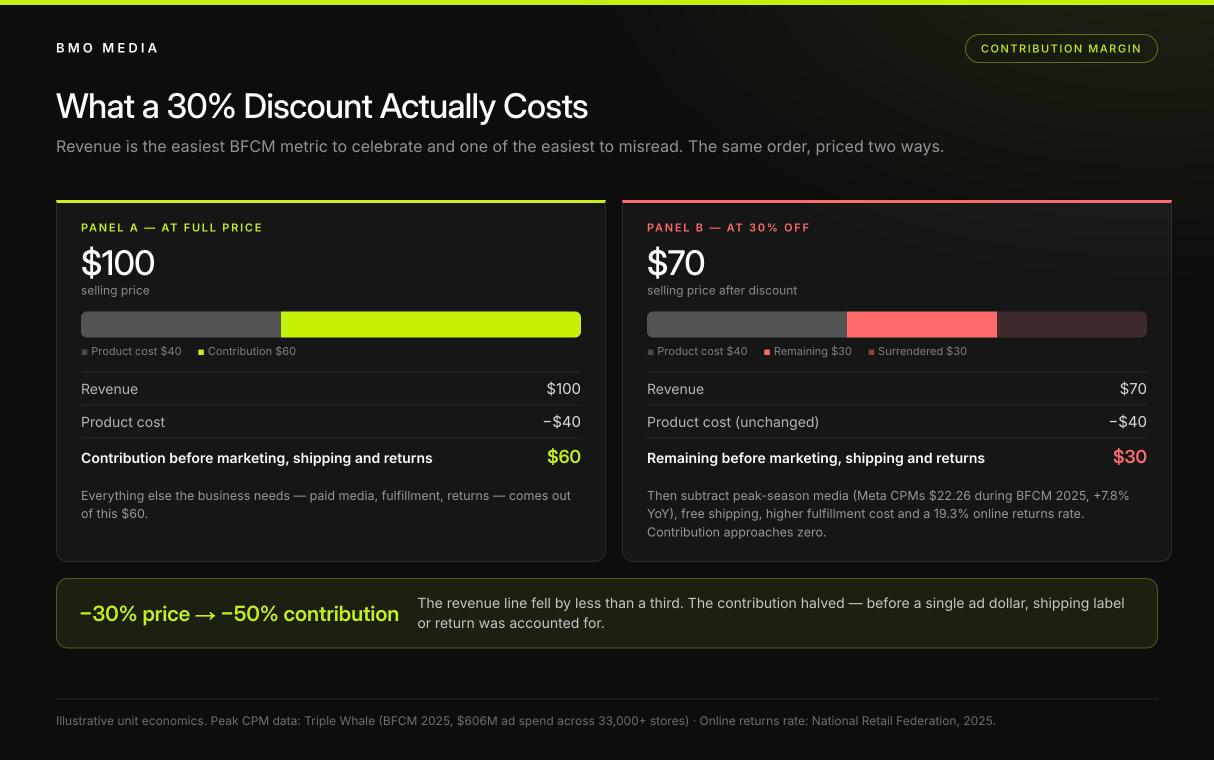
The same order, priced two ways. The revenue line falls by less than a third while contribution halves - before paid media, shipping and returns.Owned Channels Matter More When Paid Competition Peaks
Black Friday creates an unusual acquisition environment: almost every ecommerce brand wants attention at the same time. Inboxes are crowded. Social feeds are crowded. The ad auction is at its annual peak, which is what the 7.8% CPM increase above actually represents — you are paying more to reach shoppers precisely when everyone else wants them too.
That makes the audience you already have more strategically valuable. Email and SMS marketing give brands direct access to customers and high-intent prospects without reacquiring every visit through an auction. The scale is not marginal: Klaviyo reported that email and SMS drove 42% of BFCM GMV across its merchant base in 2025, generating over $3.8 billion in attributed revenue — up 27% year over year.
The lesson is not to send more messages. It is to orchestrate owned channels around customer intent. Email carries richer product stories, merchandising, education and gift inspiration. SMS supports immediacy, launches and genuine deadlines. Welcome, browse and abandonment automations capture the high-intent traffic the wider campaign generates.
BMO's work with James Michelle illustrates the principle: strengthening lifecycle performance, refining segmentation and running email and SMS as a coordinated lifecycle-first omnichannel strategy rather than two independent programs.
Paid media still matters. But your Black Friday marketing plan should not require paid media to do every job — especially in the one month of the year when it is most expensive.
BFCM readiness check. How much of your peak-season forecast depends on customers you will have to pay to reach again? A lifecycle audit can expose where owned channels can carry more of that load.
The Extended-Window Model: Make BFCM a Sequence, Not a Weekend
The traditional Black Friday marketing campaign was compressed: wait, launch a major discount, escalate urgency, send reminders, end on Cyber Monday. Shopper behaviour no longer cooperates with that shape.
The NRF survey of 8,247 US adults found that 42% of consumers planned to start holiday browsing and buying before November. Adobe's data confirms the behaviour rather than the intent: of the $257.8 billion spent online across the 2025 holiday season, $137.4 billion — roughly 53% — landed between 1 November and 1 December. More than half the season resolves before the calendar reaches December.
A stronger Black Friday marketing plan replaces one compressed promotional spike with a controlled sequence. An extended window does not mean running the same discount for four weeks. It means giving different moments different jobs: early access rewards high-intent customers; product and collection stories create demand without making every message promotional; Black Friday remains a core conversion event; Cyber Monday provides another legitimate deadline; inventory, shipping and delivery cutoffs create urgency grounded in something real rather than another artificial countdown.
One planning note specific to 2026. Black Friday falls on 27 November, the latest possible date. That leaves only 27 shopping days between Black Friday and Christmas — the shortest possible run-in. Delivery cutoffs will bite harder and earlier than they did in 2025, which makes both the extended pre-window and the accuracy of your shipping-deadline messaging more important than usual.
What an Extended BFCM Window Looked Like for Spoonful of Comfort
BMO Media used this model with Spoonful of Comfort entering Q4 2025. For the first time, the brand tested its longest-ever BFCM promotional window, including early access ahead of Black Friday and urgency distributed across multiple weeks instead of a compressed spike.
Rather than continuously escalating discounts, the program combined seasonal and collection-led storytelling, delivery cutoffs, core Black Friday and Cyber Monday moments, selective flash offers and targeted follow-ups. Automation supported the campaign rather than operating separately from it. A plain-text early-access email became one of the quarter's highest-revenue sends.
+196.9% YoY growth in email and SMS-attributed BFCM revenue
46.1% of total BFCM revenue driven by owned channels
64.91% of Cyber Monday revenue attributed to email and SMS
+25% YoY growth in email and SMS-attributed revenue across Q4
Those results do not prove every ecommerce brand should copy the same promotional calendar, and they should not be read as evidence of a specific margin improvement. They demonstrate that an intentionally paced, extended promotional strategy can scale owned-channel revenue without relying on progressively deeper discounts as the only growth lever.
Read the complete Spoonful of Comfort BFCM case study for the campaign strategy, promotional pacing and automation behind the results.
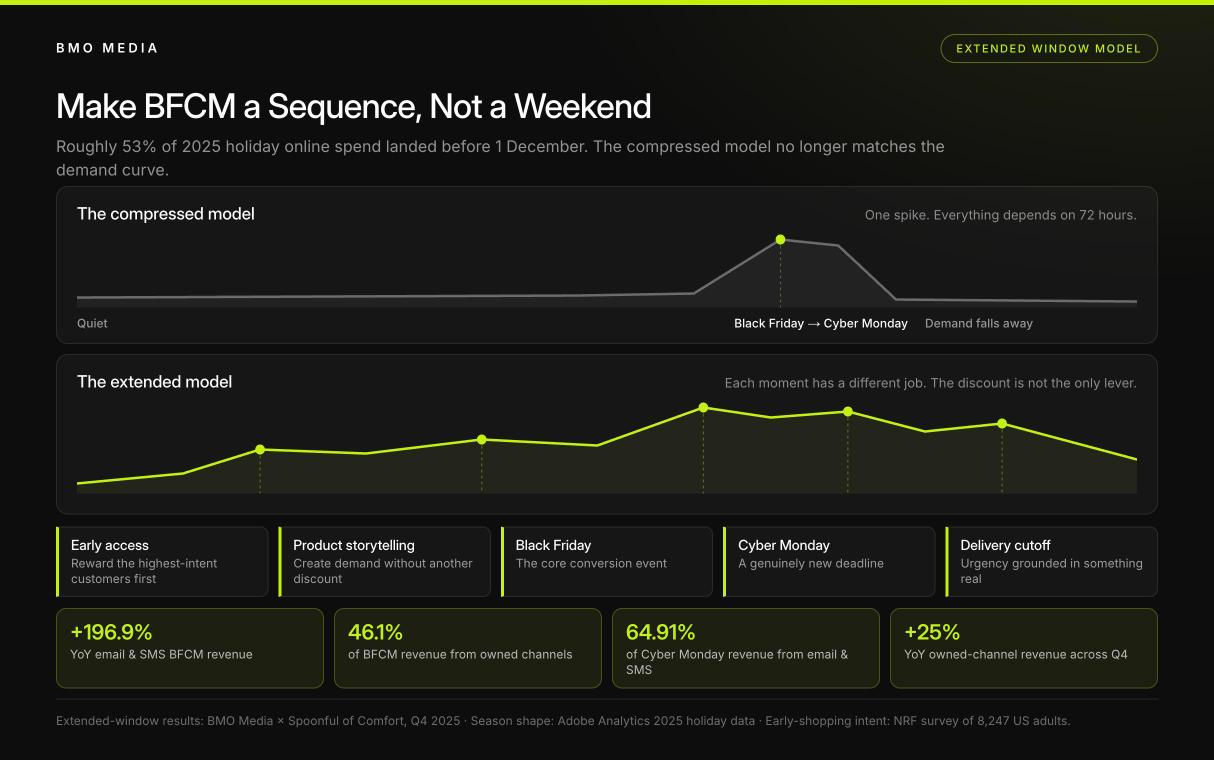
The compressed model versus the extended model. Each moment in the extended window carries a different job, and the discount is not the only lever.Segment Before the Sale, Not While Everyone Is Sending
Peak week is the wrong time to discover that segmentation is weak. By then the calendar is live, inbox competition is at its annual maximum, and there is no room to rebuild lifecycle infrastructure.
The cost of getting this wrong is measurable. Ometria recorded unsubscribe rates rising 42% year over year during the Black Friday period — the price of untargeted volume, paid in permanent list damage. Validity benchmark data shows the same pressure on the delivery side: global inbox placement falls from just under 87% in Q1 to 82.3% in Q4, with spam placement rising from 4.5% to 8.6% over the same period.
Notably, the outcome is not uniform. Attentive reported the opposite result across its 8,000+ brands during Cyber Week 2025: opt-out rates fell 17% year over year while message volume rose 46%. The divergence is the point. Sending more is not what damages a list. Sending more undifferentiated messaging is.
BMO's James Michelle lifecycle case study shows the discipline applied: refining segmentation while coordinating email and SMS around customer intent and lifecycle stage. A VIP who purchased three weeks ago should not receive the same message or cadence as a subscriber who has clicked repeatedly without buying. Segmentation is what makes restraint possible — following up based on engagement, browsing behaviour, purchase history, lifecycle stage and product interest rather than sending everything to everyone.
What Should a Black Friday Marketing Plan Actually Look Like?
1. Establish the economics. Set targets for revenue, contribution margin, discounting, acquisition efficiency and owned-channel contribution before deciding on tactics. Use your category's actual discount ceiling as the anchor, not a number that feels aggressive.
2. Build and warm the audience. Use the pre-BFCM period to grow email and SMS audiences and establish engagement before inbox competition peaks — and before Q4 deliverability pressure sets in.
3. Build meaningful segments. Create VIP, recent buyer, lapsed, engaged non-buyer, product-affinity and high-intent groups before campaigns launch. Every segment should change a decision: message, offer, timing, channel or suppression.
4. Design the offer architecture. Decide which offer belongs to which moment. Avoid a calendar where every new deadline requires a deeper discount.
5. Launch early access selectively. Give your highest-intent or highest-value customers a genuine reason to engage early — this is also where the majority of your revenue is going to come from.
6. Coordinate CRM across peak week. Black Friday and Cyber Week are not isolated sends. BMO's work with Centr shows what a broader CRM strategy for Black Friday and Cyber Week accomplishes: lifecycle segmentation, testing, automation and ongoing performance analysis across high-impact sale periods. During BFCM, BMO helped Centr generate more than $1.9 million in CRM-attributed revenue, with the broader program delivering 2.5x higher year-over-year engagement during key sale periods. Read the Centr Fitness case study.
7. Use real deadlines. Inventory constraints, shipping deadlines and delivery cutoffs create legitimate urgency without endlessly extending arbitrary countdowns. In 2026 those cutoffs arrive faster — see the 27-day run-in above.
8. Build post-purchase retention before the orders arrive. Given a 4% twelve-month repeat rate on Black Friday-acquired customers, this is where the strategy is won or lost. New customers should move into intentional post-purchase, cross-sell, replenishment, loyalty, subscription or win-back journeys depending on the business model. BMO's work with MoonBrew shows the principle beyond peak week: as acquisition accelerated, the focus shifted toward a scalable retention engine capable of supporting subscription growth, reducing early churn and generating more revenue through automation rather than constant campaign sends.
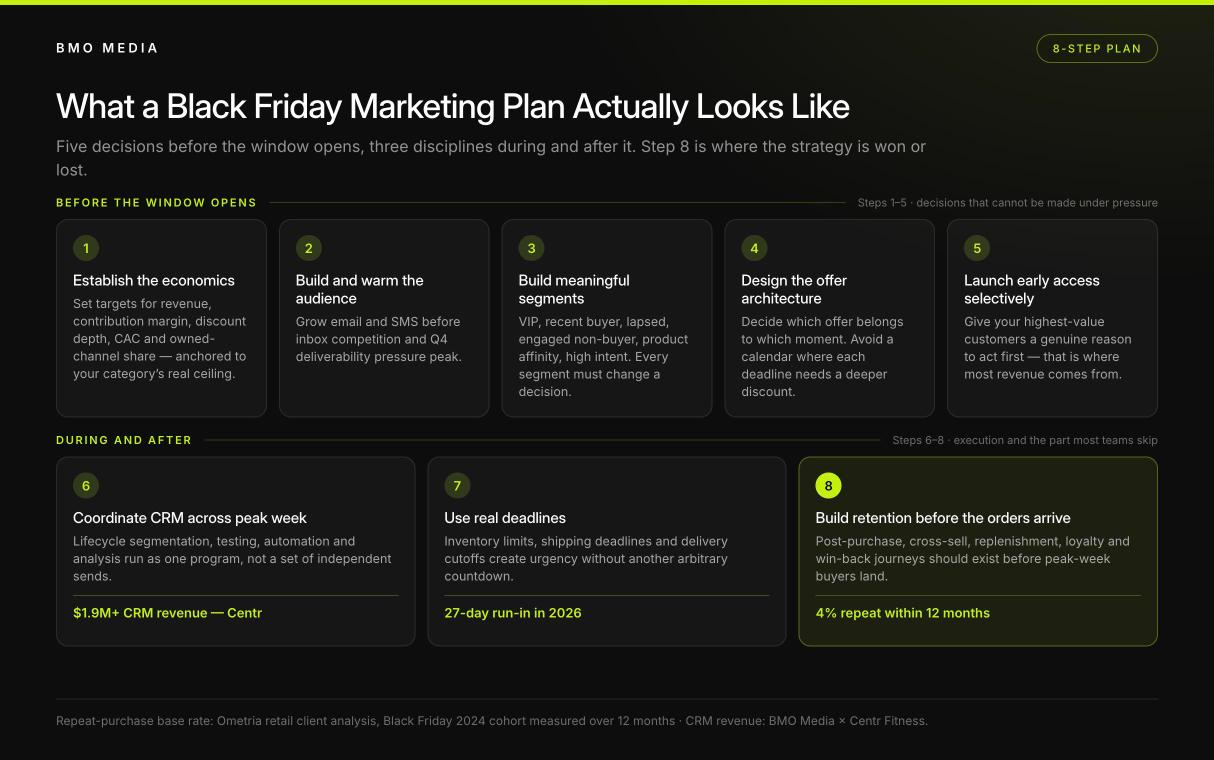
Five decisions before the window opens, three disciplines during and after it. Step 8 is where the strategy is won or lost.Measure What Peak Actually Earned
Black Friday reporting often ends too early. Teams compare this year's revenue with last year's, calculate ROAS, celebrate, and move on. A stronger analysis asks three layers of questions.
What did we sell? Gross revenue, orders, AOV, conversion rate, new versus returning customer mix. This tells you what happened commercially.
What did it cost to produce those sales? Discount rate, CAC, paid media efficiency, contribution margin and fulfillment economics where the data exists. This tells you about the quality of the revenue.
What did BFCM create after the transaction? Repeat purchase, second-order timing, unsubscribes, list health, post-purchase engagement and the later value of customers acquired during the promotional period. This tells you whether BFCM created an asset or a temporary spike. Given that only 4% of Black Friday-acquired customers repeat within a year, this is the layer that separates brands that grew from brands that simply transacted.
One distinction matters throughout: attributed revenue is not incremental revenue. Email, SMS and paid platforms use attribution windows and methodologies that assign credit to customer activity. Channel attribution is valuable for decision-making, but it should not be read as proof that every attributed dollar would have disappeared without that touchpoint. Note too that the major BFCM data sources measure different windows — Adobe uses five days, Salesforce seven, Attentive eight, Ometria fourteen — so their totals are not directly comparable to each other or to your own reporting period.
The Better BFCM Question Is Not "How Much Did We Sell?"
Black Friday will continue producing enormous revenue numbers. Market-wide volume is not the same as brand-level efficiency.
How much margin did the promotion leave?
How much revenue came through channels we own?
Did deeper discounting create genuinely new demand, or make existing demand cheaper?
Did we acquire customers worth retaining — and do we know, or are we assuming?
Did our segmentation improve relevance, or just increase message volume?
Did our lifecycle program turn peak-season attention into value beyond Cyber Monday?
Most of those questions cannot be answered in December if the measurement was not designed in October. Contribution margin by promotion, new-versus-returning split by channel, and the later value of the November cohort all require decisions about tracking that have to be made before the revenue arrives. A brand that only instrumented gross revenue can report a record Black Friday and genuinely not know whether it was a good one.
That is the difference between running a Black Friday sale and building a Black Friday marketing strategy. The best BFCM strategy is not necessarily the one with the biggest revenue screenshot on Tuesday morning. It is the one that understands where the revenue came from, what it cost to generate, and what value remains after the promotion ends — and can prove it in February, when the cohort has either come back or it has not.
Turn Peak-Season Demand Into a Lifecycle Asset
A successful Black Friday marketing campaign should leave the business with more than a revenue screenshot. It should create customers worth retaining, a larger high-intent audience, stronger lifecycle data and clearer evidence about which offers, segments and channels produced valuable demand.
Two companion posts cover the execution underneath this strategy. The Black Friday email marketing strategy sets out the campaign calendar, the five flows that must become sale-aware and the suppression rules that protect the list. The Black Friday ecommerce readiness checklist works backward eight weeks so nothing structural is still being decided in peak week.
BMO Media builds lifecycle programs across email, SMS, automation, loyalty, subscriptions and other retention channels for ecommerce brands that want more value from the customers they already have. Explore BMO's email and SMS marketing case studies to see how those strategies work across ecommerce brands, or review BMO Media's retention marketing services to understand how lifecycle strategy, creative and execution fit together.
Request a complimentary lifecycle audit to identify where your BFCM program can strengthen segmentation, automation, owned-channel contribution and post-purchase retention before peak demand arrives.
Frequently Asked Questions About Black Friday Marketing Strategy
How do you create a Black Friday marketing strategy?
Start with campaign economics and business goals, then define customer segments, promotional architecture, channel roles, campaign timing, automation and measurement. Email, SMS, paid acquisition, onsite merchandising and post-purchase retention should operate as parts of one plan rather than independent tactics.
Should Black Friday sales run longer than one weekend?
They can, and consumer behaviour supports it — roughly 53% of the 2025 season's online spend landed before 1 December. But extending BFCM should not mean repeating the same offer continuously. A longer window works when early access, product storytelling, Black Friday, Cyber Monday, flash offers and genuine shipping deadlines each create a distinct reason to act.
How should you measure a Black Friday campaign?
Revenue is the starting point, not the answer. Track discount rate, contribution margin, CAC, AOV, new versus returning mix, owned-channel attribution, unsubscribe rates and post-BFCM repeat purchase. Distinguish attributed revenue from incremental revenue.
When is Black Friday 2026?
Black Friday 2026 falls on Friday 27 November, with Cyber Monday on Monday 30 November. This is the latest possible date, leaving 27 shopping days between Black Friday and Christmas — the shortest possible run-in.
Get the next one
New DTC retention teardowns and benchmarks, straight to your inbox.
Frequently asked questions
When should you start Black Friday marketing?
Black Friday planning should begin at least eight weeks out. Audience building, segmentation, automation testing and offer architecture should be in place before promotional pressure increases. With 42% of consumers starting holiday shopping before November, the demand curve begins well ahead of peak week.
How can ecommerce brands protect margin during Black Friday?
Control discount depth against your category's actual ceiling rather than an arbitrary number, segment promotions, increase owned-channel contribution, monitor acquisition costs, use merchandising and bundles strategically, and evaluate contribution margin rather than gross revenue alone. Average BFCM discounting fell to 26.2% in 2025 while sales set records - depth is not what drove growth.
Do Black Friday customers come back?
Mostly not. Ometria found only 4% of customers acquired during Black Friday 2024 made a repeat purchase within twelve months, and that Black Friday-acquired customers were six times less likely to return than typical new customers. This is why post-purchase and retention infrastructure should be built before peak week, not after.
Record revenue, thinner margin?
We build the segmentation, owned-channel programs and post-purchase retention that make peak-season revenue worth having. Request a complimentary lifecycle audit and we will show you where the margin is leaking.
Share on
Enjoyed this read?
See how a tailored retention strategy could work for your brand.
Interested in working with us?
Request a complimentary audit and start building a stronger lifecycle foundation today.
Join the team
The retention brief
One email a month. Benchmarks, teardowns and what is actually working in DTC lifecycle right now.
Interested in working with us?
Request a complimentary audit and start building a stronger lifecycle foundation today.
Join the team
The retention brief
One email a month. Benchmarks, teardowns and what is actually working in DTC lifecycle right now.
Interested in working with us?
Request a complimentary audit and start building a stronger lifecycle foundation today.
Join the team
The retention brief
One email a month. Benchmarks, teardowns and what is actually working in DTC lifecycle right now.