Email Marketing
Black Friday Email Marketing Strategy: The Campaign and Flow Plan for Peak Week

Sammy Tran
A strong Black Friday email marketing strategy is not one oversized Friday blast. It is a coordinated system of campaigns and automated flows that starts before peak week, changes messaging as purchase intent rises, protects engaged subscribers from fatigue, and keeps converting customers after the sale. The calendar creates demand; the flows capture the intent the calendar creates.
The scale is now well documented. Klaviyo merchant base sent 22.7 billion messages during BFCM 2025, up 25% year over year, with more than 6 billion on Black Friday alone — generating over $3.8 billion in attributed revenue and driving 42% of BFCM GMV. Across the wider ecosystem, Sinch measured 20.4 billion emails during Black Friday week, with volumes up roughly 30% year over year.
Sending more is easy. Sending more without damaging engagement, deliverability or customer experience is the harder problem — and the data below shows how often brands get that trade wrong.
Why a Single Black Friday Email Blast Leaves Revenue Behind
The traditional Black Friday marketing email is straightforward: announce the discount on Friday morning, send a reminder later, send another when the sale is nearly over. That assumes every subscriber reaches purchase intent at the same time. They do not.
One customer is ready when VIP access opens. Another clicks a product on Wednesday but waits until Friday. Another adds to cart on Saturday. Another makes a first purchase on Cyber Monday and immediately enters a different lifecycle stage entirely.
The economics of treating these as one audience are stark. Klaviyo benchmark data across 183,000+ customers shows that automated flows account for 5.3% of sends but 41% of email revenue, with roughly 18x the revenue per recipient of campaigns, 3x the click rate (5.58% vs 1.69%) and 13x the placed-order rate. Omnisend, working from a different platform and a different customer base of 150,000 brands, found the same shape: automations are 2% of email sends but 30% of revenue, at $2.87 revenue per automated send against $0.18 per campaign send.
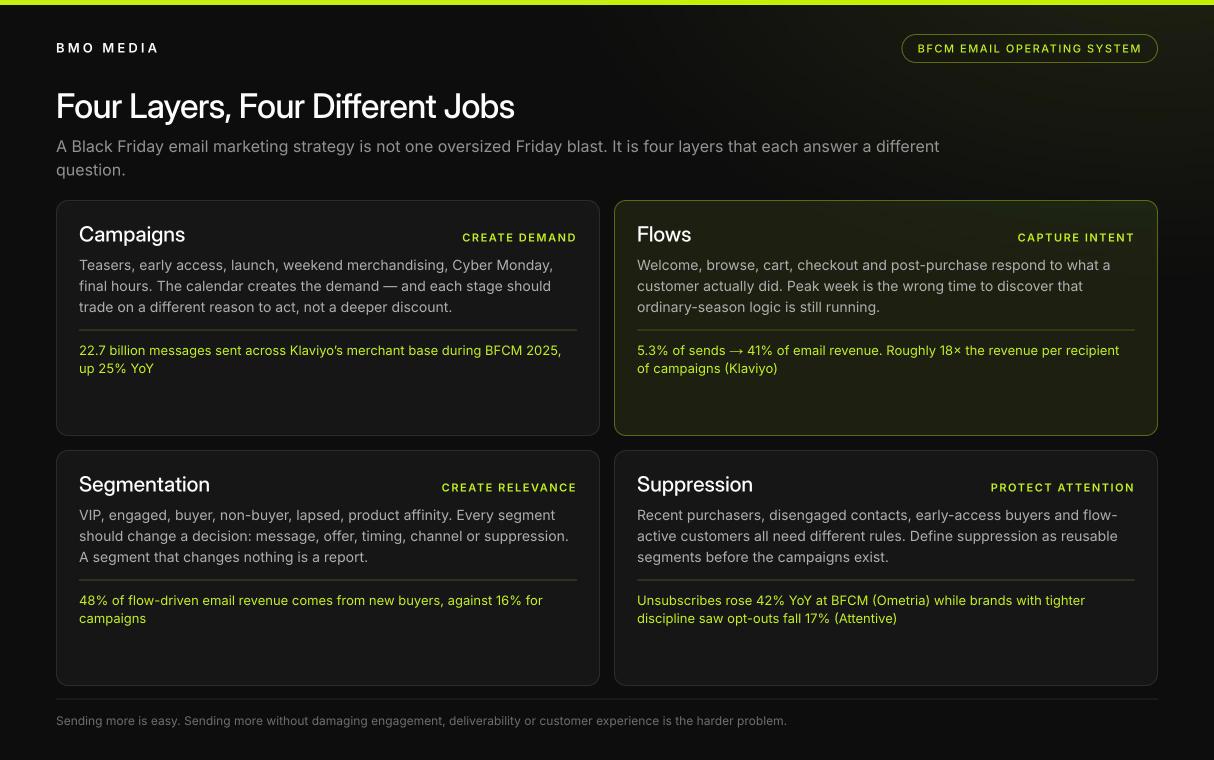
Two independent platforms, two different merchant populations, the same conclusion. A better Black Friday email marketing strategy separates campaign messaging from behavioural automation — and resources them accordingly.
Layer | Primary job |
|---|---|
Campaigns | Create and shape demand: teasers, early access, launch, reminders, Cyber Monday |
Flows | Respond to behaviour: welcome, browse, cart, checkout, post-purchase |
Segmentation | Decide who gets what: VIP, engaged, buyer, non-buyer, lapsed |
Suppression | Decide who should not get it: recent purchasers, disengaged contacts, over-messaged users |
Campaigns create demand, flows capture intent, segmentation creates relevance and suppression protects attention.
The Black Friday Email Calendar Should Build Pressure Gradually
Black Friday email should behave like a sequence, not a countdown. The useful question is not which emails to send, but what job each email performs — and who is eligible to receive it.
Stage | Objective | Audience | Message |
|---|---|---|---|
Pre-BFCM | Build anticipation | Engaged subscribers | Preview, wishlist, value |
Early access | Convert highest intent | VIP / high-value | Access + exclusivity |
Black Friday launch | Announce core offer | Eligible engaged audience | Offer + product focus |
Friday follow-up | Capture non-buyers | Engaged non-purchasers | Proof + reminder |
Weekend | Maintain demand | Segmented non-buyers | Merchandising + use cases |
Cyber Monday | Create new decision point | Eligible audience | Deadline + clear offer |
Final hours | Close genuine demand | High-intent non-buyers | Real urgency |
Post-purchase | Start retention | Buyers | Reassurance + next step |
The important word is eligible. Every email should not automatically go to the full list. Recent purchasers, VIP early-access buyers, disengaged subscribers and customers already inside high-intent flows all require different rules.
Notice what changes across the sequence: not the discount, but the reason to act. Pre-BFCM messaging trades on anticipation. Early access trades on status. The launch trades on the offer itself. The weekend trades on merchandising — showing people what to do with the offer rather than restating it. Cyber Monday trades on a genuinely new deadline. Final hours trade on scarcity that is actually true. A calendar where every stage trades on a deeper discount has only one lever and burns it by Saturday.
This is also why send frequency and send volume are different decisions. A brand can run eleven sends across the window and touch each subscriber four times, or run six sends and touch everyone six times. The first is a sequence. The second is a blast repeated.
A 2026 calendar note. Black Friday falls on 27 November — the latest possible date — leaving only 27 shopping days before Christmas. Delivery-cutoff messaging becomes a genuine urgency lever earlier in the sequence than it was in 2025, and it is the one deadline that is real rather than manufactured. Build the cutoff dates into the calendar now, before creative is written around a countdown you will have to walk back.
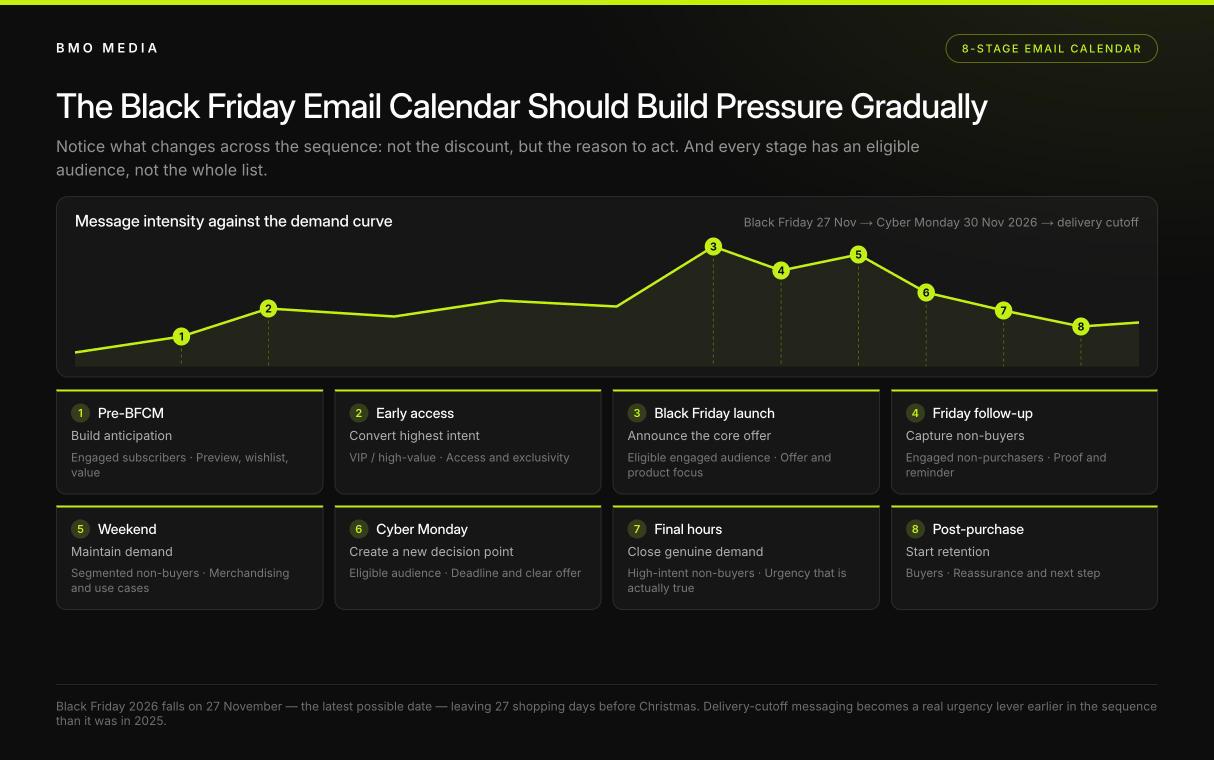
Message intensity against the demand curve, with each of the eight stages carrying its own objective, eligible audience and message.
Five Email Flows That Must Become Sale-Aware Before Black Friday
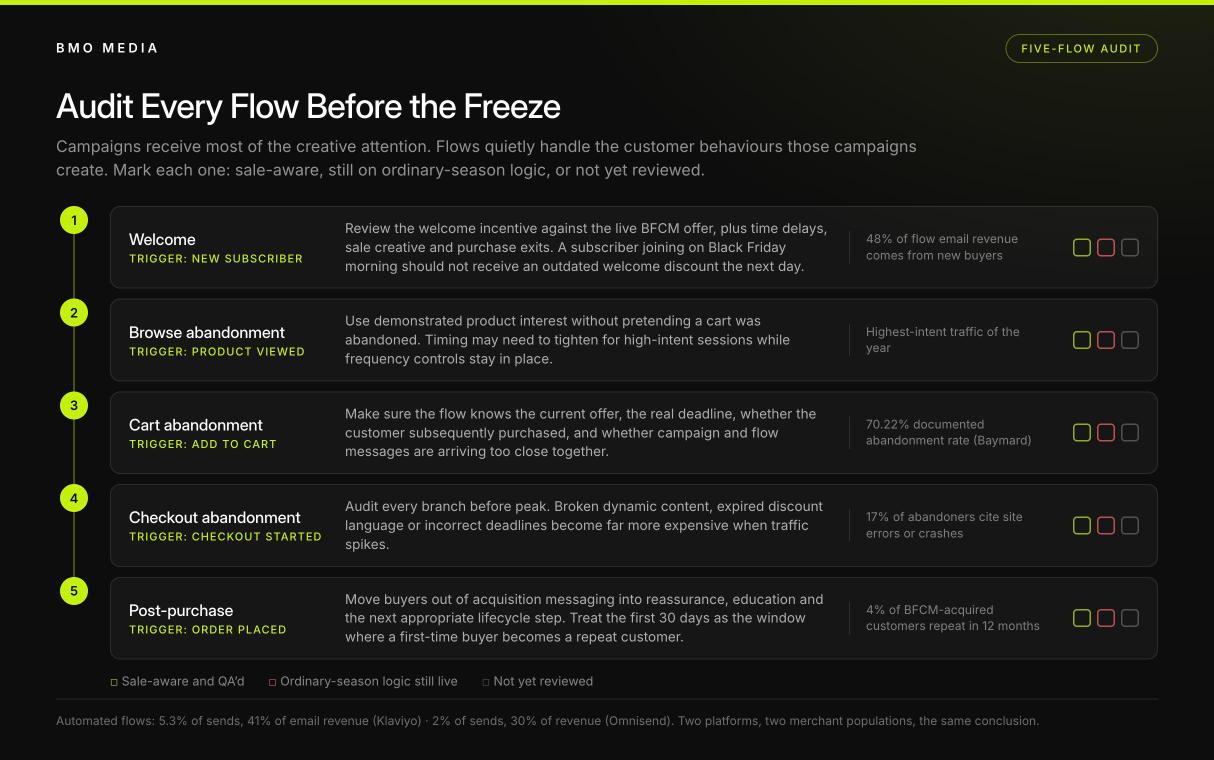
Campaigns receive most of the creative attention during BFCM. Flows quietly handle the customer behaviours those campaigns create — and, per the benchmark data above, produce a wildly disproportionate share of the revenue. BMO's email marketing agency services guide notes that automation is one of the highest-value parts of the email stack; peak week is the wrong time to discover ordinary-season logic is still running.
1. Welcome flow. Review the welcome incentive against the live BFCM offer, plus time delays, product education, sale-specific creative and purchase exits. A subscriber joining on Black Friday morning should not receive an outdated welcome discount the next day. This flow matters more than it looks: Klaviyo found that 48% of flow-driven email revenue comes from new buyers, against just 16% for campaigns.
2. Browse abandonment. Use demonstrated product interest without pretending a shopper abandoned a cart. During BFCM, timing may need to tighten for high-intent sessions while frequency controls stay in place.
3. Cart abandonment. Make sure the flow knows the current offer, the real deadline, whether the customer subsequently purchased, and whether campaign and flow messages are arriving too close together. The Baymard Institute meta-analysis of 50 studies puts the documented average cart abandonment rate at 70.22% — with 17% of abandoners citing website errors or crashes, a failure mode that peak traffic makes more likely.
4. Checkout abandonment. Audit every branch before peak. Broken dynamic content, expired discount language or incorrect deadlines become far more expensive when traffic spikes.
5. Post-purchase. Move buyers out of acquisition messaging into reassurance, education and the next appropriate lifecycle step. BMO's post-purchase flow playbook treats the first 30 days after purchase as the window where a first-time buyer becomes a repeat customer: reassure first, help them get value, request a review at the right moment, then introduce the next purchase.
Get the next one
New DTC retention teardowns and benchmarks, straight to your inbox.
Frequently asked questions
How many emails should I send on Black Friday itself?
Two to three to engaged segments, spaced across the day: an early morning launch, a midday reminder to non-openers only, and an evening send to non-purchasers. Suppress anyone who has bought. Sending four or more to the same person in 24 hours reliably raises complaints without a matching revenue lift.
When do Black Friday emails need to start in 2026?
Black Friday falls on November 27, 2026, and Cyber Monday on November 30. Begin list building in October, start warming engaged segments in the first week of November, tease dates from around November 16, and open early access on November 23. Your first sale-specific message should land 10 to 14 days before Black Friday.
How do I stop emailing people who already bought?
Build a purchase-based suppression segment that updates in real time, apply it to every campaign in the sale window, and add a purchase check inside every automated flow. This is the single highest-value hour of setup in the entire BFCM build, and it is the step most often skipped when the calendar is assembled late.
Share on
Enjoyed this read?
See how a tailored retention strategy could work for your brand.
Interested in working with us?
Request a complimentary audit and start building a stronger lifecycle foundation today.
Join the team
The retention brief
One email a month. Benchmarks, teardowns and what is actually working in DTC lifecycle right now.
Interested in working with us?
Request a complimentary audit and start building a stronger lifecycle foundation today.
Join the team
The retention brief
One email a month. Benchmarks, teardowns and what is actually working in DTC lifecycle right now.
Interested in working with us?
Request a complimentary audit and start building a stronger lifecycle foundation today.
Join the team
The retention brief
One email a month. Benchmarks, teardowns and what is actually working in DTC lifecycle right now.