Email Marketing
Email Marketing Agency Services: What You Actually Get

Sammy Tran

An email marketing agency typically delivers nine services: strategy, audits, flow automation, campaign management, copy and design, segmentation, deliverability management, A/B testing, and reporting — with SMS as the usual add-on. Retainers for DTC brands run $2,000–$10,000+ per month. Here is what each service should include, and the break-even math.
Two Reddit threads rank on page one for this exact search, both asking the same blunt question: what am I actually paying for? Fair question. Agency sites list services; almost none show the deliverables behind them. So this is the itemized version — what good looks like per service, what months one through three should produce, and what is quietly never included. We run this stack daily at BMO’s email marketing practice; where we cite our own client numbers, they link to public case studies.
Service | Core deliverables | How to judge it |
|---|---|---|
Strategy & audit | Revenue thesis, calendar, flow map | Written plan with numbers, not a deck of adjectives |
Flows/automation | Welcome, cart, browse, post-purchase, win-back builds | Flow share of email revenue trending toward 40%+ |
Campaigns | Calendar, copy, design, QA, sends | Revenue per campaign, not opens |
Copy & design | Templates, briefs, brand system | Mobile-first, accessible, on-brand |
Segmentation | Lifecycle and behavior segments, sunset policy | List engagement rates rising while list grows |
Deliverability | SPF/DKIM/DMARC, hygiene, monitoring | Inbox placement tracked monthly, issues surfaced before revenue dips |
Testing | Structured A/B roadmap | Tests read against revenue per recipient |
Reporting | Monthly revenue attribution, flow vs campaign split | Numbers tie to your store, not platform vanity stats |
SMS add-on | Consent capture, flows, campaigns | Automated share of SMS revenue leading |
The nine core services, itemized
Strategy and audit. The first real deliverable is a written revenue thesis: where email revenue comes from today (flow vs campaign split, segment performance, deliverability state) and the ranked list of what changes. If an agency’s “strategy” is a send calendar, that is scheduling, not strategy. A proper audit reads your ESP data before anyone proposes anything.
Flow automation. The highest-value service in the stack, and the reason agencies out-earn their retainers. Klaviyo’s 2026 benchmark across 183,000+ businesses: flows generate nearly 41% of email revenue from 5.3% of sends, with roughly 18× the revenue per recipient of campaigns. Deliverables: welcome, abandoned cart, browse abandonment, post-purchase, and win-back flows built, tested, and iterated monthly — not set once and admired. In our own accounts this is where results concentrate: for Darc Sport, automations grew to 30% of total email revenue.
Campaign management. Calendar planning, briefing, QA, and sends at your cadence — including the restraint part, because over-sending burns deliverability. Judge on revenue per campaign and list health, never on open rates alone.
Copy and design. A reusable template system, mobile-first and accessibility-checked, plus campaign-level copy in your voice. Watch for the deliverable gap: “design” should mean a system you own, not one-off images you rent.
Segmentation. Lifecycle stages, behavioral triggers, VIP and at-risk cohorts, and a sunset policy for the disengaged. This is the service that quietly powers all the others; it is also the first one cut-rate retainers skip.
Deliverability management. Authentication (SPF, DKIM, DMARC), list hygiene, complaint monitoring, and inbox-placement tracking as a standing monthly function. Nothing else in the stack matters from the spam folder — the mechanics are in our deliverability guide.
A/B testing. A structured roadmap — subject lines are the least of it; offers, send times, flow timing, and template structure move more — read against revenue per recipient.
Reporting. Monthly attribution you can reconcile with your store: flow vs campaign split, segment trends, deliverability state, and the next month’s ranked priorities. If reporting is a platform-screenshot PDF, you are paying for forwarding.
The SMS add-on. Most DTC-focused agencies (ours included) now run SMS alongside email, because the data demands orchestration: Omnisend’s 2026 dataset shows automated texts converting at 0.77% — six times campaign SMS — and the automation logic is shared with email.
What month 1 vs month 3 actually looks like
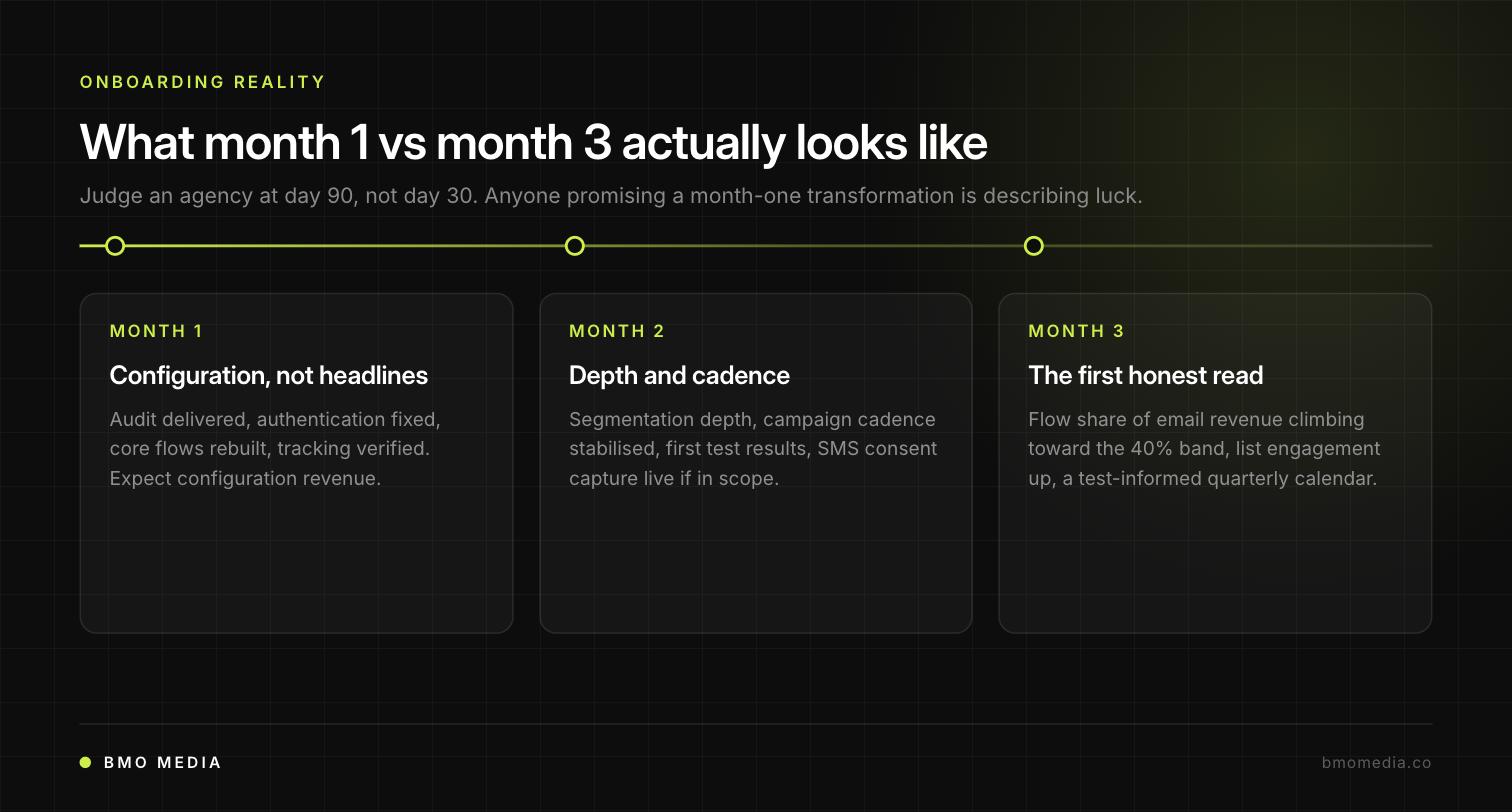
Month one is unglamorous on purpose: audit delivered, authentication fixed, core flows rebuilt or built, tracking verified. Expect configuration revenue, not headline revenue. Month two: segmentation depth, campaign cadence stabilized, first test results, SMS consent capture live if in scope. Month three: the first honest performance read — flow share of email revenue climbing toward that 40% benchmark band, list engagement trending up, and a test-informed calendar for the quarter ahead. This arc is why we tell brands to judge agencies at day 90, not day 30 — and why anyone promising a month-one transformation is describing luck or lying.
What is usually NOT included
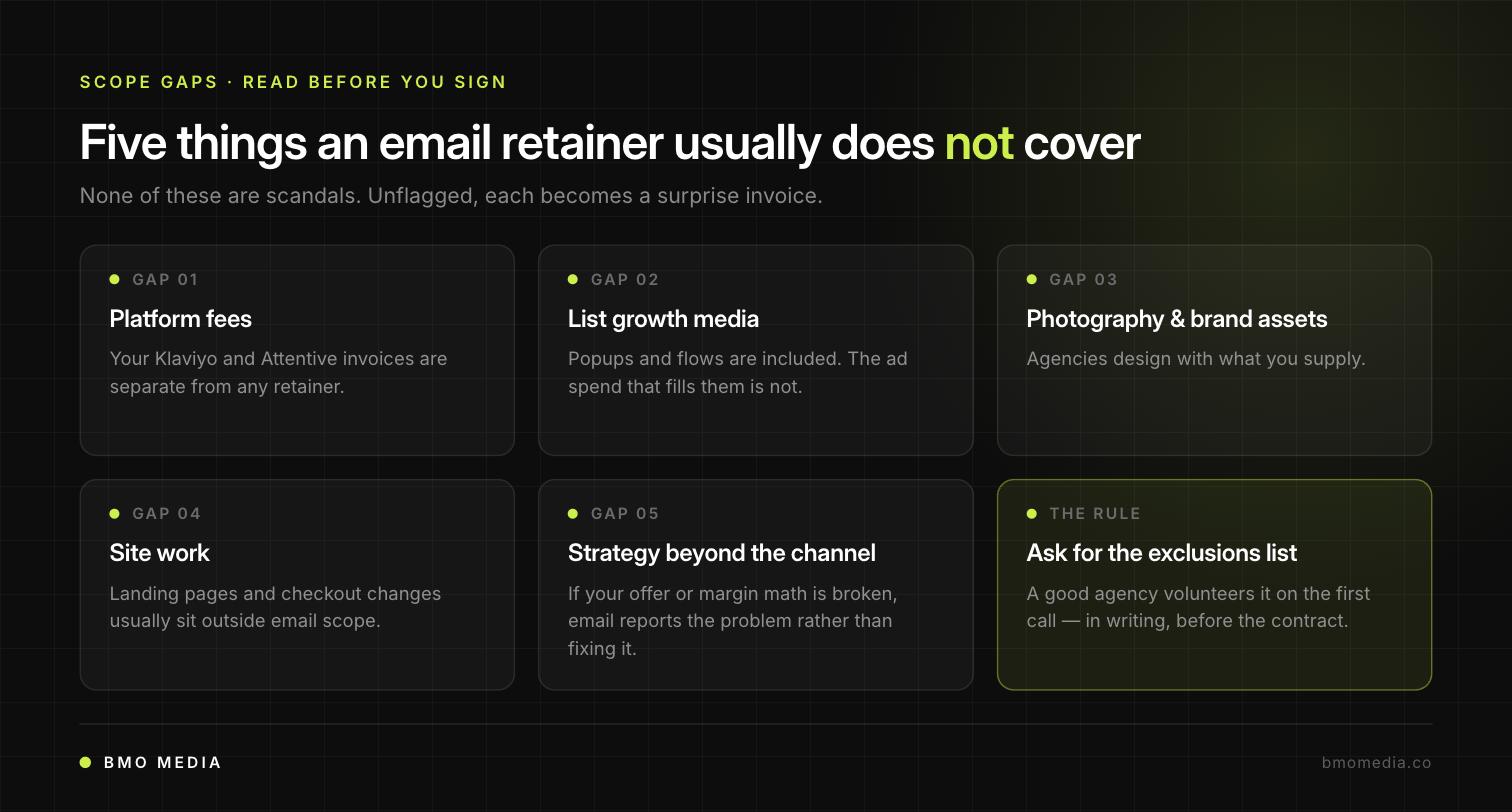
Read scopes for these five gaps before signing. Platform fees — your Klaviyo and Attentive invoices are separate from any retainer. List growth media — popups and flows are included; the ad spend that fills them is not. Photography and brand assets — agencies design with what you supply. Site work — landing pages and checkout changes usually sit outside email scope. And strategy beyond the channel — an email agency optimizes email; if your offer or margin math is broken, email reports the problem rather than fixing it. None of these are scandals. Unflagged, each becomes a surprise invoice.
What these services cost
Short version: $2,000–$10,000+ per month for DTC retainers, $3,000–$15,000 for one-off projects like flow builds or migrations, and 10–20% of email-attributed revenue under performance models. Sub-$1,000 retainers exist and generally buy template sends only — no flow work, no deliverability monitoring. The complete breakdown by model is in how much an email marketing agency costs.
Is it worth it? Run the break-even
The math is simpler than the sales calls make it. Litmus benchmarks email ROI at $36 per $1 spent; your version depends on list size and customer value. Concretely: a $4,000/month retainer breaks even when it adds $4,000 in monthly email profit — for a store with a $60 average order and healthy margin, that is a few dozen incremental orders a month, the kind of movement a rebuilt abandonment-and-welcome stack routinely produces. Anchor the “incremental” side in your own numbers: put your AOV and repeat rate through our free customer lifetime value calculator, then ask whether the flow gap between your current program and the benchmarks above covers the fee. If your list is under a few thousand subscribers, it usually does not yet — build the list first.
Agency, or keep it in-house?
The service list above is also a staffing list: strategy, automation, design, deliverability, and analytics are different skills. One strong in-house marketer covers three of them well. The agency case is strongest when the list is long and the stack is multiplying; the in-house case is strongest when email is stable and the team already exists. We wrote the decision framework — including the hybrid model most mid-size brands actually land on — in agency vs in-house, and the vetting scorecard in how to choose an agency.
Get the next one
New DTC retention teardowns and benchmarks, straight to your inbox.
Frequently asked questions
What does an email marketing agency do?
Nine things: strategy, audits, flow automation, campaign management, copy and design, segmentation, deliverability, testing, and reporting — usually with SMS as an add-on. The revenue concentrates in flows.
What should email marketing agency services cost?
$2,000–$10,000+ monthly for typical DTC scopes; projects $3,000–$15,000; performance deals at 10–20% of email-attributed revenue. Breakdown: agency cost guide.
Is an email marketing agency worth it?
When list size and order value make the break-even reachable — often a few dozen incremental orders a month — yes. Under a few thousand subscribers, grow the list before paying a retainer.
Want to see which of the nine services your program is missing?
Request a complimentary audit — you get the gap list either way.
Share on
Enjoyed this read?
See how a tailored retention strategy could work for your brand.
Interested in working with us?
Request a complimentary audit and start building a stronger lifecycle foundation today.
Join the team
The retention brief
One email a month. Benchmarks, teardowns and what is actually working in DTC lifecycle right now.
Interested in working with us?
Request a complimentary audit and start building a stronger lifecycle foundation today.
Join the team
The retention brief
One email a month. Benchmarks, teardowns and what is actually working in DTC lifecycle right now.
Interested in working with us?
Request a complimentary audit and start building a stronger lifecycle foundation today.
Join the team
The retention brief
One email a month. Benchmarks, teardowns and what is actually working in DTC lifecycle right now.