Retention
Best Black Friday Marketing Ideas That Are Not a Sitewide Discount

Sammy Tran

The best Black Friday marketing ideas that are not a sitewide discount are early access for subscribers, value-added bundles, gift with purchase, tiered spend-and-save, loyalty-gated pricing, points multipliers, narrow doorbusters, subscription offers, free shipping thresholds, and product drops. Each protects gross margin by adding value or restricting access instead of cutting price catalog-wide.
Most brands pick their Black Friday offer in a meeting that lasts twenty minutes. Someone says "what did we do last year," someone else says "30% off sitewide," and the decision is made. Then the finance team reads the November P&L in January and asks why record revenue produced worse profit than the year before.
The data says the twenty-minute answer is also the wrong one. Klaviyo's BFCM 2025 results found that discount rates across its merchant base fell 10% year over year, and that the brands offering the smallest discounts posted the highest growth, up 14% year over year. Discounting harder did not correlate with growing faster.
This post is a numbered set of twelve offers that are not a sitewide percentage cut. For each one you get the mechanic, the conditions where it works, the conditions where it fails, and what it does to your gross margin. The margin math comes first, because it is the part every other list skips.
Why does a sitewide discount cost more than the discount itself?
A discount does not cost you the discount. It costs you the share of gross profit the discount represents, and that share is always larger than the percentage on the banner.
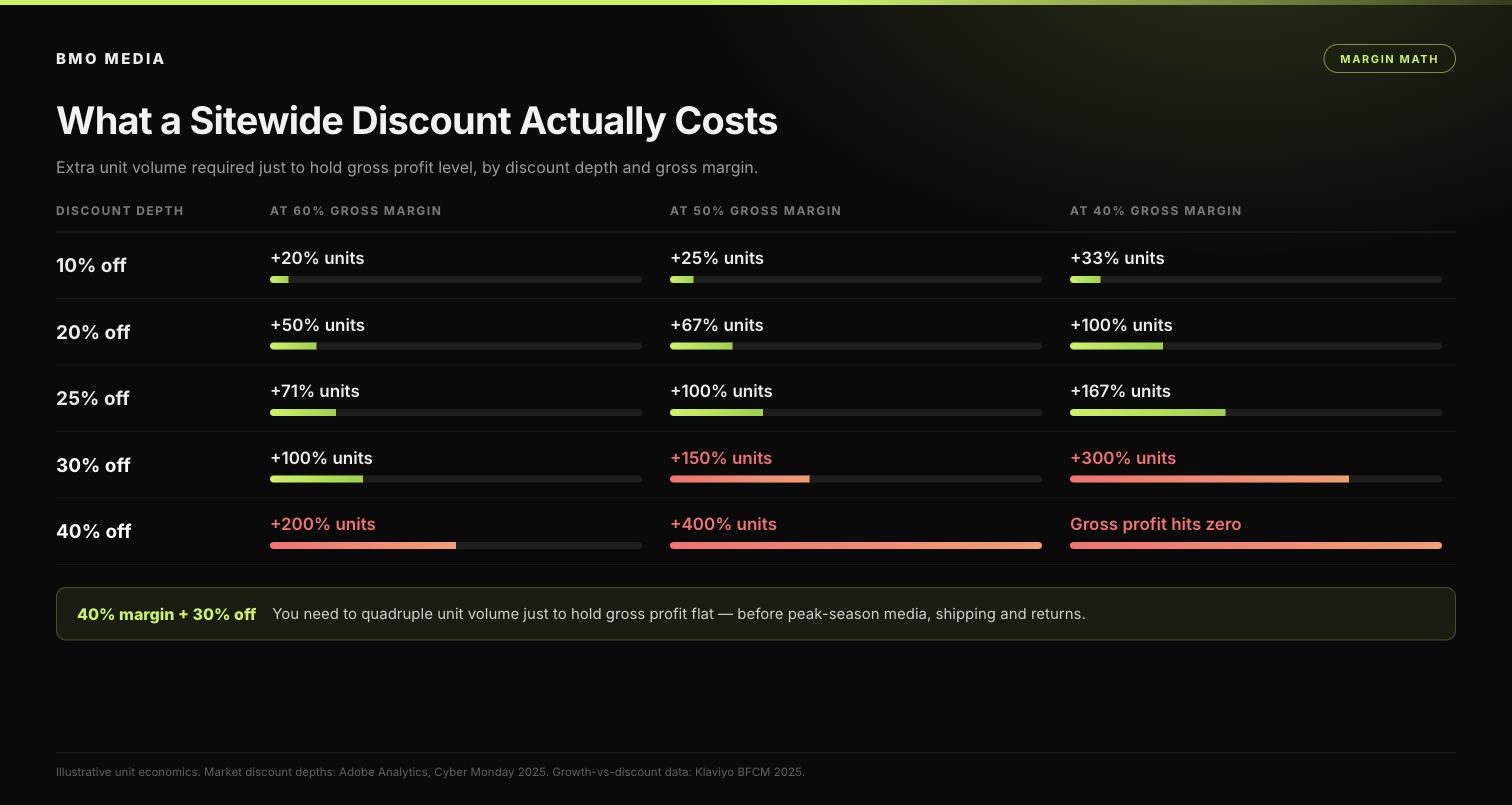
The formula is simple. If your gross margin is M and you discount by d percentage points off the retail price, your remaining margin is M minus d. To hold the same total gross profit, you need M divided by (M minus d) times the unit volume. Here is what that looks like at three common DTC margin profiles.
Table 1: Extra unit volume required to break even on gross profit
Discount depth | At 60% gross margin | At 50% gross margin | At 40% gross margin |
10% off | +20% units | +25% units | +33% units |
20% off | +50% units | +67% units | +100% units |
25% off | +71% units | +100% units | +167% units |
30% off | +100% units | +150% units | +300% units |
40% off | +200% units | +400% units | Gross profit reaches zero |
Read the 40% margin column carefully. A brand at 40% gross margin running 30% off needs to quadruple unit volume just to stand still. Almost no brand quadruples volume on Black Friday.
This is before three costs that land on top. Paid acquisition gets more expensive in the last week of November as every advertiser bids at once. Returns rise on discounted goods and the refund goes back at full retail while the pick, pack and inbound shipping do not come back. And shipping subsidies, if you are absorbing them, come out of the same shrunken margin.
Context on how deep the market actually goes: Adobe Analytics reported that on Cyber Monday 2025, discounts peaked at 31% off list price in electronics, 28% in toys, 25% in apparel, 23% in computers and 22% in televisions. If you sell apparel at 55% margin, matching that 25% market discount means you need roughly 83% more units to hold gross profit flat. The category average is not a target. It is a warning.
What are the best Black Friday marketing ideas that protect margin?
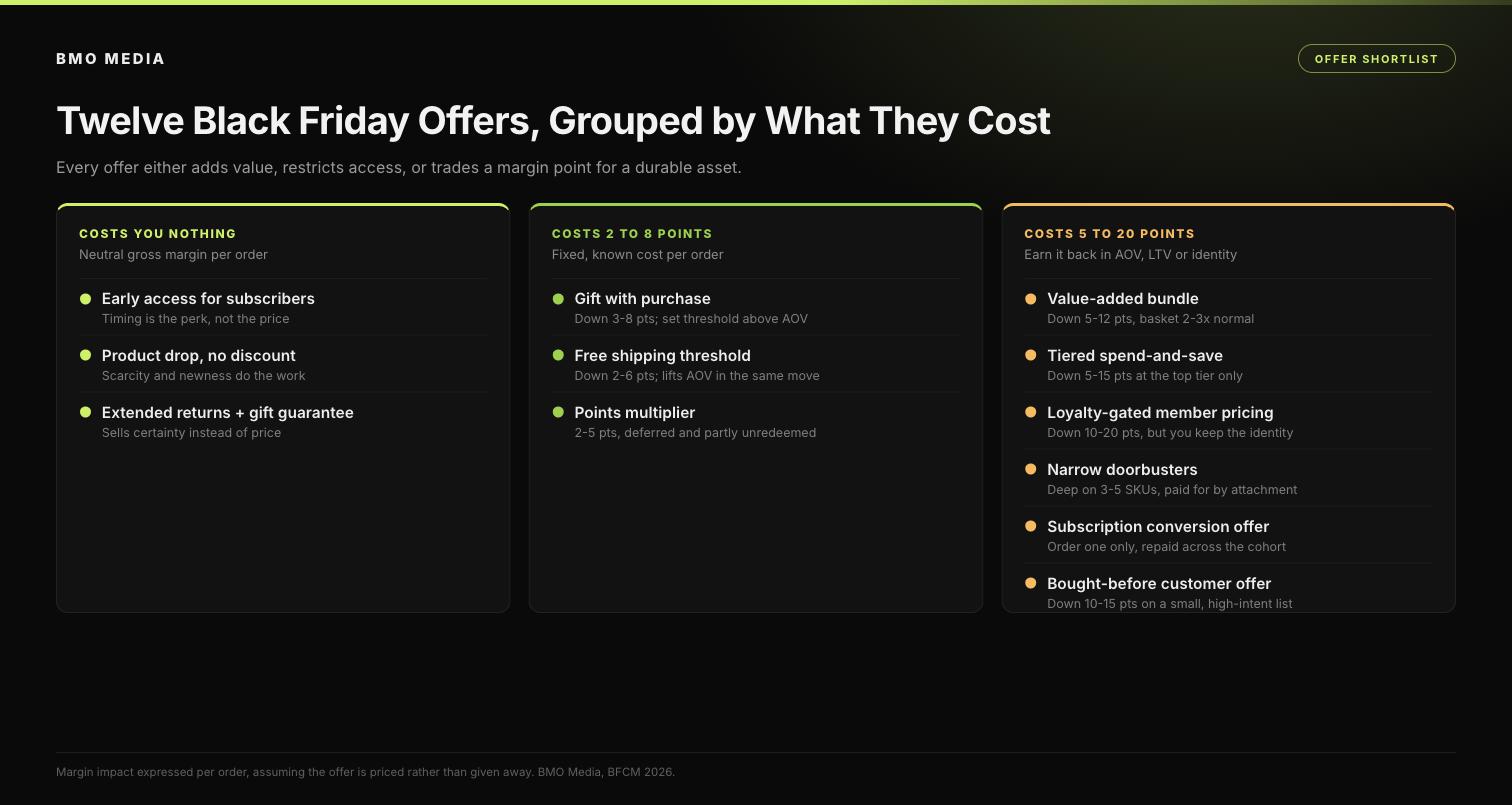
Every offer below does one of three things: it adds perceived value without cutting unit price, it restricts access so the offer feels scarce rather than cheap, or it trades a margin point for a durable asset like a subscriber, a loyalty member or a subscription.
Use this table to shortlist before you read the detail. Margin impact is expressed per order, and assumes the offer is priced sensibly rather than given away.
Table 2: Offer type compared by margin impact and best fit
# | Offer | Gross margin per order | Effect on AOV | Best fit brand | Build effort |
1 | Early access for subscribers | Neutral | Slight increase | Any brand with a list | Low |
2 | Value-added bundle | Down 5 to 12 points | Strong increase | Multi-SKU, gifting, consumables | Medium |
3 | Gift with purchase | Down 3 to 8 points | Strong increase | High margin, has sampling stock | Low |
4 | Tiered spend-and-save | Down 5 to 15 points at top tier | Strong increase | Wide catalog, low AOV | Medium |
5 | Loyalty-gated pricing | Down 10 to 20 points, members only | Neutral | Repeat purchase categories | Medium |
6 | Points multiplier | Deferred, 2 to 5 points | Slight increase | Existing loyalty program | Low |
7 | Narrow doorbusters | Down heavily on 3 to 5 SKUs | Increase via attachment | Broad catalog, clear hero SKU | Low |
8 | Subscription conversion offer | Down on first order only | Neutral now, strong LTV | Replenishable or membership | Medium |
9 | Free shipping threshold | Down 2 to 6 points | Strong increase | AOV below free ship threshold | Low |
10 | Product drop, no discount | Neutral | Neutral | Strong brand, waitlist demand | Low |
11 | Extended returns and gift guarantee | Neutral, small returns risk | Slight increase | Gifting, apparel, higher ticket | Low |
12 | Bought-before customer offer | Down 10 to 15 points, targeted | Neutral | Any brand with purchase history | Low |
1. Early access for email and SMS subscribers
The mechanic. Open the same sale 24 to 72 hours before the public, to your subscriber list only. The discount does not need to be deeper. The privilege is the timing, not the price.
When it works. When you have a list worth opening early to, and when inventory on hero SKUs is genuinely limited so early access carries real benefit. Yotpo's brand loyalty research, updated 2025, found 46.4% of shoppers want early access to sales as a loyalty benefit, ahead of most other perks tested. It is the most requested thing you can give away for free.
When it does not. When you have no capture mechanism running in the four weeks before, so the early access list is the same people who would have bought anyway. It also fails if you leak the offer publicly. The moment a coupon site has the code, early access is just a discount that started early.
Margin impact. Neutral. This is the highest return idea on the list because it costs nothing per order and it pulls demand forward into a window where you are not competing with every other advertiser for attention.
We ran an extended window built on exactly this for Spoonful of Comfort in Q4 2025. Instead of compressing everything into a 96-hour blitz, we opened early access before Black Friday and distributed messaging across several weeks with sale-aware automation and AI segmentation, so buyers stopped getting promo blasts the moment they converted. Email and SMS attributed revenue rose 196.9% year over year during BFCM, owned channels carried 46.1% of total BFCM revenue, and on Cyber Monday email and SMS accounted for 64.91% of revenue. Full detail is in the Spoonful of Comfort BFCM case study.
2. Value-added bundles
The mechanic. Group three to five products into a curated kit sold at a price below the sum of the parts but above the price of your typical order. The customer sees a saving. You see a higher basket.
When it works. When you have complementary SKUs and a gifting use case. Bundles also solve a real merchandising problem: they move slow inventory attached to a hero product rather than marking the slow inventory down on its own.
When it does not. When the bundle is transparently your bestseller plus two items nobody wants. Shoppers price-check the components. Build bundles around a genuine occasion, not around your warehouse problem.
Margin impact. Down 5 to 12 points on the blended rate, but gross profit per order usually rises because the basket is two to three times a normal order. Shopify reported an average cart of $114.70 across its merchant base during BFCM 2025. If your bundle sits meaningfully above that, you are being paid for the discount.
3. Gift with purchase above a spend threshold
The mechanic. Spend $X, receive an item free. Set the threshold 20 to 30% above your current average order value so the offer pulls baskets upward.
When it works. When the gift has high perceived value and low cost to you: a full-size product you overbought, a sample set, a branded accessory. It works especially well in beauty, supplements and food.
When it does not. When the gift costs you real money at your true landed cost, or when you set the threshold below your AOV. A threshold below AOV gives away product to people who were already going to spend that much.
Margin impact. Down 3 to 8 points, and fully controllable because you know the gift cost exactly. Unlike a percentage discount, the cost does not scale with basket size, so the bigger the order the better the economics get.
4. Tiered spend-and-save
The mechanic. Spend $75 save 10%, spend $150 save 15%, spend $250 save 20%. The discount is earned rather than granted.
When it works. When you have a wide catalog and an AOV below what a customer could plausibly spend. It is the strongest AOV lever on this list for brands with a low ticket and lots of SKUs.
When it does not. When your catalog is narrow or the ticket is high. If your product costs $400, nobody is buying a second one to reach a tier. It also fails when the tiers are set so far apart the top one looks unreachable.
Margin impact. Down 5 to 15 points at the top tier only. Model the mix before you launch: assume most orders land at tier one, some at tier two, and a small share at tier three, then compute your blended discount. The blended number is usually far lower than the headline.
Not sure which of these your margin can carry? We model offer structures against real contribution margin before BFCM, not after. Book a free retention audit and we will show you which offers your numbers actually support.
5. Loyalty-gated member pricing
The mechanic. The Black Friday price is available to loyalty members. Membership is free and takes one click at checkout or on the offer page.
When it works. When you sell in a repeat purchase category and you want to convert one-time BFCM buyers into identified, addressable members rather than anonymous discount hunters. Yotpo's research found 59.5% of consumers would likely join the loyalty program of a brand they already like, so the friction is lower than most brands assume.
When it does not. When sign-up adds steps to checkout and you have not tested the flow. Every extra field costs conversion. Baymard Institute puts documented cart abandonment at 70.22% across 50 studies, with 18% of abandoners citing forced account creation. Gate the offer, but make joining a single tap.
Margin impact. Down 10 to 20 points, but only on members, and you keep the identity. A discount given to an anonymous shopper is a cost. The same discount given in exchange for a loyalty profile is an acquisition price for a customer you can market to in January. More structures in our guide to loyalty program ideas, and we build these inside our loyalty program management service.
6. Points multiplier instead of a price cut
The mechanic. 5x points on every order for the BFCM window. No price change at all.
When it works. When you already run a functioning loyalty program with a redemption rate you understand. The cost is deferred to a future order and only a portion of points are ever redeemed, so the real cost is a fraction of the face value.
When it does not. When the program is new, when point value is unclear to customers, or when your breakage assumptions are guesses. If members do not know what a point is worth, a multiplier communicates nothing.
Margin impact. Two to five points, deferred, and partially recovered because redemption drives a return visit. This is the cheapest urgency mechanic available to a brand that has already built the loyalty infrastructure.
7. Narrow doorbusters with real unit caps
The mechanic. Discount three to five SKUs hard, publish the unit count, and let them sell out. The rest of the catalog holds price.
When it works. When you have a recognizable hero product and enough catalog depth that attachment revenue covers the loss leader. The deep discount buys traffic and the full-price attachment pays for it.
When it does not. When the doorbuster is your only product, or when you quietly restock it. Restocking a sold-out doorbuster teaches your list that your scarcity claims are not true, and that lesson survives into next year.
Margin impact. Heavily negative on those SKUs, roughly neutral overall if attachment rate holds. Track contribution margin on the whole session, not on the doorbuster line item, or the report will tell you the wrong thing.
8. Subscription or replenishment conversion offer
The mechanic. Discount the first subscription order or offer a prepaid plan at a modest saving. The offer converts a one-time buyer into recurring revenue.
When it works. When the product is genuinely replenishable and your churn curve is known. Black Friday is the cheapest customer acquisition window of the year, which makes it the best time to acquire someone whose value is measured over twelve months rather than one order.
When it does not. When churn after the discounted period is high enough that the cohort never repays the offer. Run the numbers before you commit, and use a customer lifetime value calculator rather than an assumption.
Margin impact. Negative on order one, strongly positive across the cohort if retention holds. For Centr we saw 2.5x higher engagement year over year during key sale periods, $1.9M or more in CRM-attributed revenue during BFCM, and a 20% lift in trial-to-paid conversions, which is the number that decides whether a discounted trial was worth running. See the Centr lifecycle case study, or how we approach subscription lifecycle marketing.
9. Free shipping threshold set above your AOV
The mechanic. Free shipping over $X, where X sits above your current average order value. No product discount at all.
When it works. Almost always, and it addresses the single largest documented cause of abandonment. Baymard's data shows 40% of abandoners leave because extra costs including shipping, tax and fees are too high, the top reason by a wide margin.
When it does not. When your product is heavy, bulky or shipped cold. If freight is $18 on a $60 order, a free shipping threshold is a bigger discount than the percentage cut you were avoiding.
Margin impact. Down 2 to 6 points, and it raises AOV in the same motion. This is the most reliable non-discount offer for brands with a light, cheap-to-ship product and a ticket below the shipping threshold.
10. A product drop instead of a sale
The mechanic. Launch something new on Black Friday. No discount. Scarcity and newness do the work that price usually does.
When it works. When the brand carries enough pull that a waitlist fills on its own, and when you have restrained yourself from discounting all year so the brand is not trained to wait for sales.
When it does not. When your list is small or your audience only engages during promotions. A drop into a cold list is a quiet day with high expectations attached.
Margin impact. Neutral, which makes it the highest margin idea here and the one with the highest variance. Brands that can do this should. Most cannot yet.
11. Extended returns window and a gift guarantee
The mechanic. Extend returns through January and guarantee delivery before a stated date. Sell certainty instead of price.
When it works. In gifting, apparel and anything above roughly $75 where purchase anxiety is the real barrier rather than price. It costs nothing to announce and it converts hesitant gift buyers.
When it does not. In categories with already high return rates, or when your fulfillment cannot honor the delivery promise. A missed delivery guarantee costs more in support tickets and refunds than the sale was worth.
Margin impact. Neutral, with modest returns exposure. Worth pairing with any other offer on this list rather than running alone.
12. A targeted offer for customers who bought before
The mechanic. Segment past purchasers and send them a different, better offer than the public one, tied to what they already own.
When it works. When purchase history is clean and your segmentation can act on it. Klaviyo's BFCM 2025 data showed revenue from repeat customers up 13.5% year over year, and cross-channel shoppers placed 11% more orders than single-channel shoppers.
When it does not. When everyone gets the same "exclusive" offer regardless of history. Customers compare notes, and a fake segment is worse than no segment.
Margin impact. Down 10 to 15 points on a small, high-converting audience. Because the send volume is low and the conversion rate is high, the blended cost across the whole promotion is minor. This is where email marketing and SMS marketing earn their keep, since the offer only works if the segmentation and the send infrastructure are already sound.
How should you sequence these offers across the BFCM window?
The compressed 96-hour blitz is the default, and it is usually wrong. It forces every message into the most expensive, most crowded four days of the year and it caps how much revenue your owned channels can carry.
Spreading the window works better. Adobe recorded $44.2 billion online across Cyber Week 2025, up 7.7% year over year, with Cyber Monday alone reaching $14.25 billion. Salesforce measured $336.6 billion in global Cyber Week 2025 sales, up 7%, but noted order volumes grew only 2% globally while average selling price rose 6%. Volume is not where the growth came from. Basket size was.
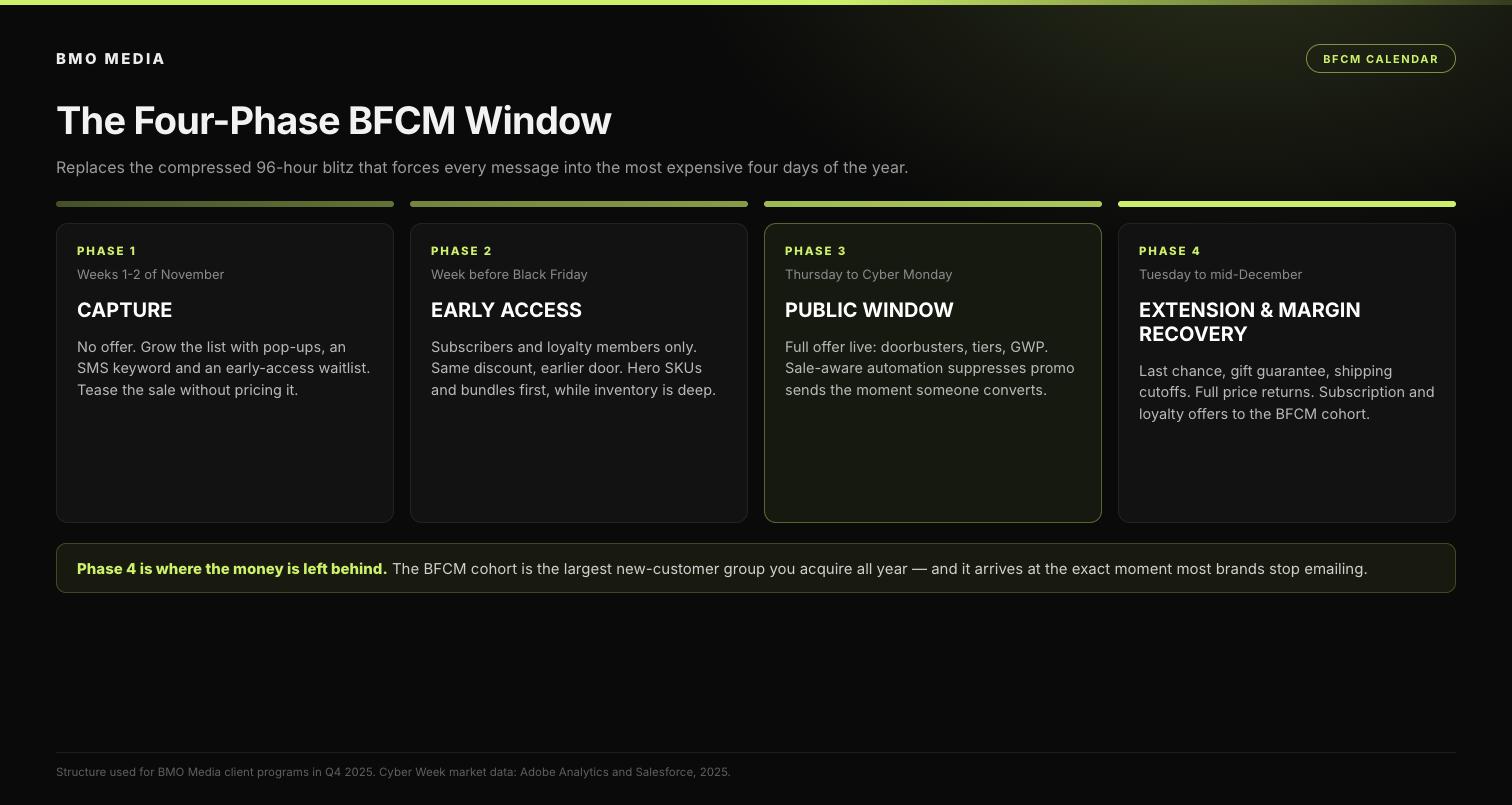
Phase 4 is where most brands leave money behind. The BFCM cohort is the largest new-customer group you will acquire all year, and it arrives at the exact moment you stop emailing. Post-purchase flows, subscription offers and loyalty enrollment aimed at that cohort in December are the difference between a discount that cost you money and one that bought you a customer.
Our Q4 2025 work with Spoonful of Comfort ran on this shape, and the extended window rather than the compressed one is what produced the 25% year over year lift across the whole of Q4, not just the peak weekend. Klaviyo's own BFCM 2025 data points the same direction: email and text drove 42% of total revenue across its merchant base, rising to 43% on peak days.
For a fuller planning sequence, see our Black Friday marketing strategy guide and the operational checklist in how to prepare for Black Friday.
How do you know whether the offer actually worked?
Revenue is the wrong scoreboard for an offer decision. Every offer on this list can grow revenue while shrinking profit. Measure the things that tell you which happened.
Table 3: What to measure instead of gross revenue
Metric | How to calculate | What good looks like | What it catches |
Contribution margin per order | Revenue minus COGS, discount, shipping, payment fees, returns provision | Positive and within 15% of a normal week | Offers that sell volume at a loss |
Blended discount rate | Total discount value divided by gross revenue | Below your category average | Tier and bundle mixes drifting deeper than modeled |
New vs returning revenue split | Attributed revenue by customer status | New customer share rising | Whether you discounted people who would have paid full price |
Owned channel share of revenue | Email, SMS and push attributed revenue over total | 35% or higher during peak | Over-reliance on paid media at peak CPMs |
AOV vs trailing 90-day AOV | Peak AOV divided by baseline AOV | Above 1.0 | Whether the AOV mechanic did its job |
60-day repeat rate of BFCM cohort | Repeat orders from BFCM buyers within 60 days | Above your annual average | Whether you bought customers or bought orders |
Two of these matter more than the rest. Contribution margin per order tells you whether the offer was affordable. The 60-day repeat rate of the BFCM cohort tells you whether it was worth it. A brand that acquires 10,000 discounted customers who never return has not had a good Black Friday, no matter what the November revenue line says.
Owned channel share is the third to watch. Across the accounts we run, the brands that hold 40% or more of peak revenue in email and SMS are the ones whose margin survives November, because that revenue does not carry an ad cost on top of the discount. Darc Sport is a clear example of what the channel can do once it is built properly: 41,000 SMS subscribers added in two months, a 29.8% increase in SMS revenue, $7.89 in SMS revenue per campaign message sent, an 80% increase in revenue via SMS automation and a 12% increase in total orders.
Frequently asked questions
What is the best Black Friday offer if I cannot afford any discount?
Early access plus a free shipping threshold set above your average order value. Early access costs nothing per order and Yotpo's research shows it is the loyalty perk shoppers ask for most. A shipping threshold addresses the top documented reason for cart abandonment, which Baymard puts at 40% of abandoners citing extra costs. Together they create urgency and lift basket size without touching unit price.
Does early access cannibalize Black Friday weekend sales?
It moves revenue, it does not usually destroy it. Early access shifts demand from your most expensive traffic days to a window where you are reaching people through owned channels at near-zero marginal cost. The risk is not cannibalization. It is inventory: if hero SKUs sell out during early access you have nothing to sell at peak. Cap early access allocation by SKU and hold back stock for the public window.
How deep should a Black Friday discount be?
Deep enough to be credible in your category, shallow enough that you do not need volume you cannot get. Use the break-even table above. If you are at 50% gross margin, 20% off already requires 67% more units. Adobe's 2025 category data shows peak depths of 25% in apparel and 31% in electronics, but Klaviyo found the brands discounting least grew fastest, up 14% year over year. Match the market only if your margin can pay for it.
Are bundles better than percentage-off discounts?
For most DTC brands, yes. A bundle raises average order value while a percentage discount lowers it, and the bundle's cost is fixed and known while a percentage discount scales with every basket. Bundles also let you move slower inventory attached to a hero product rather than marking it down separately. The exception is single-product brands, where there is nothing to bundle.
When should Black Friday emails and texts start sending?
List capture should start in early November, with the first offer signals going out the week before Black Friday to subscribers. The compressed four-day approach concentrates all sends into the days when inbox competition and ad costs both peak. Distributing messaging across several weeks, with sale-aware automation suppressing promo sends to people who already bought, is what produced a 196.9% year-over-year lift in owned channel revenue for Spoonful of Comfort in Q4 2025.
Do loyalty-gated offers really drive sign-ups during BFCM?
They do when joining is one tap. Yotpo found 59.5% of consumers would likely join the loyalty program of a brand they like, so intent is not the barrier. Friction is. Every additional checkout field costs conversion, and 18% of abandoners in Baymard's data cite forced account creation. Gate the offer, but let membership happen inside the existing checkout rather than as a separate step.
Your offer is a margin decision, not a marketing decision. BMO Media runs retention and lifecycle programs for DTC brands across email, SMS, loyalty, reviews, push and subscriptions. We will audit your list, your flows, your segmentation and your offer structure, then tell you which of the twelve ideas above your margin can actually carry this year. Book a free retention audit or talk to our team before your BFCM calendar locks.
Get the next one
New DTC retention teardowns and benchmarks, straight to your inbox.
Frequently asked questions
What is the best Black Friday offer if I cannot afford any discount?
Early access plus a free shipping threshold set above your average order value. Early access costs nothing per order and it is the loyalty perk shoppers ask for most. A shipping threshold addresses the top documented reason for cart abandonment. Together they create urgency and lift basket size without touching unit price.
How deep should a Black Friday discount be?
Deep enough to be credible in your category, shallow enough that you do not need volume you cannot get. At 50% gross margin, 20% off already requires 67% more units. Adobe's 2025 category data shows peak depths of 25% in apparel and 31% in electronics, but Klaviyo found the brands discounting least grew fastest, up 14% year over year. Match the market only if your margin can pay for it.
Are bundles better than percentage-off discounts?
For most DTC brands, yes. A bundle raises average order value while a percentage discount lowers it, and the bundle's cost is fixed and known while a percentage discount scales with every basket. Bundles also let you move slower inventory attached to a hero product rather than marking it down separately. The exception is single-product brands, where there is nothing to bundle.
Share on
Enjoyed this read?
See how a tailored retention strategy could work for your brand.
Interested in working with us?
Request a complimentary audit and start building a stronger lifecycle foundation today.
Join the team
The retention brief
One email a month. Benchmarks, teardowns and what is actually working in DTC lifecycle right now.
Interested in working with us?
Request a complimentary audit and start building a stronger lifecycle foundation today.
Join the team
The retention brief
One email a month. Benchmarks, teardowns and what is actually working in DTC lifecycle right now.
Interested in working with us?
Request a complimentary audit and start building a stronger lifecycle foundation today.
Join the team
The retention brief
One email a month. Benchmarks, teardowns and what is actually working in DTC lifecycle right now.