Retention
How to Prepare for Black Friday: The Ecommerce Readiness Checklist for 2026

Sammy Tran

To prepare your ecommerce business for Black Friday, work backward at least eight weeks. Lock the commercial strategy first, then validate inventory, audience health, segmentation, lifecycle flows, deliverability, creative, onsite experience and measurement. The final weeks should be spent testing and monitoring what you already built — not making fundamental decisions under peak-season pressure.
Black Friday readiness is often treated as a marketing calendar problem. It is actually an operating-system problem.
Your offer affects margin and inventory. Inventory affects merchandising. Merchandising affects email and SMS. Campaign volume affects deliverability. Acquisition creates new subscribers who enter automated flows. Those customers then need a post-purchase experience capable of turning a discounted first order into something more valuable.
So the real question is not "what should we do?" but "when does each part of the business need to be ready?"
Shopify stores should also read the retention layer that the standard operations checklist leaves out.
The Eight-Week Black Friday Ecommerce Countdown
Black Friday 2026 falls on Friday 27 November, with Cyber Monday on 30 November. That is the latest possible date, which creates a specific problem worth planning around now: it leaves only 27 shopping days between Black Friday and Christmas, the shortest possible run-in. Delivery cutoffs will arrive faster relative to the sale, and gifting customers will have less margin for error.
Preparation should begin well before November. Demand starts earlier than most calendars assume — the National Retail Federation survey of 8,247 US adults found 42% of consumers planned to start holiday browsing and buying before November, and Adobe Analytics data shows the behaviour follows the intent: of $257.8 billion in US online holiday spend in 2025, $137.4 billion landed between 1 November and 1 December. Roughly half the season resolves before December begins.
For a DTC brand, an eight-week countdown creates enough room to make decisions, test them and correct problems before peak volume arrives.
Timing | Primary job | What should be completed |
|---|---|---|
8 weeks out | Strategy | Goals, economics, offer direction, owners |
7 weeks out | Audience | List health, segmentation, acquisition plan |
6 weeks out | Lifecycle | Flow audit, BFCM logic, post-purchase |
5 weeks out | Deliverability | Authentication, engagement, list hygiene |
4 weeks out | Offer + inventory | SKU forecast, bundles, margin checks |
3 weeks out | Campaign production | Email, SMS, creative, landing pages |
2 weeks out | QA + testing | Offers, flows, links, checkout, tracking |
1 week out | Freeze + monitor | Lock major changes, dashboards, escalation |
The sequence matters more than the specific dates. If inventory decisions are still changing after campaigns have been built, creative needs rebuilding. If segmentation happens after campaign logic is finalized, everyone receives generic messaging. If flow audits happen during peak week, automated messages conflict with live promotions.
Preparation creates optionality. Last-minute work removes it.
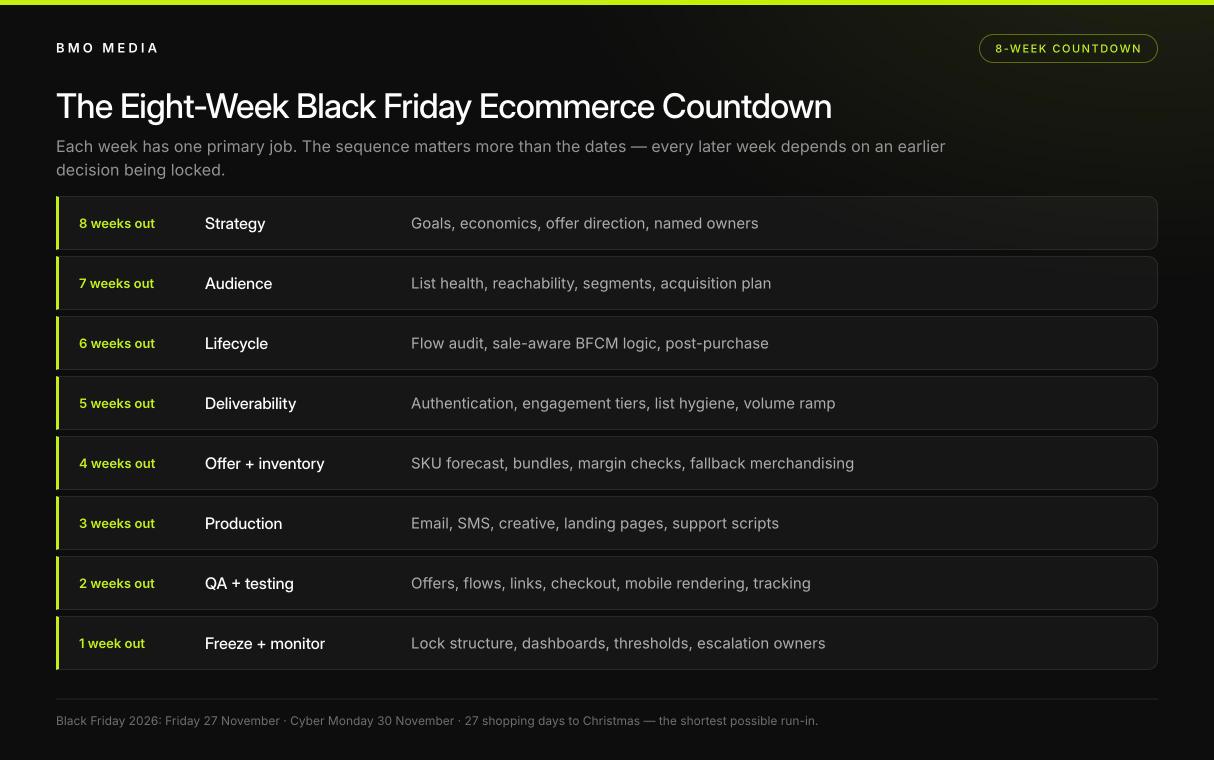
The eight-week Black Friday ecommerce countdown. Each week carries one primary job, and every later week depends on an earlier decision being lockedEight Weeks Out: Set the Economics Before You Set the Discount
Start with the business outcome, not the creative concept. Define what BFCM needs to achieve across revenue, contribution margin, new customer acquisition, returning customer revenue, inventory movement, average order value, owned-channel contribution and repeat purchase after BFCM.
Then pressure-test the offer against those goals. A 30% discount is not automatically better than 20% because it produces more orders. A bundle is not automatically better because it increases AOV. Free shipping is not free to the business.
The 2025 data argues strongly for restraint. The Klaviyo 10,000-brand cohort recorded an average BFCM discount of 26.2%, down from 29.1% in 2024 — and noted that no major deal day topped a 30% average. Records were set on shallower discounting, not deeper. Adobe category peaks give you a ceiling to plan against: electronics 30.9%, toys 29.6%, apparel 25.1%, computers 23.4%, sporting goods 20.3%, furniture 18.8%.
Factor in the back end too. The National Retail Federation puts the 2025 online returns rate at 19.3%, against 15.8% across all retail — so a discounted order carries both a thinner margin and a higher chance of coming back.
This is also the right time to decide what not to discount. High-demand products with limited inventory may not need the same incentive as slower-moving SKUs. Before creative begins, finance, ecommerce, merchandising and marketing should agree on the rules.
Seven Weeks Out: Audit List Health and Build Segments
A large list is not necessarily a healthy Black Friday audience. Before peak season, determine how much of the database is genuinely reachable and engaged. Review engagement, customer status, product affinity, purchase recency and channel opt-in status.
This is worth doing carefully, because the majority of your BFCM revenue will come from people already on that list. Ometria found that 55% of Black Friday revenue came from existing customers versus 45% from new ones, with 75% of repeat purchasers returning during Black Friday 2025. Klaviyo saw the same pattern: repeat-buyer revenue grew 13.6% year over year against 9% for new buyers.
Segment | BFCM role |
|---|---|
VIP / high-value | Early access and exclusivity |
Recent buyers | Relevant cross-sell or suppression |
Engaged non-buyers | Core conversion audience |
High-intent browsers | Product-specific follow-up |
Lapsed customers | Reactivation |
Category affinity | Relevant merchandising |
Disengaged contacts | Restricted frequency or suppression |
Each segment should change a decision: message, offer, timing, channel or suppression. A segment that changes nothing is a report, not a segment.
Two audits are worth running alongside the segment build. First, reachability — what share of the list has opened or clicked anything in the last 90 days, and what share in the last 30. That figure, not total list size, is the audience your BFCM forecast should be built on. A 200,000-record list with 40,000 engaged contacts is a 40,000-person Black Friday.
Second, acquisition source quality. Contacts collected through a giveaway, a heavily incentivised popup or a co-registration partner behave very differently at peak than contacts who subscribed after browsing product pages. If a meaningful share of the list arrived through one low-intent source, that cohort deserves its own frequency rules rather than being folded into "engaged" on the strength of a single open.
This is also the last comfortable moment to grow the list before it matters. Subscribers acquired now have six weeks to receive a welcome sequence, engage, and establish a positive sending reputation before volume rises — subscribers acquired in the week before Black Friday have none of that, and they arrive at exactly the wrong time for a deliverability profile.
Explore BMO's email and SMS case studies for examples of how segmentation supports lifecycle execution across DTC brands.
Six Weeks Out: Audit Every Flow Before the Freeze
BFCM campaigns generate attention. Automations capture what people do with that attention — and they do a disproportionate share of the work. Klaviyo benchmarks put automated flows at 5.3% of sends and 41% of email revenue; Omnisend independently measured automations at 2% of sends and 30% of revenue. The flow audit should happen before peak traffic, not after Black Friday begins.
Welcome. Check whether the standard incentive conflicts with the BFCM offer, whether timing makes sense for a peak-week subscriber, and whether purchase exits are correct.
Browse abandonment. Confirm product content reflects the live promotion and that timing suits high-intent seasonal traffic.
Cart and checkout abandonment. Validate discounts, deadlines, dynamic blocks and immediate purchase exits. The Baymard Institute meta-analysis across 50 studies puts the documented cart abandonment rate at 70.22%, with 40% of abandoners citing extra costs and 17% citing website errors or crashes — both of which peak traffic makes worse.
Win-back. Decide whether lapsed customers stay in ordinary win-back logic or enter the BFCM campaign structure.
Post-purchase. Move new buyers out of acquisition messaging and into reassurance, education and retention. BMO's post-purchase flow playbook focuses on turning the first 30 days after purchase into the foundation for a second order.
What This Looks Like When It Is Done Properly
BMO Media applied this sequence with Spoonful of Comfort entering Q4 2025 — locking an extended promotional window early, distributing urgency across multiple weeks instead of one compressed spike, and making sure sale-aware welcome and abandonment flows were live before promotional traffic arrived.
+196.9% YoY growth in email and SMS-attributed BFCM revenue
46.1% of total BFCM revenue driven by owned channels
64.91% of Cyber Monday revenue attributed to email and SMS
+25% YoY growth in email and SMS-attributed revenue across Q4
The relevant detail for a readiness checklist is when that work happened. The flows were sale-aware before the campaigns ran, which is why automation performance stayed stable as volume increased rather than degrading under it. Read the full Spoonful of Comfort BFCM case study for the pacing and automation behind those numbers.
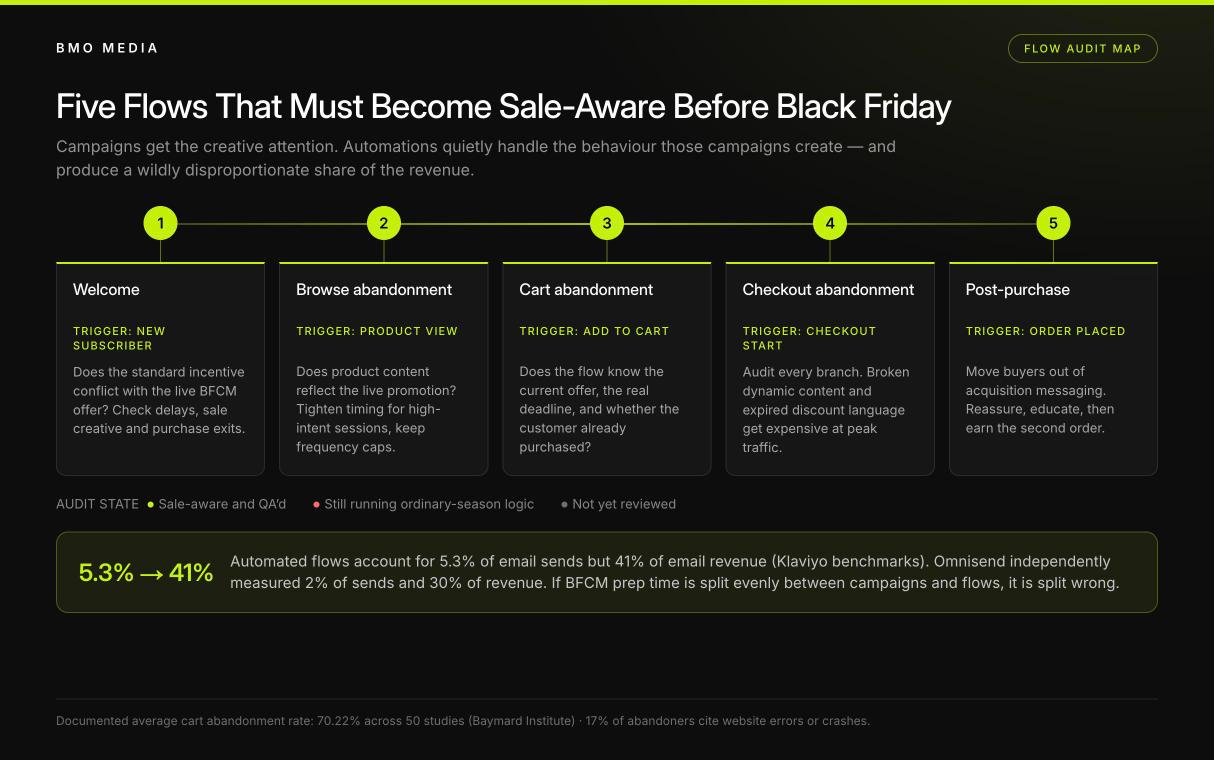
Every flow should be sale-aware before the freeze: welcome, browse abandonment, cart abandonment, checkout abandonment and post-purchaseFive Weeks Out: Warm Deliverability Before Volume Rises
Deliverability problems become more expensive during BFCM because the value of every missed inbox placement rises — and the seasonal baseline is already working against you. Validity benchmark data shows global inbox placement dropping from just under 87% in Q1 to 82.3% in Q4, with spam placement rising from 4.5% to 8.6%. Placement varies by provider too: Gmail 87.2%, Yahoo/AOL 86.0%, Apple 76.3%, Microsoft 75.6%.
Review SPF, DKIM and DMARC configuration, sending domain health, bounces, spam complaints, recent engagement, inactive subscribers, acquisition sources and consent before promotional volume increases. Google's bulk sender requirements require senders of 5,000+ daily messages to Gmail to hold Postmaster Tools spam rates below 0.30%, with 0.10% as the target — a threshold that peak volume can push an otherwise compliant sender across.
The objective is not simply to reduce the list. It is to understand which part of the audience deserves additional peak-season pressure. A sudden jump in volume to dormant contacts is not a Black Friday strategy. It is a deliverability gamble, and Q4 is when the odds are worst.
If volume is going to rise sharply, ramp into it rather than jumping. Mailbox providers respond to sudden changes in sending pattern as much as to the content itself, so a program that normally sends twice a week and moves to daily in one step looks different to a filter than one that steps up over three weeks. The pre-BFCM period is where that ramp belongs.
Have a rollback position ready too. If complaint rates climb during peak week, the fastest correction is not better creative — it is cutting the least-engaged tier out of the next send. Decide now which segment that is and what the trigger number is, so the decision takes minutes rather than a meeting.
Four Weeks Out: Align the Offer With Inventory
Marketing should not create demand that inventory cannot support. By four weeks out, merchandising and lifecycle teams should know promotional priorities, projected inventory, stockout risks, replenishment dates, bundles, exclusions, shipping constraints, gifting cutoffs and return rules.
The cost of getting this wrong is not just a lost sale. A 2026 survey of 1,000 US consumers commissioned by inventory platform Doss found that 82% would try a competitor if their preferred brand is frequently out of stock, 62% have already switched brands because of a stockout, and 45% simply buy from a different retailer when it happens. A stockout during your highest-traffic weekend hands a competitor a trial at the moment purchase intent is highest.
If a hero product has constrained inventory, do not build the entire BFCM campaign around it without a fallback. If excess inventory exists in a complementary category, bundles may create a stronger commercial outcome than a blanket discount — a bundle moves slow stock at a blended margin without publishing a discount that resets the anchor price on your best seller.
The operational half of this is a communication protocol. Agree now how a stockout gets from the warehouse to the person scheduling sends, and how fast. During peak week the gap between a product selling out and the next email promoting it is often measured in hours, and every message sent into that gap generates a support ticket, a disappointed customer and a refund.
Build the fallback merchandising before you need it. One alternate hero product, one alternate bundle and pre-approved swap copy cost an afternoon in October and are worth considerably more than that on the Saturday of Black Friday weekend.
Product | Normal price | BFCM price | Inventory | Strategic role |
|---|---|---|---|---|
Hero SKU | $100 | $90 | Limited | Protect margin |
High-stock SKU | $80 | $60 | High | Drive volume |
Complementary SKU | $40 | Bundle | High | Increase basket |
New product | $120 | No discount | Moderate | Maintain value |
Three Weeks Out: Production Should Be Underway, Not Starting
At three weeks, strategic decisions should be turning into execution. Campaign production should cover email, SMS, push where applicable, onsite banners, landing pages, paid creative, offer terms, FAQs, customer-service scripts and post-purchase messaging.
The two most commonly forgotten items on that list are the customer-service scripts and the offer terms. Support will field the same six questions all weekend — does this apply to sale items, can I combine codes, when is the delivery cutoff, what is the return window on a discounted order — and if the answers are not written down, four people will invent four versions of them in live chat. Write the terms once, publish them on the landing page, and give support the same document.
This is also when the channel calendar needs to be viewed as one system. A customer should not receive an SMS, a generic campaign email, a cart message and a push notification inside a narrow window simply because four teams scheduled independently. Put every scheduled touch — campaigns, SMS, push, and the flows likely to fire — on one calendar view and look at it from the perspective of a single high-intent customer who is in every audience at once. That person is your best customer, and they are the one most likely to be over-messaged into unsubscribing.
BMO's work with Centr shows cross-channel CRM execution around high-impact sale periods: lifecycle segmentation, creative testing, automation and weekly performance analysis run as one program. During BFCM, that approach generated more than $1.9 million in CRM-attributed revenue for Centr, with 2.5x higher year-over-year engagement across key sale periods. Read the Centr Fitness case study for how CRM was managed as a coordinated growth system rather than a collection of individual sends.
Two Weeks Out: QA Everything the Customer Can Touch
Two weeks before Black Friday is not the time for a new strategy. It is the time to try to break the strategy you already built.
Offer QA. Confirm discount codes, automatic discounts, bundles, exclusions and thresholds.
Lifecycle QA. Trigger welcome, browse, cart, checkout and post-purchase flows yourself. Check links, dynamic fields, branches and exits.
Campaign QA. Check audience logic, suppression rules, UTM parameters, links, mobile rendering and offer terms. Mobile is not a secondary case: Adobe recorded mobile at 56.4% of 2025 holiday season revenue, up from 54.5% in 2024, and Salesforce measured mobile at 70% of global Cyber Week orders. If it renders badly on a phone, it renders badly for the majority.
Storefront QA. Test product pages, navigation, search, cart and checkout on multiple devices — under load if you can simulate it. Shopify recorded peak sales of $5.1 million per minute on Black Friday 2025 and Adobe measured $16 million per minute during Cyber Monday's evening peak; your share of that curve arrives all at once. Contentsquare benchmark data across 6,000 websites found 53% of users exited after a single page when content loaded slowly.
Measurement QA. Confirm dashboards and attribution settings before revenue arrives, not after.
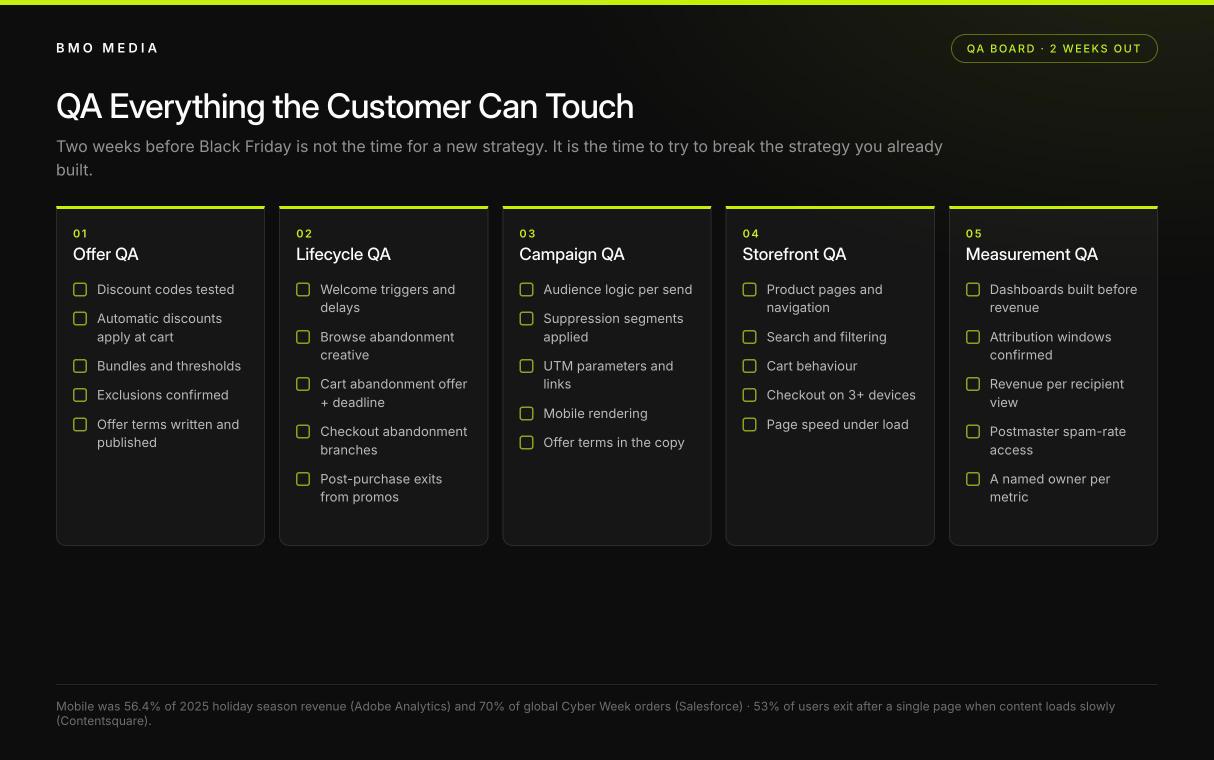
Use the QA board as a working document two weeks out: offer, lifecycle, campaign, storefront and measurement, each with a named ownerOne Week Out: Lock What Needs to Stop Changing
The final week should feel quieter than the previous seven. Establish a practical change freeze covering core offer architecture, major flow logic, segmentation definitions, campaign calendar, primary creative, landing-page structure and tracking configuration.
Allow controlled changes only for inventory availability, broken links, genuine operational issues, performance-driven adjustments, customer-service information and urgent compliance corrections.
The distinction that matters: structural decisions freeze early, operational corrections stay open. A team that can still fix a broken link on Black Friday morning is prepared. A team still debating offer architecture on Black Friday morning is not.
Write the freeze down and circulate it. An unwritten freeze is not a freeze — it is a preference that loses every argument against a senior stakeholder with a late idea. The document only needs two lists: what is locked, and who can authorise an exception. In practice one named person should hold that authority for the whole window, because the failure mode is not a single bad change but four reasonable changes made independently by four people who each assumed the others knew.
The freeze also protects the QA you just finished. Every structural change made after testing invalidates part of it, and there is no time left to re-run the full pass. A campaign that was verified on Tuesday and edited on Thursday is an untested campaign going into the highest-traffic weekend of the year.
What Should You Monitor During BFCM?
Preparation does not eliminate active management. It changes what the team does during peak: instead of building, the team monitors.
Area | Monitor |
|---|---|
Revenue | Actual vs forecast |
Inventory | Stock and sell-through |
Site | Errors, checkout, conversion |
Email / SMS | Revenue, clicks, unsubscribes, complaints |
Paid | Spend, CAC, efficiency |
Customer service | Repeated questions and issues |
Fulfillment | Capacity and delays |
Offers | Redemptions and errors |
Watch the spam complaint rate daily rather than weekly — it is the one metric that can cause lasting damage inside a single weekend, and Gmail's 0.30% threshold does not pause for peak season. Most dashboards report it on a lag, so check Postmaster Tools directly rather than trusting an ESP summary refreshed once a day.
Set thresholds in advance, not in the moment. For each row, agree now what number triggers action and what that action is: at what stock level does the hero product get pulled from the next send, at what complaint rate does the disengaged segment get suppressed, at what checkout error rate does someone wake up the developer. Deciding this during peak week means deciding it while tired, under revenue pressure, and with an incentive to wait one more hour.
Assign owners before Black Friday. Everyone should know who has authority to pause a campaign, change an inventory message, correct an offer or escalate a technical issue — and each owner should know where to look without asking someone else for access. The most common peak-week failure is not that nobody noticed a problem. It is that the person who noticed did not have permission to fix it and could not reach the person who did.
BFCM readiness check. If you cannot name the owner for each row in that table today, that is the gap to close first — not the campaign calendar. A complimentary lifecycle audit will surface where the accountability and the automation gaps actually sit.
Readiness Should Include What Happens After the Sale
Before peak week begins, decide what will happen to first-time customers, gift buyers, subscribers who never purchased, VIP customers, discounted subscribers and customers whose preferred products sold out.
A BFCM customer who buys once at a deep discount and never returns is economically different from one who purchases again at full price — and the base rate is worse than most teams assume. Ometria found that only 4% of customers acquired during Black Friday 2024 made a repeat purchase within twelve months, and that Black Friday-acquired customers were six times less likely to return than a typical new customer. Just 11% of 2024's Black Friday shoppers returned for Black Friday 2025.
That does not mean peak-season acquisition is worthless. It means the value has to be manufactured after the sale, by a post-purchase program that exists before the orders land. Deciding this in January is deciding it too late.
Decide the second-order path per group, not in general. A first-time buyer who bought a gift needs a different next message than one who bought for themselves — the gift buyer may never use the product and is being nurtured toward a second gifting occasion, not a replenishment. A VIP who bought at a discount they would not normally need should probably not be trained to wait for the next one. A subscriber who browsed heavily and never converted is more valuable in January than most of the people who did buy, because their intent was real and the offer simply was not right.
Set the January expectation before December, too. BFCM cohorts inflate every acquisition metric and then depress every retention metric sixty days later. If nobody has agreed in advance that the Q1 repeat rate will look worse because of what happened in November, the January conversation becomes an argument about whether the program is broken rather than a plan for the customers it acquired.
The BFCM Readiness Scorecard
Readiness area | Ready when... |
|---|---|
Economics | Margin and acquisition thresholds are documented |
Inventory | Promotional SKUs and constraints are known |
Segmentation | Campaign audiences and suppression rules exist |
Flows | Peak-season logic has been QA'd |
Deliverability | Authentication and list health are stable |
Creative | Core assets are approved |
Storefront | Mobile purchase journey passes testing |
Measurement | Dashboards and attribution are validated |
Operations | Owners and escalation paths are documented |
Retention | Post-purchase journeys are ready |
Use it as a gate rather than a report. Each row should be answerable yes or no by a named person, and "mostly" counts as no. The value of the scorecard is that it converts a vague sense of readiness into a specific list of things that are not done yet, early enough to do something about them.
If several answers are still no with one week to go, the solution is usually not another campaign idea. Fix the highest-risk dependencies first — the ones where failure is visible to the customer and cannot be corrected mid-weekend. A broken checkout, a flow sending an expired discount, or an offer that does not apply at the cart are all in that category. A campaign that could have been better written is not; it will underperform quietly and cost you a fraction of what a broken purchase path costs.
The rows also fail at different speeds. Creative and campaign gaps hurt for one weekend. Deliverability damage, list attrition and a missing post-purchase program hurt for the following year, because they degrade the asset that produces revenue outside of peak season. Given a choice between polishing the Cyber Monday email and fixing the welcome flow, fix the flow.
Black Friday Readiness Is a Process, Not a Deadline
The biggest advantage of preparing eight weeks early is not that every prediction turns out correct. It is that the team has time to discover what is wrong. A weak segment can be rebuilt. A broken flow can be corrected. An unhealthy list can be managed. An offer with poor economics can be redesigned. An inventory constraint can change merchandising. A deliverability issue can be addressed before sending volume peaks.
That flexibility disappears as Black Friday gets closer. By the week of 27 November, every one of those fixes has become a compromise instead.
It is worth saying plainly that no brand completes all of this. The point of an eight-week structure is not perfection; it is sequencing, so that the things you run out of time for are the things that matter least. A team that ran out of time on a third creative concept has a good Black Friday. A team that ran out of time on the cart flow does not — and both teams were equally busy.
The other benefit compounds. Most of this work is reusable: the segments, the flow logic, the deliverability baseline, the suppression rules and the post-purchase program all persist after November. A brand that builds them properly this year starts next year's countdown at week four rather than week eight, and spends the difference on the parts that actually vary — the offer, the merchandising and the creative.
The same logic applies across the wider plan. If you are still setting discount depth and owned-channel targets, start with the Black Friday marketing strategy that protects margin. If the calendar is taking shape but the sends and automations underneath it are not, the Black Friday email marketing strategy covers the campaign and flow plan for peak week.
BMO Media approaches lifecycle growth as a connected operating system across strategy, email, SMS, automation, subscriptions, loyalty, push and other retention channels. Explore BMO's retention marketing services to see how those capabilities work together, or review BMO's ecommerce lifecycle case studies for the execution behind the strategy.
Request a complimentary lifecycle audit before peak-season execution begins. The goal is simple: identify the gaps while there is still enough runway to fix them.
Frequently Asked Questions About Preparing for Black Friday Ecommerce
When should Black Friday offers be finalized?
The core offer architecture should be settled at least four weeks out, so inventory, creative, automation, landing pages and support information can be built and tested around it.
How do you prepare email and SMS for Black Friday?
Audit audience health and segmentation first, then review automated flows, campaign cadence, suppression, consent and deliverability. Prioritise flows — they represent roughly 5% of sends but 41% of email revenue, so they carry more risk and more upside than the campaign calendar.
How should ecommerce brands prepare inventory for Black Friday?
Forecast demand at SKU level, identify constrained and excess inventory, confirm replenishment and fulfillment capacity, and align promotional depth with margin and stock position. Stockouts carry a retention cost as well as a lost sale: 62% of consumers say they have switched brands because of one.
What should be locked before Black Friday?
Core offer architecture, flow logic, audience definitions, primary creative, landing pages and measurement should be substantially locked before peak week. Operational corrections — broken links, inventory messaging, service information — should stay open.
Get the next one
New DTC retention teardowns and benchmarks, straight to your inbox.
Frequently asked questions
When is Black Friday 2026?
Black Friday 2026 falls on Friday 27 November, with Cyber Monday on Monday 30 November. This is the latest date Black Friday can fall, leaving 27 shopping days until Christmas - the shortest possible run-in, which makes delivery cutoffs a more significant planning constraint than usual.
When should ecommerce brands start preparing for Black Friday?
Major preparation should begin at least eight weeks before BFCM, and complex businesses may need longer. Demand itself starts earlier: 42% of US consumers say they begin holiday shopping before November, and roughly half of the season's online spend lands before 1 December.
What should be on a Black Friday ecommerce checklist?
At minimum: commercial goals, promotion economics, inventory, segmentation, lifecycle flows, deliverability, campaign production, storefront QA, checkout testing, analytics, customer support, fulfillment and post-purchase retention.
Not sure your BFCM readiness holds up?
We audit the economics, segments, flows, deliverability and post-purchase program before peak week exposes the gaps. Request a complimentary lifecycle audit and we will show you what is not ready yet.
Share on
Enjoyed this read?
See how a tailored retention strategy could work for your brand.
Interested in working with us?
Request a complimentary audit and start building a stronger lifecycle foundation today.
Join the team
The retention brief
One email a month. Benchmarks, teardowns and what is actually working in DTC lifecycle right now.
Interested in working with us?
Request a complimentary audit and start building a stronger lifecycle foundation today.
Join the team
The retention brief
One email a month. Benchmarks, teardowns and what is actually working in DTC lifecycle right now.
Interested in working with us?
Request a complimentary audit and start building a stronger lifecycle foundation today.
Join the team
The retention brief
One email a month. Benchmarks, teardowns and what is actually working in DTC lifecycle right now.