Retention
Black Friday Marketing Examples: Six Campaigns Broken Down by Mechanic

Sammy Tran

The best Black Friday marketing examples share one trait: a mechanic, not a creative idea. Six repeatable structures do most of the work. Loyalty-gated early access, tiered discount ladders, bundles, extended promo windows, SMS flash drops, and post-peak win-backs. Each targets a different segment, runs a different send sequence, and costs a different amount of margin.
Most roundups of black friday campaign examples show a screenshot and move on. That does not help when you are three weeks out and deciding what to actually build. What you need is the structure underneath: who received it, in what order, and what it cost to run.
The stakes are set by volume. Shopify merchants processed $14.6 billion over BFCM 2025, up 27% year over year, on an average cart of $114.70 (Shopify, 2025). Adobe Analytics put US Cyber Week online spend at $44.2 billion, with Cyber Monday alone setting a record at $14.25 billion (Adobe Analytics, 2025). Salesforce measured $336.6 billion in global Cyber Week sales and found AI agents influenced 20% of global orders (Salesforce, 2025).
Owned channels carry a disproportionate share of that. Across Klaviyo's customer base during BFCM 2025, email and text drove 42% of total revenue, rising to 43% on peak days, with $3.8 billion in attributed revenue, up 27% year over year (Klaviyo, 2025).
Here are the six mechanics, side by side, before we break each one down.
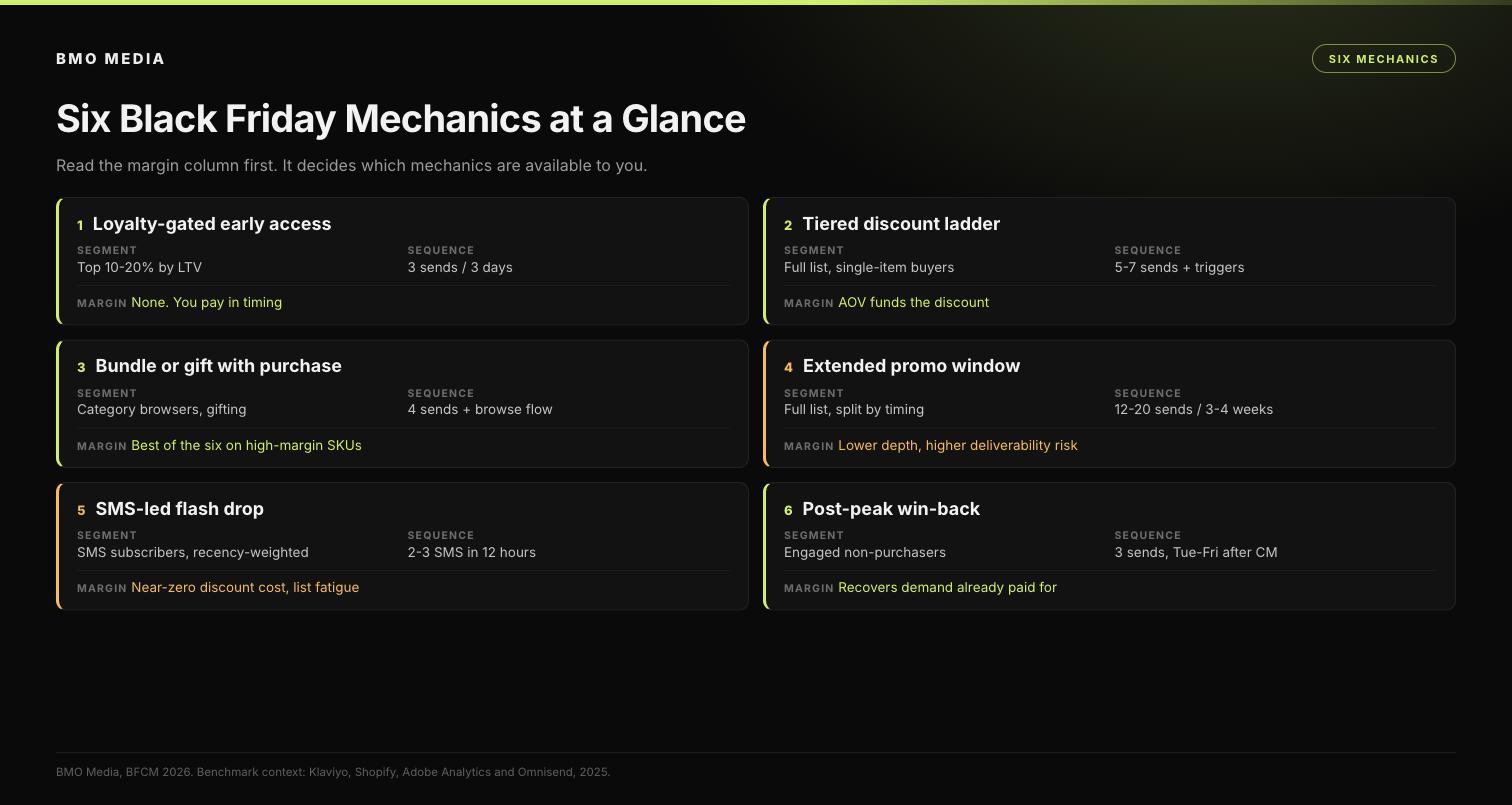
The six mechanics at a glance
Read this table by the last column first. The margin consequence is what decides whether a mechanic is available to you, and it is the column every other roundup leaves out. A brand running 38% gross margin and a brand running 68% gross margin should not run the same Black Friday campaign, no matter how well the creative performed for someone else.
Mechanic | Offer structure | Segment it targets | Send sequence | Margin consequence |
1. Loyalty-gated early access | Public sale price, opened 24 to 72 hours early | Top 10 to 20% by LTV, active loyalty members, subscribers | 3 sends over 3 days, email led, one SMS | None. You pay in timing, not points of margin |
2. Tiered discount ladder | Save more at higher spend thresholds | Full list, weighted to single-item buyers | 5 to 7 sends, threshold reminders keyed to cart value | Effective discount rises with basket, so AOV funds it |
3. Bundle or gift with purchase | Fixed-price kit or free add-on above a threshold | Category browsers and gifting buyers | 4 sends plus one browse-triggered flow | Best of the six if the bundle is built from high-margin SKUs |
4. Extended promo window | One offer, spread across weeks instead of 96 hours | Full list, split into early, mid and late buyers | 12 to 20 sends across 3 to 4 weeks | Lower discount depth needed, higher deliverability risk |
5. SMS-led flash drop | Limited quantity or limited hours, no sitewide cut | SMS subscribers only, recency weighted | 2 to 3 SMS in under 12 hours | Near zero discount cost, high list fatigue cost |
6. Post-peak win-back | Second-chance offer or restock, narrower than the main sale | Non-purchasers who engaged during the peak | 3 sends across the Tuesday to Friday after Cyber Monday | Recovers demand already paid for in the main sale |
What separates a Black Friday campaign that works from one that just looks good?
Discount depth is not the lever most brands think it is. Klaviyo found that during BFCM 2025 same-site sales rose 11% year over year while discount depth fell 10% (Klaviyo, 2025). Adobe recorded peak Cyber Week discounts of 31% on electronics, 25% on apparel and 17% on sporting goods (Adobe Analytics, 2025). Against that backdrop, a blanket 40% off is not competitive positioning. It is a margin donation with a design brief attached.
Three things actually separate the campaigns that produce profit from the ones that produce screenshots.
Segment before offer. The offer is decided second. Who sees it, and when, is decided first. A first-time visitor and a three-time buyer with 4,000 loyalty points should not receive the same message on the same morning.
Sequence over single send. One hero email is a coin flip. A sequence covers the buyer who opens on Wednesday, the one who opens Friday at 6am, and the one who only reads texts.
Automation running underneath. Omnisend's 2026 Ecommerce Marketing Report, which analyzed 27 billion emails across 150,000 brands in 2025, found automated emails made up just 2% of sends but produced 30% of all email revenue, earning $2.87 per send against $0.18 for broadcast campaigns (Omnisend, 2025 data). If your abandoned cart and browse flows are not sale-aware in November, you are running your highest-intent traffic through your lowest-relevance messages.
Cross-channel coordination compounds all three. Klaviyo reported that shoppers reachable on both email and SMS placed 11% more orders, viewed 71% more products, and added 34% more items to cart than single-channel shoppers (Klaviyo, 2025).
Example 1: How does a loyalty-gated early access campaign work?
Offer structure. The same headline discount as the public sale, opened 24 to 72 hours earlier. Access is granted by identity, not by a secret code that leaks to a coupon site within an hour. Eligibility comes from loyalty tier, points balance, purchase recency, or active subscription.
Segment. Top 10 to 20% by lifetime value, plus every active loyalty member and subscriber. Typically 8% to 15% of a healthy list.
Send sequence.
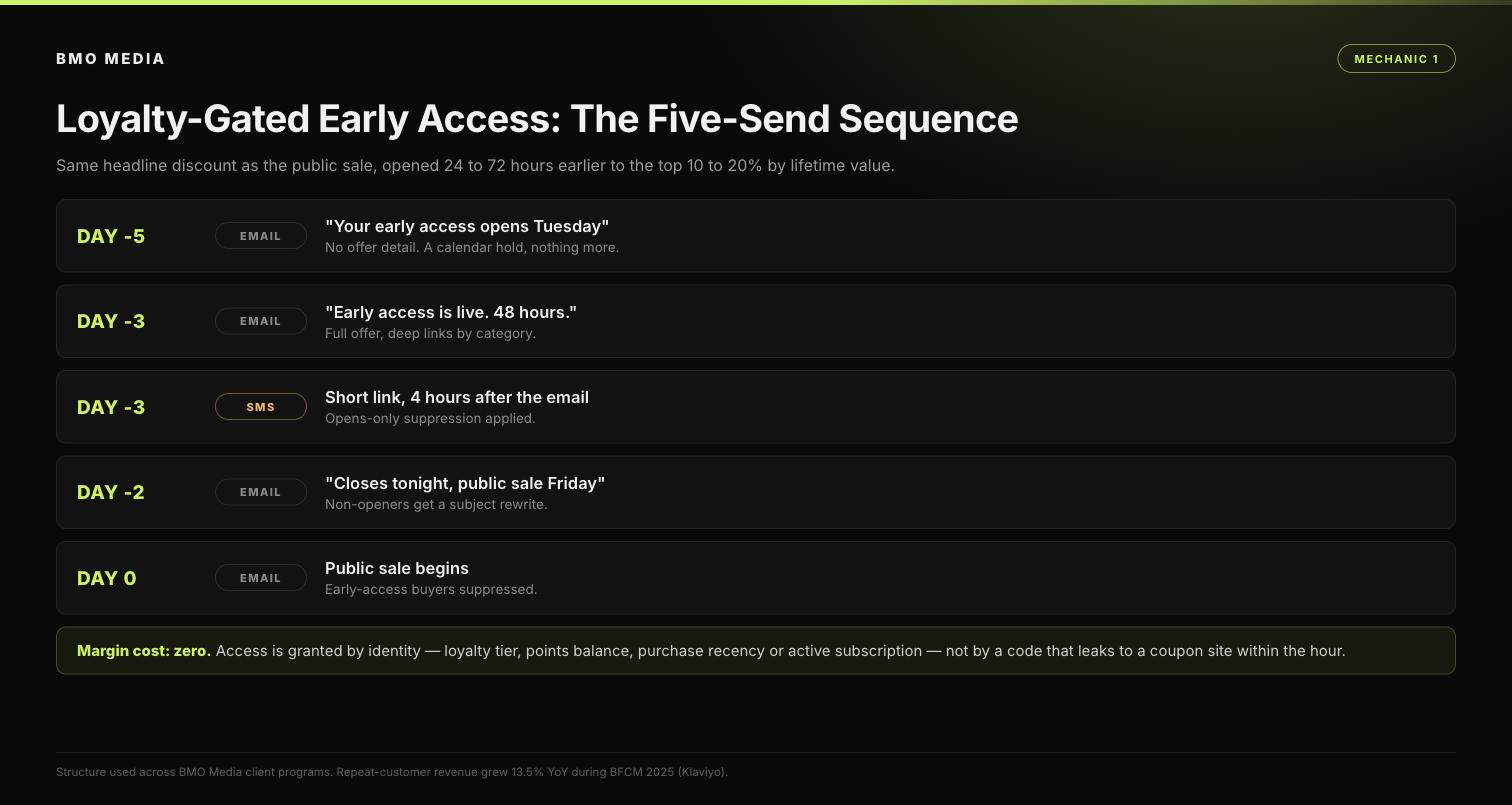
Margin consequence. Zero incremental discount cost. You are paying in timing, not in points of margin. The real cost is cannibalization risk: some of those buyers would have purchased at full price. The offsetting gains are earlier cash, a demand read three days before you commit inventory to the public window, and a discount reframed as a status benefit rather than a price cut.
Why it works. It rewards the people who already fund the business. Klaviyo found revenue from repeat customers grew 13.5% year over year during BFCM 2025, outpacing new buyer revenue (Klaviyo, 2025). Early access is the cheapest way to put that group first. If you are gating on points rather than order count, a functioning loyalty program is the prerequisite, not an afterthought.
Example 2: How does a tiered discount ladder raise average order value?
Offer structure. Discount scales with basket size. A common ladder is $10 off $75, $30 off $150, $60 off $250. The customer chooses their own discount depth by choosing their own basket. Percentage ladders work too, but dollar thresholds are easier to compute in a subject line and harder to misread.
Segment. The full list, with extra weight on single-item buyers and one-time purchasers. This mechanic exists to move people from one unit to three.
Send sequence. Five to seven sends across the sale window, with two of them triggered rather than scheduled. The trigger matters more than the broadcast: a cart sitting at $130 should receive a message saying $20 more unlocks $30 off, not the same hero email everyone else got.
Send | Timing | Audience | Message job |
1 | Sale open | All | Explain the ladder in one line |
2 | +12 hours | Non-openers | Resend with tier math in the subject |
3 | Triggered | Cart between two tiers | Name the gap in dollars |
4 | Mid-sale | Openers, no purchase | Show a basket that hits tier two |
5 | Final 12 hours | All non-buyers | Deadline plus top tier reminder |
Margin consequence. This is the mechanic that pays for itself. Because effective discount rises only when basket size rises, gross profit per order can exceed a shallower sitewide cut. The failure mode is setting tier one too low, which lets your normal AOV buyers claim a discount they did not have to work for. Set tier one at roughly 1.2 times current AOV.
Example 3: Why do bundles protect margin better than a sitewide percentage off?
Offer structure. A fixed-price kit, or a free gift above a spend threshold. The customer never sees a percentage applied to a SKU they were going to buy anyway. They see a curated set at a price they cannot assemble themselves.
Segment. Category browsers and gifting buyers. Browse abandoners from the four weeks before the sale are the strongest audience here because you already know the category.
Margin consequence. Bundles win because you choose which SKUs go into them. Below is an illustrative model comparing four mechanics on the same customer. Assume a 40% COGS ratio at full price unless stated. Substitute your own numbers before you commit.
Mechanic | Basket at MSRP | Discount | Revenue per order | COGS | Gross profit | Gross margin |
Sitewide 25% off | $100 | 25% | $75.00 | $40.00 | $35.00 | 46.7% |
Early access, 15% off, VIP basket | $110 | 15% | $93.50 | $44.00 | $49.50 | 52.9% |
Tiered ladder, $30 off $150 | $150 | 20% | $120.00 | $60.00 | $60.00 | 50.0% |
Bundle from 65% margin SKUs | $150 | 22% | $117.00 | $52.50 | $64.50 | 55.1% |
Read the gross profit column, not the discount column. The sitewide cut carries the deepest headline discount and delivers the worst absolute outcome, because it applies to a basket that never grew. The bundle is discounted almost as deeply and still returns $64.50 per order, because that discount was funded by SKU selection rather than by margin.
The catch. Bundles need inventory certainty. If one component sells out on Friday morning, the whole offer breaks and your sends for the rest of the weekend point at a dead page. Build bundles from stock you over-ordered, not from your hero SKU.
Running BFCM on a list you have not audited? We will pull your flow coverage, segment health, deliverability and revenue-per-recipient, then tell you which of these six mechanics your list can actually support. Request a complimentary retention audit.
Example 4: What happens when you extend the promo window instead of compressing it?
This one is our own client work, so the numbers are ours to show.
The brand. Spoonful of Comfort, a gifting brand with hard operational limits on how much volume it can ship in a 96-hour spike.
Offer structure. One coherent offer, spread across weeks rather than compressed into Black Friday weekend. Early access opened before Black Friday. Messaging was distributed across the whole window instead of stacked into two days of urgency.
Segment. The full list, split by purchase timing behavior. AI-driven segmentation sorted early buyers, mid-window deliberators and late deadline responders, and each group received a different cadence. Automations were made sale-aware so browse and cart flows carried the promotion rather than contradicting it.
Send sequence.
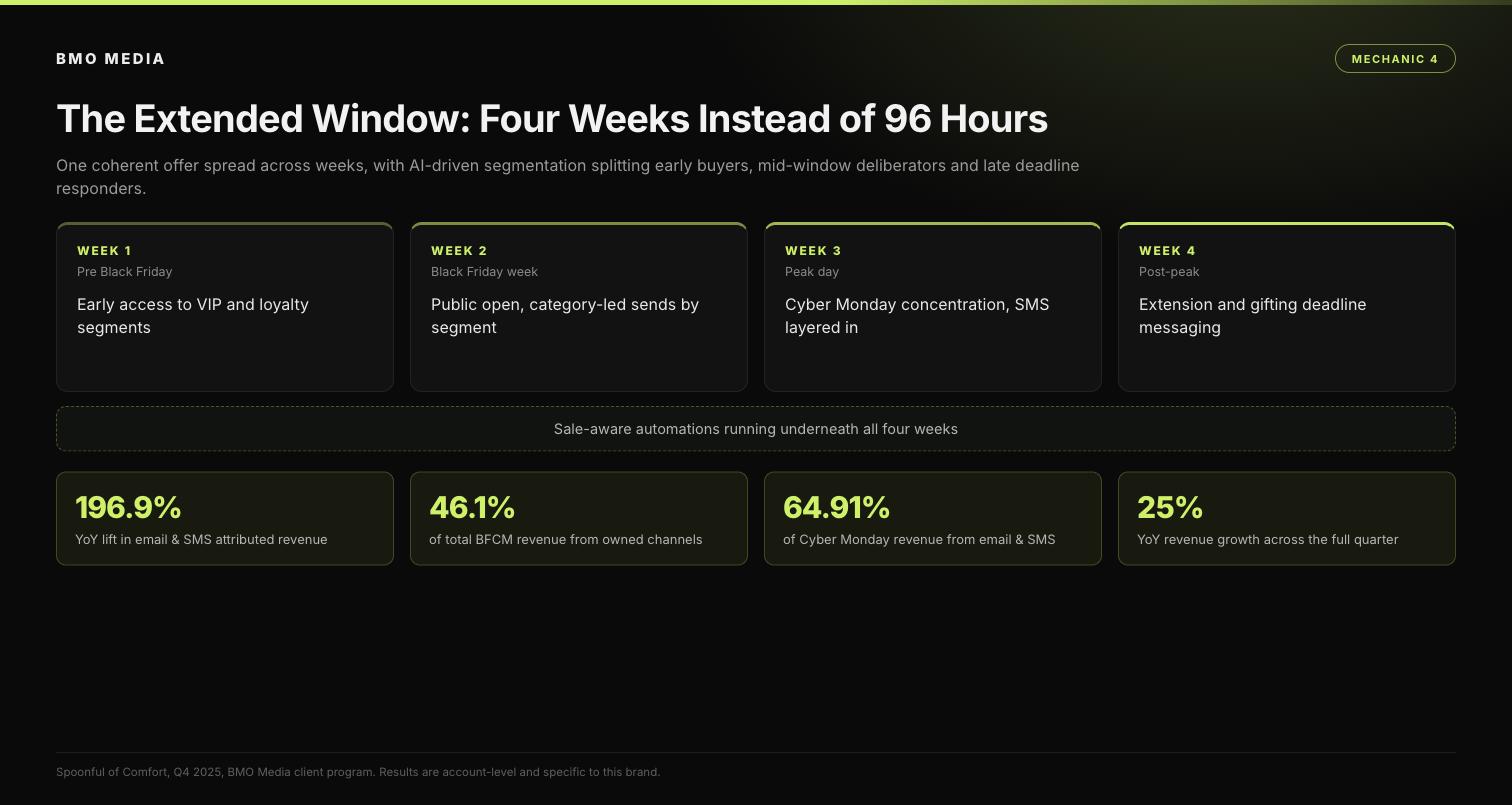
What we saw. During BFCM Q4 2025 the program produced a 196.9% year over year increase in email and SMS attributed revenue. Owned channels accounted for 46.1% of total BFCM revenue, and 64.91% of Cyber Monday revenue came from email and SMS alone. Across the full quarter, revenue was up 25% year over year. The full breakdown is in the Spoonful of Comfort case study.
Margin consequence. Extending the window reduced the discount depth needed to hit the number, because demand was not competing with itself inside a single weekend. The trade is deliverability risk. Twelve to twenty sends in a month will damage a list that has not been warmed and segmented properly. That is the constraint that decides whether this mechanic is available to you, and it is why the email marketing infrastructure work happens in September, not in the third week of November.
Example 5: How do SMS flash drops create urgency without discounting everything?
Offer structure. A limited quantity or limited hours release. No sitewide percentage. The scarcity is real: a set number of units, or a window that closes at a stated time. This is the mechanic for brands with genuine drop culture or genuinely constrained inventory, and it fails badly for brands that fake it.
Segment. SMS subscribers only, weighted by recency. Anyone who has clicked an SMS in the past 90 days goes in tier one. The rest get the drop announcement only if tier one does not clear the inventory.
Send sequence. Two to three messages inside twelve hours. A teaser the night before, the drop message itself, and a low-stock message only if stock is genuinely low.
Why the timing works. Omnisend's SMS benchmark analysis of 246 million campaign sends across 27,000 brands in 2025 found click rates peak in Q4, rising from 18.02% in October to 20.28% in November and 23.92% in December (Omnisend, 2025 data). The same analysis found automated SMS produced a 20.34% click rate and $0.75 per message, against 12.39% and $0.15 for broadcast campaigns.
What we have seen on our side. Building a list large enough to make this work is its own project. For Darc Sport we added 41,000 SMS subscribers in two months, which supported a 29.8% increase in SMS revenue and $7.89 in revenue per campaign message, with an 80% increase in revenue coming from SMS automation. Details are in the Darc Sport case study, and the list-building side is covered under SMS marketing.
Margin consequence. Close to zero discount cost, which makes this the cheapest mechanic on the list in dollar terms. The cost is list fatigue. Every flash drop spends attention you cannot borrow back, so cap it at one or two per season.
Example 6: How does a post-peak win-back recover revenue after Cyber Monday?
Offer structure. A narrower second-chance offer in the days after Cyber Monday. Not a repeat of the main sale, which punishes everyone who bought on time. Usually a restock announcement, a category-limited extension, or a gifting deadline framed around shipping cutoffs rather than price.
Segment. This is the mechanic where segmentation does all the work. The audience is everyone who engaged during peak and did not buy.
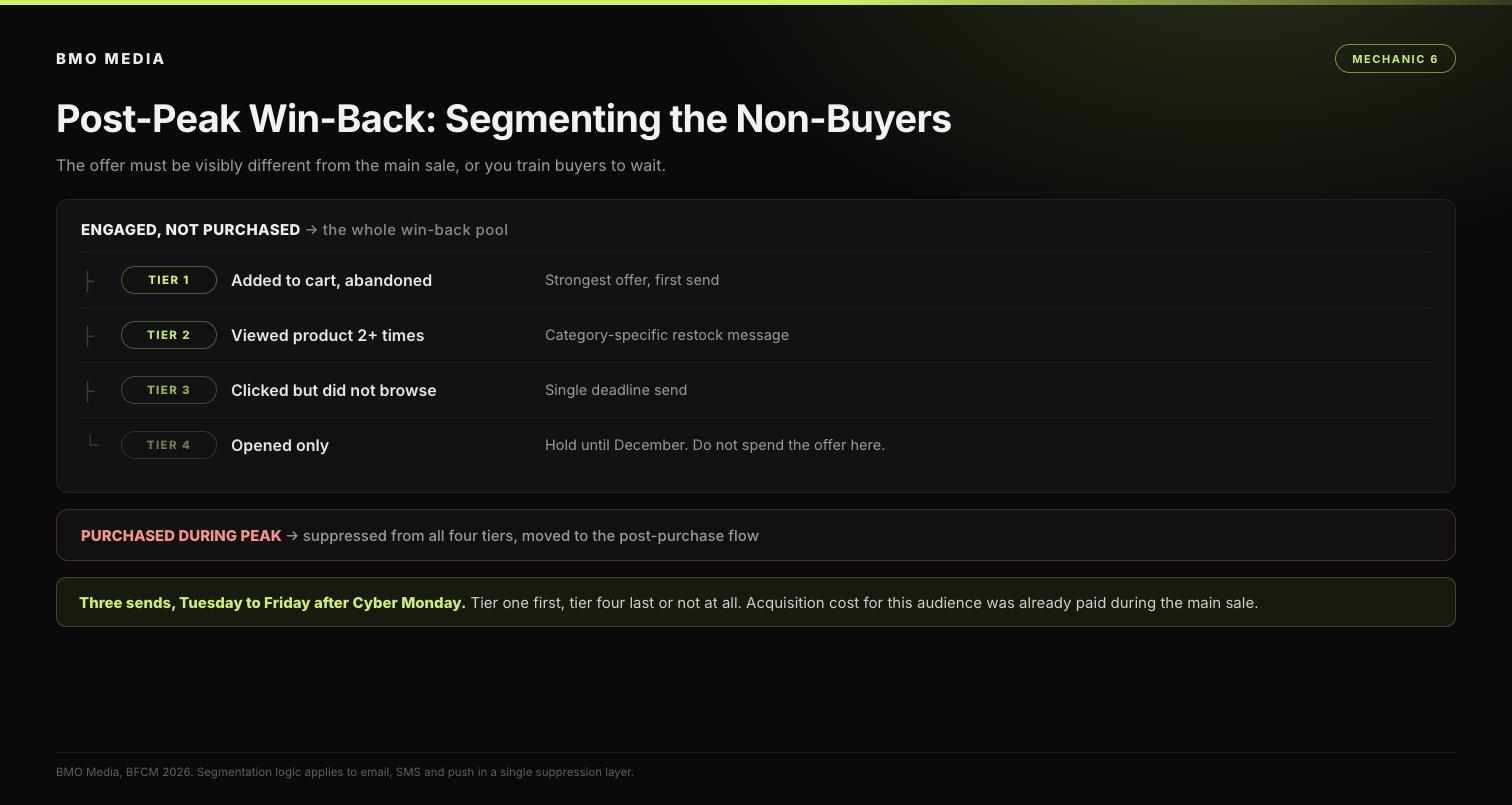
Send sequence. Three sends across the Tuesday to Friday after Cyber Monday, tier one first, tier four last or not at all.
Margin consequence. The most efficient of the six, because acquisition cost for this audience was already paid during the main sale. You are recovering demand you generated and did not convert. The risk is training buyers to wait, which is why the offer must be visibly different, not simply the same discount extended.
A lifecycle version of this. For Centr, we ran segmentation across acquisition, win-back, paying customers and free trials, with email, push and in-app messaging aligned to the same lifecycle stage. That program produced 2.5 times higher engagement year over year during key sale periods, more than $1.9 million in CRM-attributed revenue during BFCM, and a 20% lift in trial-to-paid conversions. The Centr case study covers the structure, and the same logic applies to subscription programs where the win-back audience is churned members rather than non-buyers.
How do you choose the right Black Friday mechanic for your brand?
Pick by constraint, not by preference. Four inputs decide it: gross margin, inventory certainty, list size and fulfillment capacity.
If your constraint is | Avoid | Run instead | Because |
Thin gross margin (under 45%) | Sitewide percentage off | Bundle, or tiered ladder | Discount is funded by SKU mix or basket growth, not by margin |
Fulfillment capacity | Compressed 96-hour sale | Extended window | Demand spreads across weeks your operation can absorb |
Small or cold list | Extended window | Loyalty-gated early access | Fewer sends, warmest audience, lowest deliverability risk |
Inventory uncertainty | Bundles | SMS flash drop or ladder | No fixed component that can sell out and break the offer |
Strong list, weak AOV | Early access alone | Tiered ladder | The mechanic exists specifically to move one unit to three |
Everything already running | Nothing new | Post-peak win-back | Highest efficiency, uses demand you already paid for |
Two more rules from running these programs.
Stack at most two. Early access plus a ladder works. Early access plus a ladder plus a bundle plus a flash drop produces an offer no one can explain in a subject line, and confusion converts worse than a weaker offer stated clearly.
Decide the mechanic before the creative brief. The design work is fast once the structure is fixed. Reversing that order is how brands end up with beautiful emails carrying an offer that loses money at scale. If you want the full planning sequence, our Black Friday marketing strategy guide covers the calendar, and the Black Friday ecommerce preparation checklist covers the technical work that has to land before November.
Frequently asked questions
What is the best Black Friday offer for a small DTC brand? For most small brands with a list under 20,000, loyalty-gated early access paired with a tiered ladder outperforms a sitewide cut. Early access gives your best customers a reason to buy without an extra discount, and the ladder raises basket size on the public window. Both work on a small list because neither depends on send volume.
How many emails should you send during Black Friday week? Between five and eight to the full list across the sale window, plus triggered sends that only reach people whose behavior earned them. Volume is less important than suppression. If you are sending eight and suppressing purchasers, engaged non-buyers and unengaged segments correctly, that reads as relevance. Eight sends to everyone reads as noise and costs you deliverability into December.
Does extending the Black Friday promo window hurt urgency? Not if the window has internal deadlines. An extended window that runs three weeks with one closing date has no urgency. The same window with early access closing, a tier expiring, a category selling out and a shipping cutoff has four. Urgency comes from stated deadlines, not from the total length of the sale.
Should Black Friday discounts be sitewide or segmented? Segmented, in almost every case. Sitewide discounts apply your deepest cut to buyers who would have paid full price, which is where most of the margin damage happens. Segmenting by lifetime value, purchase recency and browse behavior lets you spend discount only where it changes a decision.
When should you start Black Friday email and SMS campaigns? List building and deliverability work should start in September. Sends start with early access in the week before Black Friday. Klaviyo found product views rose 41% year over year during BFCM 2025 as shoppers researched longer before buying (Klaviyo, 2025), so the pre-sale window is where consideration is actually happening.
Is email still worth the effort compared to paid channels? Yes, and the gap is measurable. Litmus reported in its 2025 State of Email research that marketers see returns between 10:1 and 36:1 from email programs, and that brands using dedicated email analytics report 43% higher ROI (Litmus, 2025). Omnisend put combined email, SMS and push return at $79 per $1 spent across its 2025 dataset (Omnisend, 2025 data). Neither figure is available on rented traffic.
Start with your list, not your offer
Every mechanic above depends on segmentation, suppression and automation that has to exist before November. The brands that post strong BFCM numbers are not the ones who found a better discount in October. They are the ones whose flows, segments and deliverability were already working in September.
If you want a working order of operations, it runs like this. Build and clean the list first, because every mechanic here is capped by how many engaged, reachable people you have. Fix deliverability second, since a list that lands in Promotions in September will land in spam in November when volume triples. Make automations sale-aware third, so your highest-intent traffic stops receiving off-promotion messages during the busiest week of the year. Choose the mechanic fourth, using the constraint table above. Brief the creative last.
That order matters because only the last step is fast. List building takes months, deliverability repair takes weeks, and flow rebuilds take days. A brand that starts with the creative brief in November is choosing from whichever mechanics its infrastructure happens to allow, which is usually the sitewide cut, which is the worst one on the list.
Book a call with BMO Media and we will audit your retention program for free: flow coverage, segment health, deliverability, revenue per recipient, and which of these six mechanics your list is ready to run this year.
Get the next one
New DTC retention teardowns and benchmarks, straight to your inbox.
Frequently asked questions
What is the best Black Friday offer for a small DTC brand?
For most small brands with a list under 20,000, loyalty-gated early access paired with a tiered ladder outperforms a sitewide cut. Early access gives your best customers a reason to buy without an extra discount, and the ladder raises basket size on the public window. Both work on a small list because neither depends on send volume.
How many emails should you send during Black Friday week?
Between five and eight to the full list across the sale window, plus triggered sends that only reach people whose behavior earned them. Volume is less important than suppression. Eight sends to everyone reads as noise and costs you deliverability into December.
Does extending the Black Friday promo window hurt urgency?
Not if the window has internal deadlines. An extended window that runs three weeks with one closing date has no urgency. The same window with early access closing, a tier expiring, a category selling out and a shipping cutoff has four. Urgency comes from stated deadlines, not from the total length of the sale.
Share on
Enjoyed this read?
See how a tailored retention strategy could work for your brand.
Interested in working with us?
Request a complimentary audit and start building a stronger lifecycle foundation today.
Join the team
The retention brief
One email a month. Benchmarks, teardowns and what is actually working in DTC lifecycle right now.
Interested in working with us?
Request a complimentary audit and start building a stronger lifecycle foundation today.
Join the team
The retention brief
One email a month. Benchmarks, teardowns and what is actually working in DTC lifecycle right now.
Interested in working with us?
Request a complimentary audit and start building a stronger lifecycle foundation today.
Join the team
The retention brief
One email a month. Benchmarks, teardowns and what is actually working in DTC lifecycle right now.