Retention
What Is BFCM? Dates, Meaning and What It Means for DTC
Sammy Tran

BFCM stands for Black Friday Cyber Monday, the four-day shopping window that runs from the Friday after US Thanksgiving through the following Monday. In 2026 that is Friday 27 November to Monday 30 November. For DTC brands it is the largest revenue weekend of the year and, less obviously, the largest customer-acquisition event of the year.
What BFCM stands for and when it falls in 2026
The acronym compresses two separate shopping days that have effectively merged into one continuous event.
Black Friday is the day after Thanksgiving in the United States, historically the start of the Christmas shopping season and originally an in-store phenomenon. Cyber Monday is the Monday that follows, invented in 2005 by a US retail trade body to name the online spike that appeared when people returned to work and shopped from office broadband. Both dates move each year because Thanksgiving is the fourth Thursday of November.
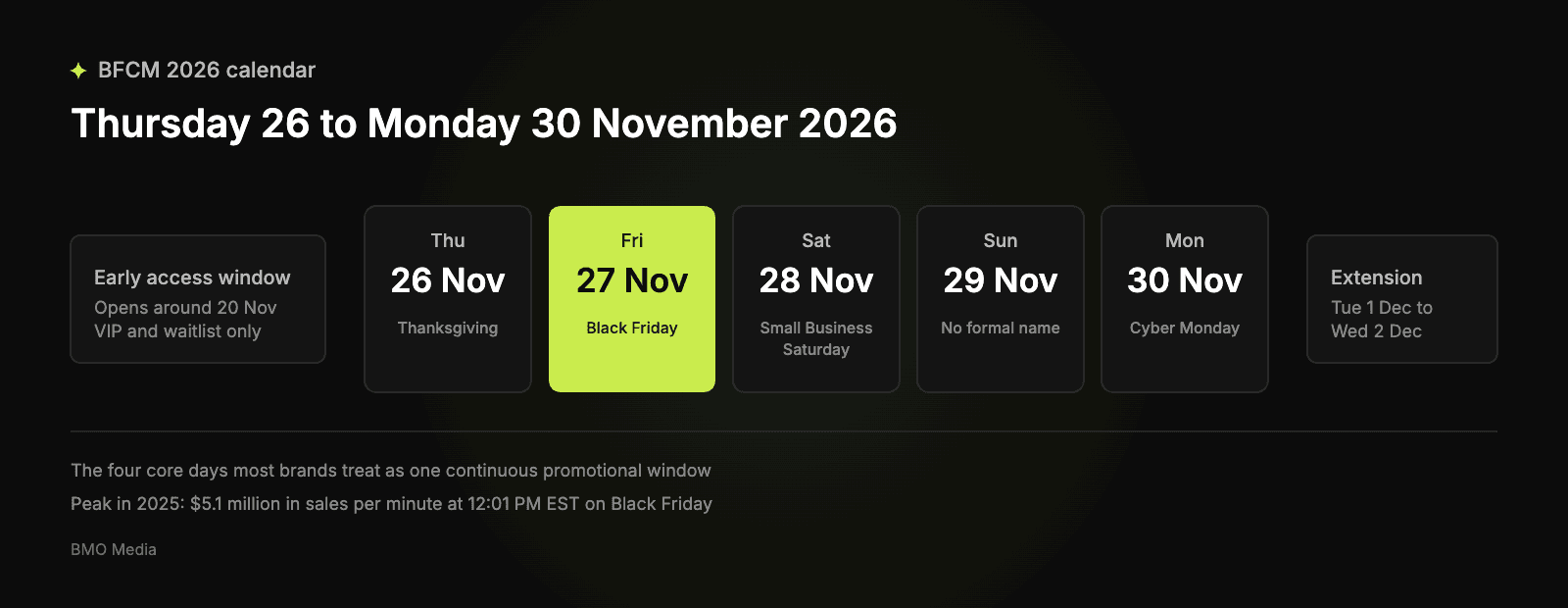
For 2026: Thanksgiving falls on Thursday 26 November, Black Friday on Friday 27 November, and Cyber Monday on Monday 30 November. Small Business Saturday sits on 28 November and Sunday 29 November has no formal name, though most brands now treat all four days as a single promotional window rather than two events with a gap.
The practical meaning of the acronym has drifted well beyond those four days. Most DTC brands now open early access in the week before Black Friday and run some form of extension through to the following Wednesday, which is why the industry talks about BFCM as a period rather than a date. When a supplier, an agency or a platform says "BFCM planning", they usually mean the eight to ten weeks of preparation that precede it, not the weekend itself.
How the weekend actually behaves
The scale is worth stating precisely, because it changes what a brand should plan for.
Shopify merchants sold $14.6 billion globally over the 2025 BFCM weekend, a 27% increase on 2024, across more than 81 million shoppers, peaking at $5.1 million in sales per minute at 12:01 PM EST on Black Friday, with an average cart value of $114.70 (Shopify investor press release, 2 December 2025).
Three things follow from those numbers. The first is compression: a peak of $5.1 million per minute means demand arrives in a burst, and a brand whose site, inventory or sending infrastructure fails for twenty minutes has lost a meaningful share of its weekend. The second is that the average cart is modest. At $114.70, minus a Black Friday discount, minus acquisition cost, minus fulfilment, a first order from a new customer is frequently break-even or slightly negative. The third is that participation is now near-universal, which means the constraint on your result is rarely demand. It is attention, and specifically inbox attention, in a week when every brand a customer has ever bought from is sending at once.
That last point is why deliverability and sending history matter more during BFCM than at any other point in the year, and why the preparation window is measured in weeks rather than days.
Why BFCM matters more to retention than to acquisition
This is the part the definition pages leave out.
If first orders are close to break-even after discount and acquisition cost, then BFCM is not a profit event. It is a customer-acquisition event that happens to collect revenue on the way through. The profit arrives later, on the second and third orders, and only if the brand has a system for producing them.
Bain's research with Fred Reichheld found that a 5% increase in customer retention produces "more than a 25% increase in profit." That relationship is ordinary in most months and decisive in December, because the cohort you acquire over four days in November is usually the largest single cohort of your year. Whether it is worth anything is decided in the following 30 to 60 days.
The mechanism that decides it is automation rather than campaigns. Klaviyo's 2026 benchmark report, drawn from more than 183,000 businesses, found that automated flows produced 41% of all email revenue from just 5.3% of total sends, at roughly 18 times the revenue per recipient of one-off campaigns, with flow click rates of 5.58% against 1.69% for campaigns. The same pattern holds in SMS: Omnisend's 2026 data puts automated SMS conversion at 0.77% against 0.12% for campaigns, at $0.74 revenue per message versus $0.15.
In plain terms, the messages that decide your BFCM profit are the ones nobody writes in November. They are the post-purchase, replenishment and win-back sequences that were configured in September and simply run.
What BFCM means for a DTC brand's calendar
Treating BFCM as a four-day event is the most common and most expensive mistake. A workable calendar looks like this.
September is for infrastructure. Segments built on last year's purchase behavior, list hygiene, and the start of a sending ramp so that mailbox providers see a consistent pattern rather than a November spike.
October is for list growth and flow builds. This is the last month in which acquiring a subscriber produces someone who will actually know your brand by Black Friday. It is also when every automated flow should be built and tested with a real order, because testing during the sale is how brands discover that their cart flow has been switched off since August.
Early November is for the engagement ramp and waitlist capture. Sending volume rises gradually, early-access lists fill, and the offer is finalized.
BFCM week itself is for sending and monitoring only. No structural changes. The account should be frozen by the Monday.
December and January are where the money is made. The cohort acquired over the weekend either converts to a second order or it does not, and the difference is worth more than anything that happened on the Friday.
See the full Q4 playbook: Q4 and BFCM retention playbook.
The four numbers that decide a BFCM result
Most BFCM dashboards report revenue and stop. These four say more.
Flow revenue as a share of total revenue. Flows are stable by design, so this ratio should hold roughly steady during the weekend. If it falls, something has broken rather than an audience having gone quiet.
Revenue per recipient by segment. This tells you which audiences deserve a resend on the Sunday and which are exhausted. A blended figure hides both.
Inbox placement by mailbox provider. Gmail and Yahoo throttle differently and diverge quickly under peak volume. A healthy blended deliverability rate can conceal a Gmail problem affecting most of your list.
Second-order rate for the BFCM cohort at 30 and 60 days. The number that determines whether the weekend was profitable. It cannot be known in November, which is precisely why so few brands measure it.
Postscript's 2026 benchmarks across more than 17,000 Shopify stores show how wide the outcomes are: abandoned-cart SMS click-through ranged from 9.5% to 17.3%, earnings per message from $3.52 to $10.95, and subscriber lifetime value from $25 to $553. That spread is not explained by copy. It is explained by list quality and by whether the automated layer was built before the traffic arrived.
What good looks like
Spoonful of Comfort entered Q4 with a returning customer base and strong gifting demand, and needed year-over-year growth through owned channels without burning engagement during the most competitive weeks of the year. The work was segmentation, sale-aware automation, and priming every flow before the weekend rather than patching during it. That produced 196.9% BFCM revenue growth.
Centr rebuilt CRM strategy around high-impact sales periods, coordinating email, SMS and lifecycle data into one system so a subscriber reached on one channel was suppressed on the next. Across Black Friday and Cyber Week that produced more than $1.9 million in BFCM CRM revenue.
Neither outcome came from the promotion. Both came from work completed before November, which is the honest answer to what BFCM means for a brand that intends to win it.
It is worth being clear about what those numbers do and do not show. Neither brand invented a tactic that a competent operator could not copy. Both had the segments, the consent and the automated flows already running when the traffic arrived, so the weekend simply expressed work that was already done. That is the uncomfortable and useful conclusion for anyone reading this in September: almost none of the work that determines a BFCM result happens during BFCM.
What to do next, depending on when you are reading this
If it is September or earlier, you have the full runway. Start with segments and list hygiene, then flows, then the ramp. Our Q4 and BFCM retention playbook covers the sequence.
If it is October, skip the segment rebuild and prioritize two things: getting every automated flow live and tested, and growing the list while there is still time for new subscribers to become familiar with you.
If it is November, do not attempt list growth or structural changes. Freeze what exists, segment the list you have, exclude anyone with no open or click in 180 days, and put your remaining effort into the post-purchase sequence, because that is the only lever still capable of changing the outcome.
There is one decision that applies whatever the month. Decide now which single metric you will judge the weekend on, and write it down before the numbers arrive. Brands that pick total revenue in advance tend to discount harder and celebrate a weekend that lost money. Brands that pick second-order rate at 60 days plan differently in October, because that metric cannot be bought with a deeper discount. The choice of metric shapes the plan far more than the plan shapes the metric.
If you want the whole program run for you rather than assembled in-house, that is what we do. BFCM done for you.
FAQ
What does BFCM stand for?
Black Friday Cyber Monday. It refers to the four-day shopping window from the Friday after US Thanksgiving through the following Monday.
When is BFCM 2026?
Black Friday is 27 November 2026 and Cyber Monday is 30 November 2026. Thanksgiving falls on 26 November.
Is BFCM only relevant to US brands?
No. It began as a US event but is now observed by ecommerce brands across most markets, including the UK, Australia and much of Europe, because the discounting expectation has spread with the calendar.
How far in advance should BFCM planning start?
Eight to ten weeks for the owned-channel layer, because list growth and sending-reputation warm-up cannot be compressed. Operational and inventory prep can start later.
Is BFCM actually profitable for DTC brands?
Often not on first orders, once discount, acquisition cost and fulfilment are counted against an average cart around $115. It becomes profitable when the acquired cohort places a second order, which is why post-purchase automation matters more than the promotion itself.
Get the next one
New DTC retention teardowns and benchmarks, straight to your inbox.
Frequently asked questions
What does BFCM stand for?
Black Friday Cyber Monday. It refers to the four-day shopping window from the Friday after US Thanksgiving through the following Monday.
When is BFCM 2026?
Black Friday is 27 November 2026 and Cyber Monday is 30 November 2026. Thanksgiving falls on 26 November.
Is BFCM only relevant to US brands?
No. It began as a US event but is now observed by ecommerce brands across most markets, including the UK, Australia and much of Europe, because the discounting expectation has spread with the calendar.
Request a complimentary BFCM readiness audit
Share on
Enjoyed this read?
See how a tailored retention strategy could work for your brand.
Interested in working with us?
Request a complimentary audit and start building a stronger lifecycle foundation today.
Join the team
The retention brief
One email a month. Benchmarks, teardowns and what is actually working in DTC lifecycle right now.
15415 Jeffrey Rd, Ste 110 #1013
Irvine, CA 92618
Interested in working with us?
Request a complimentary audit and start building a stronger lifecycle foundation today.
Join the team
The retention brief
One email a month. Benchmarks, teardowns and what is actually working in DTC lifecycle right now.
15415 Jeffrey Rd, Ste 110 #1013
Irvine, CA 92618
Interested in working with us?
Request a complimentary audit and start building a stronger lifecycle foundation today.
Join the team
The retention brief
One email a month. Benchmarks, teardowns and what is actually working in DTC lifecycle right now.
15415 Jeffrey Rd, Ste 110 #1013
Irvine, CA 92618