Subscriptions
Black Friday Loyalty and Subscription Offers: Converting Peak Buyers Into Repeat Revenue

Sammy Tran

Use Black Friday to sell enrollment, not just units. A subscription or loyalty-gated offer converts the same peak traffic into a customer with a second, third, and fourth order already scheduled. The discount cost is identical. The difference is what you own on December 1: a receipt, or a relationship.
Most BFCM planning treats loyalty and subscription as bolt-ons. A points banner goes up on the homepage. The subscribe and save widget stays where it always was. Everything else is a percentage. That is a costly way to spend your highest-traffic weekend of the year, because peak is the only moment when acquisition cost is temporarily subsidized by demand you did not have to buy.
What is a Black Friday subscription offer, and how is it different from a discount?
A Black Friday subscription offer is a peak-season promotion where the incentive is attached to enrollment rather than to a single transaction. The customer gets the deal because they started a subscription, joined a program, or committed to a recurring cadence. A discount, by contrast, is paid out against one order and expires the moment that order ships.
The mechanical difference matters more than the wording. When you discount a one-time purchase, you have bought a unit of revenue at a known cost. When you discount an enrollment, you have bought a stream, and you can amortize that same cost across every order in the stream. Recharge's Subscription Trend Report 2026, built on data from roughly 20,000 brands, found that subscribers placed nearly three times more orders than one-time shoppers. That multiple is the entire argument. A 30% discount spread across 3.8 orders is not a 30% discount.
There are three viable structures, and most brands can run two of them at once:
Offer type | What the customer commits to | What you give up | What you get back |
One-time discount | Nothing beyond this order | Margin on a single order | Revenue today, no forward visibility |
Loyalty gated offer | Program enrollment, an email and phone number, a profile | A smaller discount, plus a points liability | A named, contactable, scored customer |
Subscribe and save | A recurring cadence with a minimum term or a first-refill guarantee | Margin on order one and a smaller ongoing margin | A forecastable revenue stream |
The second and third columns are the ones operators skip. Write them down before you set the percentage, because the offer you can afford is a function of what the customer gives you back, not of what your competitor is running.
Why do loyalty and subscription outperform deeper discounts at peak?
Because the discount arms race stopped working, and the 2025 data says so plainly. Klaviyo's BFCM 2025 recap reported that discount rates fell 10% year over year across ecommerce, and that the brands offering the smallest discounts saw the highest growth at 14% year over year. In the same dataset, revenue from repeat customers grew 13.5% year over year, outpacing revenue from new buyers.
That is a market telling you where the margin is. Volume was not the problem in 2025. Adobe Analytics reported Cyber Week 2025 at $44.2 billion in US online spend, up 7.7%, with Black Friday alone at $11.8 billion and Cyber Monday setting a record at $14.25 billion. Shopify merchants posted $14.6 billion in global BFCM sales, up 27%, on an average cart of $114.70. Demand showed up. What did not show up was any reward for cutting deeper than the brand next to you.
The other reason is structural. Adobe's category discount depths on Cyber Monday 2025 ran to 31% off electronics, 28% off toys, and 25% off apparel. If your entire offer is a percentage, you are competing inside a band every shopper can see and compare in one tab. An enrollment offer moves the comparison to a different axis: not how cheap, but what happens next. That is much harder for a competitor to match on a landing page, and it is the axis your retention program is already built to defend.
There is also a plain traffic argument. Baymard Institute's 2026 cart abandonment roundup puts the documented average abandonment rate at 70.22% across 50 studies. Roughly seven in ten people who reach your cart at peak leave without buying. An enrollment mechanic gives you a second, cheaper reason to bring them back that is not another percentage off.
What does the 12-month payback math look like for each offer type?
Here is the model that should decide your offer. It compares three ways of spending broadly similar margin at peak, followed across twelve months.
Illustrative model. This is not client data. Assumptions: 100 buyers per cohort, $115 average order value (anchored to Shopify's reported BFCM 2025 average cart of $114.70), 60% gross margin before any offer, so $46 in cost of goods per order. Deep discount cohort takes 40% off one order and repeats at a modelled 25% rate. Loyalty cohort takes 25% off, earns points worth 5% of spend at a modelled 60% redemption rate, and repeats at a modelled 45% rate. Subscription cohort takes 25% off the first order and 15% off refills, and averages 2.8 refills across twelve months after churn. Refills and repeats are modelled at list price before the stated offer. Your own numbers will differ; the shape is the point.
Per 100 peak buyers, 12 months | Deep discount (40% off) | Loyalty gated (25% off + 3x points) | Subscribe and save (25% / 15%) |
Orders in 12 months | 125 | 145 | 380 |
Peak revenue | $6,900 | $8,625 | $8,625 |
Post-peak revenue | $2,875 | $5,175 | $27,370 |
12-month revenue | $9,775 | $13,800 | $35,995 |
Cost of goods | $5,750 | $6,670 | $17,480 |
Points liability redeemed | $0 | $259 | $0 |
12-month gross profit | $4,025 | $6,871 | $18,515 |
Gross profit per buyer | $40.25 | $68.71 | $185.15 |
Index vs deep discount | 1.0x | 1.7x | 4.6x |
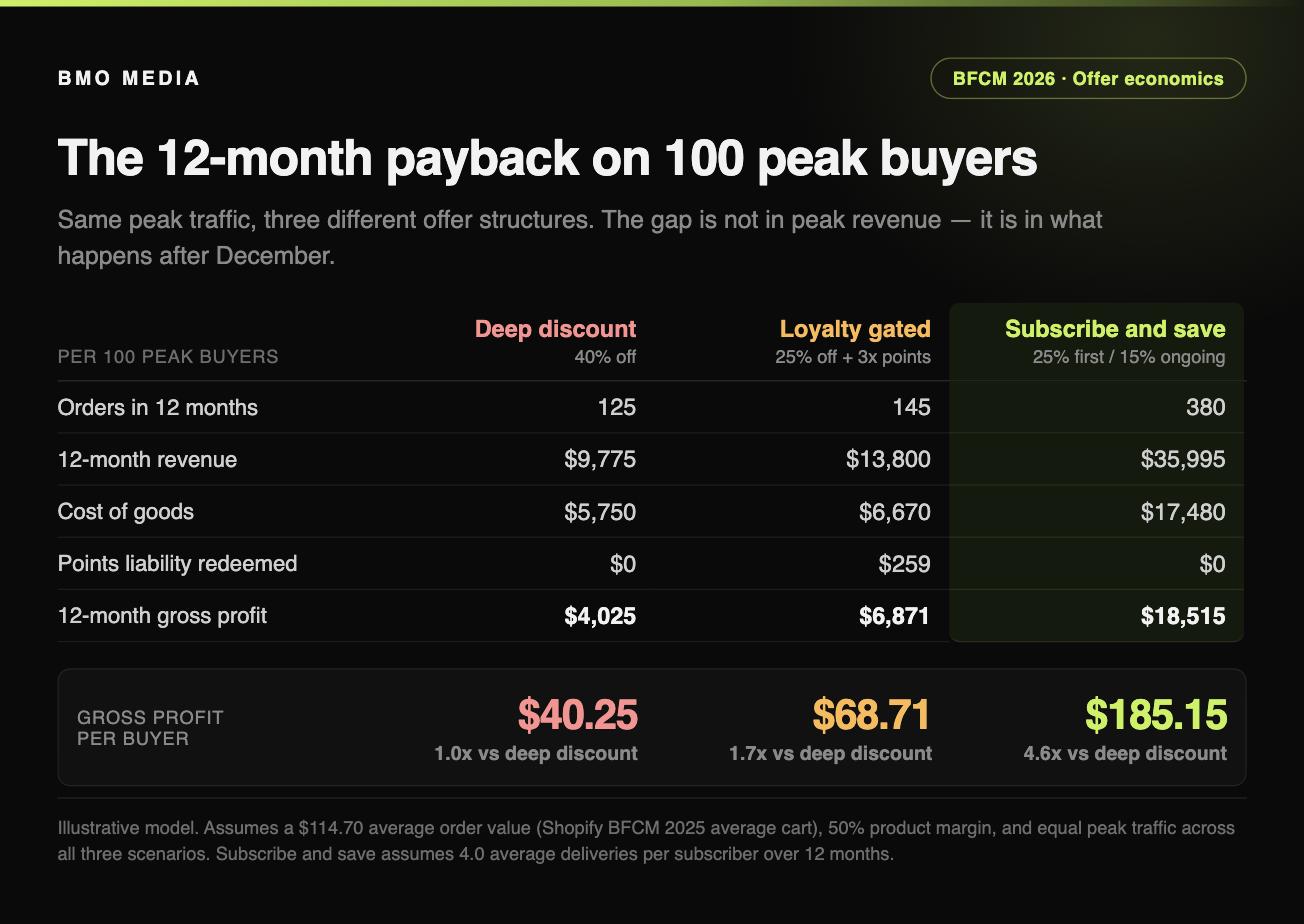
Three things fall out of this. First, the subscription cohort's order multiple in the model (3.8 orders per buyer versus 1.25) lands close to the near-3x figure Recharge reported across its brand base, which is a useful sanity check that the model is not fantasy. Second, the loyalty column wins on a smaller discount, because the repeat rate does the work the percentage was doing. Third, the points liability is real but small, and it lands in Q1 when you want purchase reasons anyway.
Run this with your own AOV, margin, and churn before you set your offer. Our customer lifetime value calculator will give you the inputs in a few minutes.
Not sure which of the three columns your brand can actually support? BMO Media runs a free retention audit that models your BFCM offer against your real repeat rate, churn curve, and margin. Book a call and we will build the version of this table with your numbers in it.
How do you structure a subscribe and save Black Friday offer?
Structure it so the first order is the cheap one and the stream is the profitable one, then protect the second delivery with everything you have. The most common failure we see is a brand that offers a spectacular first-order subscription discount, acquires a large cohort of deal-seekers, and loses most of them before delivery two. That is not a subscription program. That is a discount with extra steps.
Four rules hold up across categories:
Discount the first order harder than the refills, but not by much. A 25/15 split gives the shopper a real peak reason to enroll without training them that the subscription is only worth it once. Recharge's 2026 report noted brands increased first-order discounts by 18%, which makes the gap between order one and order two the number to watch.
Add value that is not a percentage. Free gift on delivery two, early access to the next drop, a members-only SKU, free shipping locked for the term. These cost less than margin points and they survive a competitor's price match.
Set cadence at checkout, not after. Pre-select the cadence that matches real consumption for that SKU. A shopper who has to guess will guess wrong and cancel.
Guarantee the exit. Skip, swap, and pause controls visible before purchase raise enrollment rates and lower the panic cancels that follow the first charge. Recharge reported a 35% decrease in same-day cancellations, and self-service controls are the mechanic behind most of that.
This is the argument for treating peak as a subscription acquisition event rather than a revenue event. When we built the lifecycle program for Centr, the membership business, we aligned email, push, and in-app messaging across acquisition, free trials, paying members, and win-back. The trial-to-paid path is where subscription economics are actually decided, and rebuilding that sequence produced a 20% lift in trial-to-paid conversions. That single number moves more twelve-month revenue than any percentage point you could have added to the Black Friday banner. The same program drove over $1.9M in CRM-attributed revenue during BFCM and 2.5x higher engagement year over year during key sale periods.
If you are designing or rebuilding the offer itself, our DTC subscription program management service covers offer structure, cadence logic, and the flows that defend delivery two.
How does a loyalty gated Black Friday offer protect your margin?
A loyalty gated offer makes the discount conditional on membership. The public site shows one price. Members see a better one, and they see it earlier. That single condition does three things at once: it raises enrollment in the weeks before Black Friday, it moves revenue off the most crowded, most discounted hours of the year, and it gives you a legitimate reason to hold the public discount shallower than your competitors.
The pre-Black Friday window is where this is won. Early access to members converts warm demand at a lower discount because the incentive is access, not price. We saw this run cleanly with Spoonful of Comfort in Q4 2025. Rather than cutting deeper, we used early access ahead of Black Friday and leaned on owned channels. Email and SMS attributed revenue during BFCM rose 196.9% year over year, owned channels accounted for 46.1% of total BFCM revenue, and Q4 finished up 25% year over year. The discount was not the lever. Sequencing and audience were.
Gating also fixes the enrollment problem loyalty programs usually have. Yotpo's brand loyalty research, a poll of 2,000 US consumers updated in 2025, found 59.5% would likely join the loyalty program of a brand they love, while 38% named "making a purchase is the only way to earn points" as their single biggest frustration. Black Friday solves the first half: intent is at its annual high, so the ask converts. Your program design has to solve the second half by awarding points for the actions you want in January, not only for spend.
Practical version: open enrollment two to three weeks out, run a members-only early access window of 24 to 48 hours, keep the public Black Friday discount five to ten points shallower than the member price, and put the join prompt in every email, SMS, and on-site module during that window. If your program needs the underlying mechanics rebuilt first, start with our ecommerce loyalty program service and these loyalty program ideas.
How do you run a points multiplier on Black Friday without giving away Q1?
Run the multiplier on earn, not on redemption, and cap the redemption window so the liability lands where you want revenue. A 3x or 5x points multiplier during Cyber Week costs you nothing on Black Friday itself. It creates a balance the customer has to come back to spend, and you decide when that is.
The math is simpler than it looks. If your base program awards 1 point per dollar and 100 points are worth $5, your baseline give is 5% of spend. A 3x multiplier during a four-day window takes that to 15% of spend for those four days, but only on the orders that occur inside the window, and only for the share of points that are actually redeemed. In the model above, points liability at a 60% redemption rate came to $259 against $8,625 of peak revenue, roughly 3% of revenue, and it converted into repeat orders worth several times that in gross profit.
Three controls keep it safe:
Control | Setting that works | What it prevents |
Multiplier window | 4 to 5 days, Thanksgiving through Cyber Monday | Points inflation across all of Q4 |
Redemption window | Points unlock in January, expire end of Q1 | A liability that sits on the books indefinitely |
Redemption floor | Minimum basket to redeem, at or above your AOV | Sub-AOV redemption orders that lose money |
Earn actions | Points for reviews, referrals, SMS opt-in, subscription enrollment | The "purchase is the only way to earn" complaint |
The last row is the one most brands leave on the table. Peak traffic is the cheapest moment all year to buy an SMS opt-in with points instead of with paid media. Darc Sport is the clearest example we have run: an SMS acquisition and lifecycle build that added 41,000 SMS subscribers in two months, contributed to a 12% increase in total orders and an 11% rise in conversion rate, with 30% of total email revenue coming from automations. Those subscribers are the audience your January reactivation depends on. Our SMS marketing service covers the opt-in mechanics and compliance side of running that at peak volume.
How do you stop subscription churn after Black Friday?
Assume the churn spike is coming and pre-build against it, because the January and February cancel wave is a design problem, not a customer problem. Peak cohorts are lower intent by construction. They enrolled on a discount, and the first full-price or near-full-price charge is where the offer gets re-evaluated. If nothing has happened between the first delivery and that charge, the customer has no evidence beyond the price.
The window that matters is delivery one plus fourteen days. That is where the retention program has to do its work. Four plays carry most of the load:
Play | Timing | Purpose |
Onboarding sequence | Order confirmation to delivery day | Set expectations on cadence, next charge date, and how to skip |
Usage and education content | Days 3 to 14 after delivery one | Create a reason to consume the product, not shelve it |
Pre-billing notice with controls | 3 to 5 days before charge two | Convert a would-be cancel into a skip or a swap |
Cancel-flow intercept | At cancellation | Offer pause, cadence change, or SKU swap before accepting the cancel |
The pre-billing notice is counterintuitive and it works. Telling someone they are about to be charged looks like handing them an exit. In practice it replaces a surprise charge, which produces cancels and disputes, with a controlled decision that usually resolves as a skip. A skipped order is a retained subscriber.
This is also where a properly segmented lifecycle program earns its keep. On Centr, the segmentation ran across acquisition, win-back, paying customers, and free trials, with email, push, and in-app messaging aligned to each. Treating a January-at-risk subscriber the same as a day-one trialist is the fastest way to lose both. For the underlying diagnosis, read our breakdowns of subscription churn rate benchmarks and the causes behind subscription churn.
What does a BFCM loyalty and subscription calendar look like?
The offer is only as good as the sequence around it. Below is the shape we run, expressed as a timeline. Dates shift with your category, but the order does not.
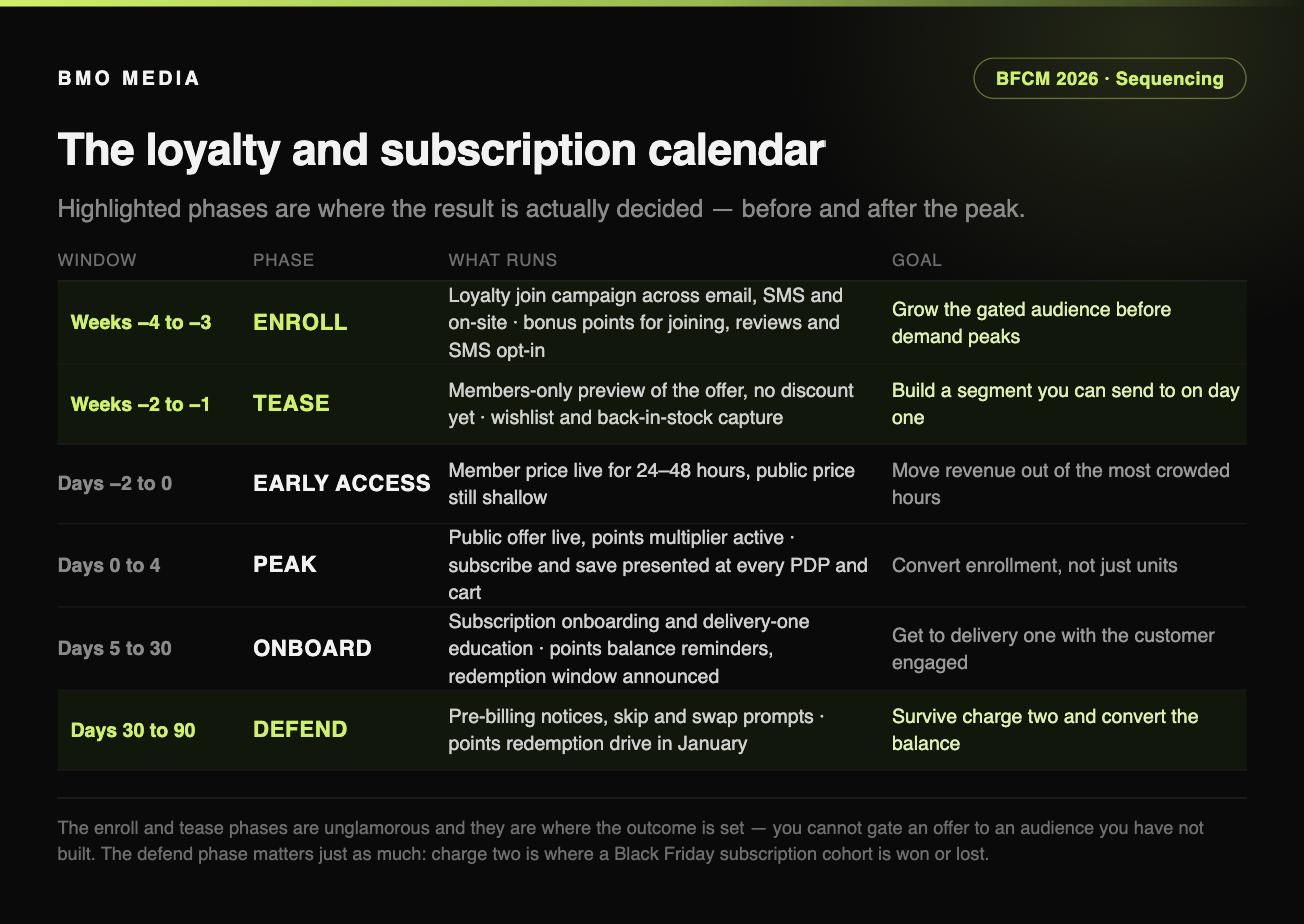
Two notes on running it. The enroll and tease phases are unglamorous and they are where the result is set, because the size of your gated audience on day zero caps everything downstream. And the defend phase needs to be built in October, not January, since nobody staffs a churn-prevention project in the first week of the new year. If you are still building the wider peak plan, our guides on Black Friday marketing strategy and preparing your ecommerce store for Black Friday cover the surrounding campaign work.
Which numbers tell you the offer worked?
Judge peak on cohort quality, not on the four-day revenue line. The revenue number will look fine either way, because demand at peak is not your achievement. What you want to know is whether the buyers you acquired are worth more than the ones you acquired last year.
Six numbers, measured on a fixed schedule:
Metric | When to read it | What good looks like |
Enrollment rate (loyalty joins per buyer) | Daily during the window | Rising through early access, not flat |
Subscription attach rate | Daily during the window | Higher than your non-peak baseline |
Owned-channel revenue share | Day 5 | A meaningful share of peak revenue, not a rounding error |
Delivery-two retention | Day 45 to 60 | Within a few points of your non-peak cohort |
Points redemption rate | End of Q1 | High enough to drive Q1 orders, low enough to protect margin |
12-month gross profit per acquired buyer | Month 12 | Above the prior year's peak cohort |
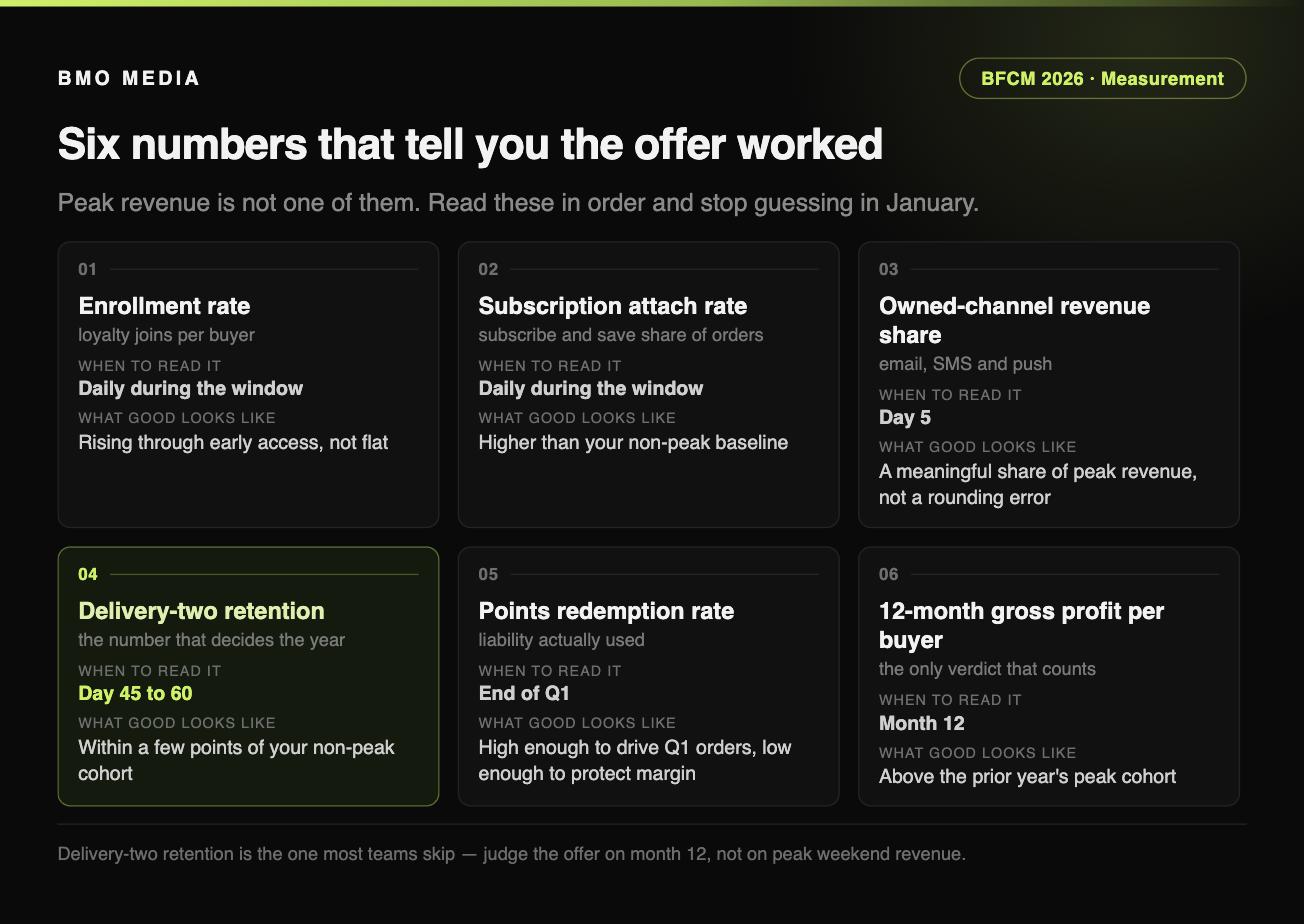
The fourth row is the honest one. If your peak subscription cohort retains far worse at delivery two than a normal-month cohort, your offer bought deal-seekers and the enrollment number was vanity. Fix the onboarding and the pre-billing sequence before you fix the discount. The third row is where owned channels prove their case: at Spoonful of Comfort, owned channels carried 46.1% of BFCM revenue in Q4 2025, which is what makes the retention program a revenue line rather than a cost center.
Track these in one view alongside your email marketing program reporting so peak is measured on the same basis as the rest of the year.
Frequently asked questions
Should I offer a subscription discount on Black Friday if I have never run one? Yes, but run it as a contained test rather than a site-wide change. Pick your two or three highest-repeat SKUs, offer a modest first-order incentive with a smaller ongoing discount, and build the onboarding and pre-billing flows before the window opens. Launching a subscription offer at peak with no retention flows behind it produces enrollments in November and cancellations in January.
How deep should a subscribe and save Black Friday discount be? Deep enough to beat your one-time offer, shallow enough that the ongoing price still works. Most DTC brands land in the 20% to 30% range on the first order and 10% to 20% ongoing. The number that matters is the gap between order one and order two. A very large gap trains the customer that the subscription was only ever worth it once.
Is a loyalty gated Black Friday offer worth it for a small program? It is often worth more to a small program than a large one, because peak is the cheapest enrollment moment you will get all year. Even a program with a few thousand members can use a 24-hour early access window to move revenue out of the most discounted hours and grow the list you will market to in Q1.
Do points multipliers cannibalize Black Friday margin? Not if the redemption is windowed. The multiplier costs nothing at the moment of purchase. The cost lands when points are redeemed, and you control that by setting the unlock date, the expiry, and a minimum basket. Run redemption in January and the liability converts into orders in your weakest month.
How much subscription churn should I expect from a Black Friday cohort? Expect it to be worse than your normal-month cohort and plan for the gap rather than the absolute number. Benchmark your peak cohort against your own non-peak cohort at delivery two and delivery three. If the gap is more than a few points, the problem is almost always the post-purchase sequence, not the discount depth.
Can I run a loyalty offer and a subscription offer at the same time? Yes, and the two reinforce each other when the loyalty program awards points for subscription enrollment. That makes enrollment feel like a reward rather than a commitment, and it gives you one balance to market against in January across both audiences.
Get the version of this with your numbers in it
Peak is four days. The revenue it produces is decided over the following twelve months by what you enrolled people into and how well you defended it. If you want to know whether your current loyalty and subscription setup can carry a peak cohort, BMO Media will run a free retention audit: your repeat rate, churn curve, offer structure, and the twelve-month payback on last year's peak buyers, with the specific fixes ranked by revenue impact.
Book your free retention audit or see how we build DTC loyalty programs that hold margin at peak.
Get the next one
New DTC retention teardowns and benchmarks, straight to your inbox.
Frequently asked questions
How deep should a subscribe and save Black Friday discount be?
Deep enough to beat your one-time offer, shallow enough that the ongoing price still works. Most DTC brands land in the 20% to 30% range on the first order and 10% to 20% ongoing. The number that matters is the gap between order one and order two. A very large gap trains the customer that the subscription was only ever worth it once.
Do points multipliers cannibalize Black Friday margin?
Not if the redemption is windowed. The multiplier costs nothing at the moment of purchase. The cost lands when points are redeemed, and you control that by setting the unlock date, the expiry, and a minimum basket. Run redemption in January and the liability converts into orders in your weakest month.
How much subscription churn should I expect from a Black Friday cohort?
Expect it to be worse than your normal-month cohort and plan for the gap rather than the absolute number. Benchmark your peak cohort against your own non-peak cohort at delivery two and delivery three. If the gap is more than a few points, the problem is almost always the post-purchase sequence, not the discount depth.
Share on
Enjoyed this read?
See how a tailored retention strategy could work for your brand.
Interested in working with us?
Request a complimentary audit and start building a stronger lifecycle foundation today.
Join the team
The retention brief
One email a month. Benchmarks, teardowns and what is actually working in DTC lifecycle right now.
Interested in working with us?
Request a complimentary audit and start building a stronger lifecycle foundation today.
Join the team
The retention brief
One email a month. Benchmarks, teardowns and what is actually working in DTC lifecycle right now.
Interested in working with us?
Request a complimentary audit and start building a stronger lifecycle foundation today.
Join the team
The retention brief
One email a month. Benchmarks, teardowns and what is actually working in DTC lifecycle right now.