Retention
Post-Black Friday Win-Back: What to Run in December and January

Sammy Tran

Run win-back on the Black Friday cohort in two waves. December targets the discount buyer while intent is still warm, using a non-discount second-purchase offer inside 14 to 30 days. January targets the lapsed and the never-repeated with a reactivation sequence and a reason to return that is not price. The metric that decides both is second order rate.
Almost every article about Black Friday is about acquiring the cohort. Very few are about the 60 days that follow, which is when that cohort either becomes a customer base or quietly disappears. Black Friday customer retention gets a fraction of the attention acquisition gets, and the gap is expensive. The discount you gave in November is a cost you have already paid, and a first order at 30% off rarely covers acquisition on its own. The second order is where the money is.
This is the post-Black Friday retention plan we run for DTC brands from December 1 through January 31: how to segment the cohort, what to send each week, which offers work without another markdown, and how to read the result. Treat it as your post-holiday email strategy, not as a cleanup task.
Why do the 60 days after Black Friday decide the quarter?
Because peak week is a small slice of the season, and a smaller slice of the cohort's value.
US consumers spent $257.8 billion online between November 1 and December 31, 2025, up 6.8% year over year, according to Adobe Analytics. Cyber Week, from Thanksgiving through Cyber Monday, accounted for $44.2 billion of that. Do the division and peak week is roughly 17% of the season. The other 83% happened on days most brands treat as a wind-down.
Table 1. Where holiday online spend actually landed, US, 2025 season
Period | US online spend | Share of season |
Cyber Week (Thanksgiving to Cyber Monday) | $44.2B | 17% |
Every other day, November 1 to December 31 | $213.6B | 83% |
Full season | $257.8B | 100% |
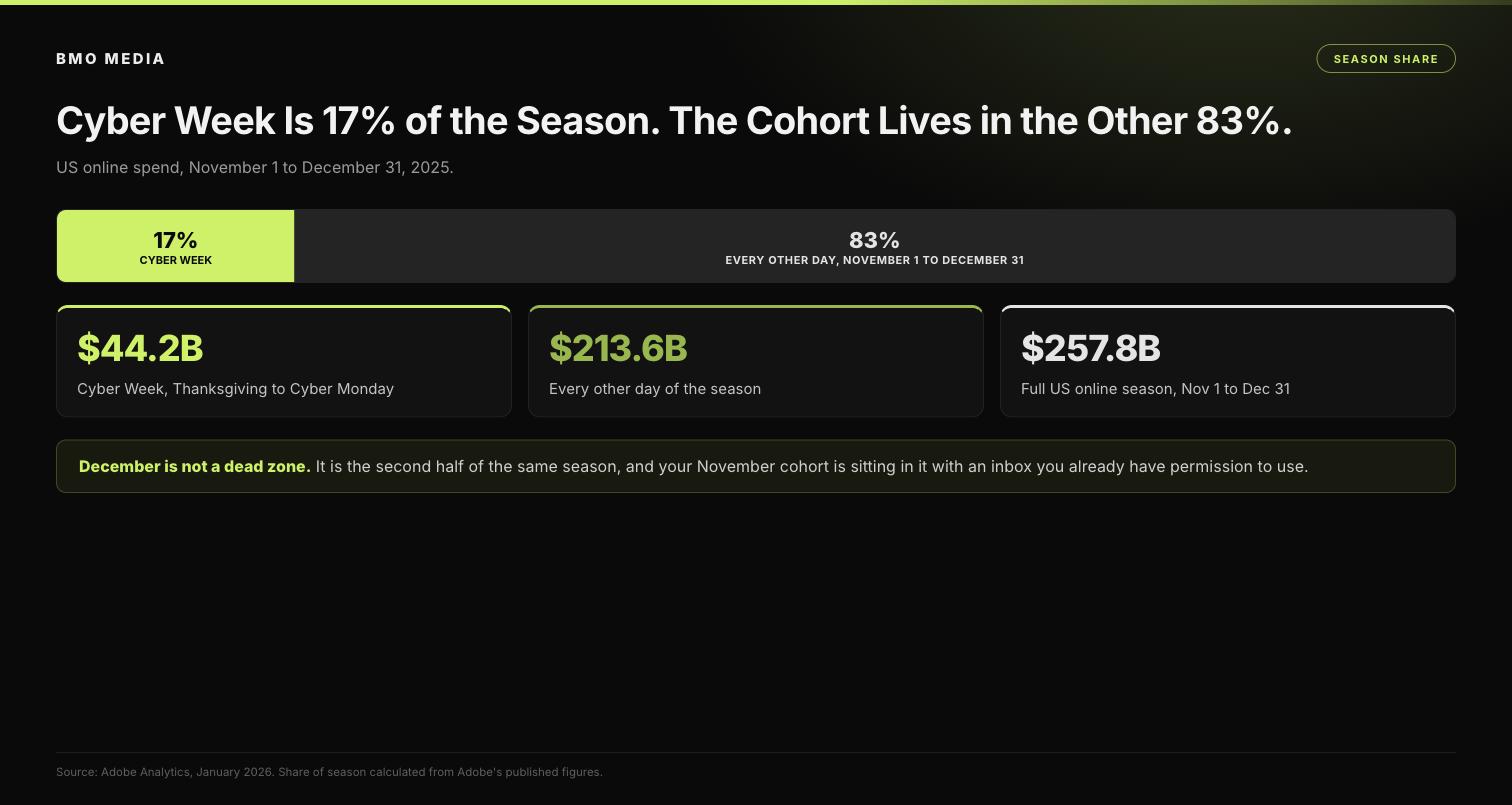
Source: Adobe Analytics, January 2026. Share of season calculated from Adobe's published figures.
Shopify merchants sold $14.6 billion to more than 81 million shoppers over the BFCM weekend at an average cart price of $114.70, Shopify reported in December 2025. That is the scale of the pool handed to lifecycle teams on December 1.
Adobe also counted 25 separate days on which US consumers spent more than $4 billion online, up from 18 days the prior season. Salesforce put global online holiday sales for the 2025 season at $1.29 trillion and noted that the last two weeks of December grew 12% year over year globally and 9% in the US. December is not a dead zone. It is the second half of the same season, and your November cohort is sitting in it with an inbox you already have permission to use.
We see this in client data. For Spoonful of Comfort, the headline everyone quotes is BFCM: email and SMS attributed revenue up 196.9% year over year, with 46.1% of BFCM revenue coming from owned channels. The number we actually care about is the whole-quarter one. Q4 2025 finished up 25% year over year. That lift did not come from a bigger Friday. It came from an extended promo window, early access for known buyers, messaging distributed across weeks instead of compressed into 96 hours, and sale-aware automation that kept flows from fighting the campaign calendar.
Why is second order rate the metric that decides whether Black Friday was profitable?
Second order rate is the percentage of a cohort that places a second order within a fixed window. Pick 90 days and hold it constant so the number is comparable across cohorts.
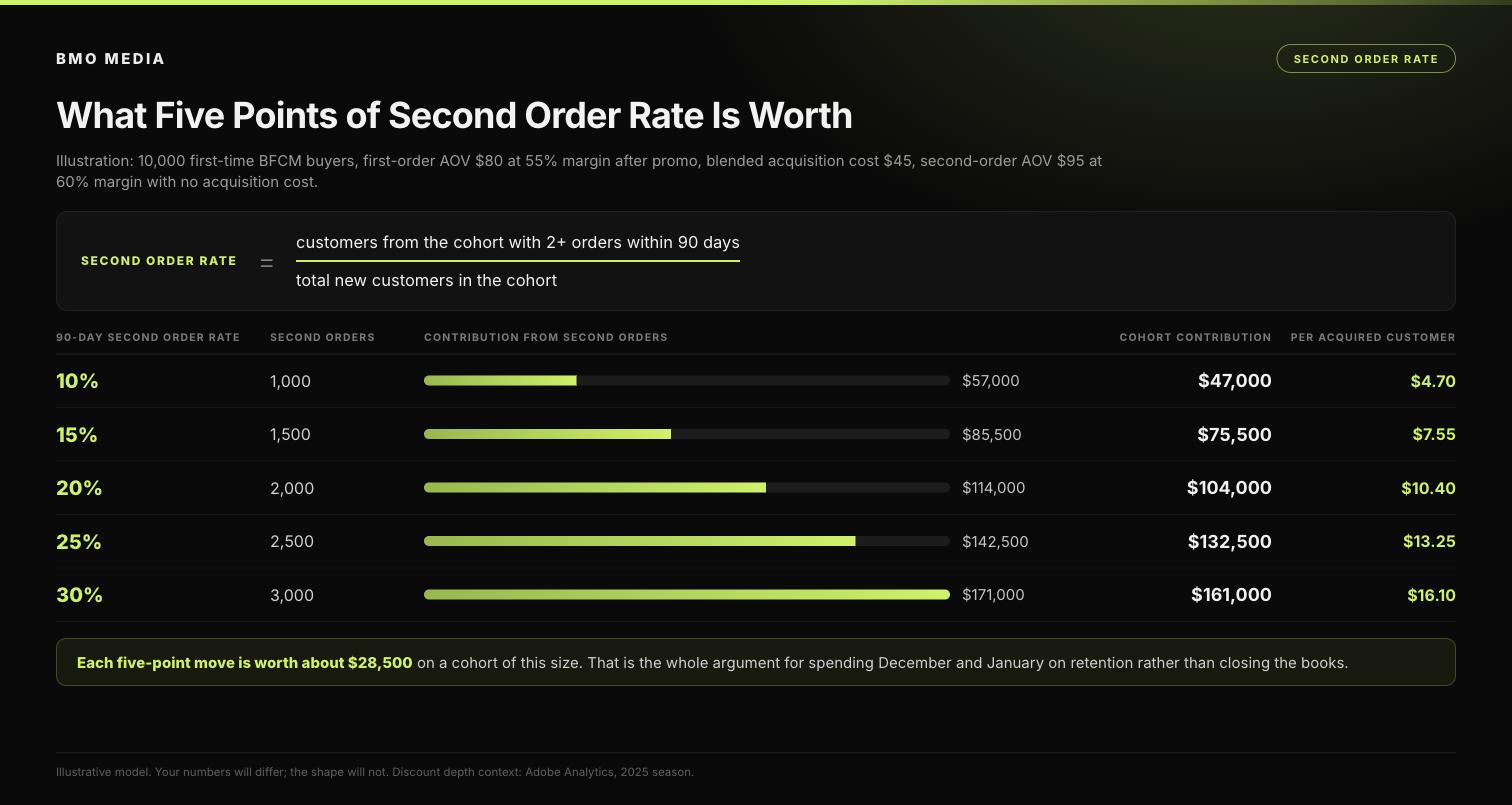
It matters more than any other post-peak number because the first order in a BFCM cohort is usually a break-even event. Adobe recorded average discounts of 30.9% on electronics, 29.6% on toys and 25.1% on apparel during the 2025 season. Strip that off the gross margin, subtract blended acquisition cost, and the first order frequently contributes close to zero. Everything the cohort is worth arrives later.
Table 2. What five points of second order rate is worth (illustration)
Assumptions: 10,000 first-time BFCM buyers, first-order AOV $80 at 55% margin after promo, blended acquisition cost $45, second-order AOV $95 at 60% margin with no acquisition cost. Your numbers will differ. The shape will not.
90-day second order rate | Second orders | Contribution from second orders | Cohort contribution | Per acquired customer |
10% | 1,000 | $57,000 | $47,000 | $4.70 |
15% | 1,500 | $85,500 | $75,500 | $7.55 |
20% | 2,000 | $114,000 | $104,000 | $10.40 |
25% | 2,500 | $142,500 | $132,500 | $13.25 |
30% | 3,000 | $171,000 | $161,000 | $16.10 |
Each five-point move is worth about $28,500 on a cohort of this size. That is the entire argument for spending December and January on retention work rather than closing the books on the quarter. If you want to model this against your own margins and repurchase cycle, run it through the customer lifetime value calculator before you build the calendar.
The market is moving the same direction. Klaviyo reported $3.8 billion in attributed value over BFCM 2025, up 27% year over year, and noted that revenue from repeat customers grew 13.5% year over year, outpacing revenue from new buyers. Discount rates across ecommerce fell 10% year over year in the same dataset. Brands are getting paid for relationships, not markdowns.
How should you segment the Black Friday cohort before you send anything?
Do not treat the November list as one audience. A gift buyer, a loyal customer who bought again, and a first-timer who only moved at 30% off need different messages, and sending them the same thing is how brands burn a cohort in three weeks.
Build the segments on December 1, before the first send.
Table 3. Segmenting the BFCM cohort for December and January
Segment | How to define it | December priority | January priority |
First-time discount buyer | 1 lifetime order, placed in the promo window, code applied | Utility and completion content, no new offer | Full win-back sequence, offer at message 3 |
First-time full-price buyer | 1 lifetime order, little or no discount applied | Early access and VIP framing | Loyalty enrollment, category expansion |
Gift buyer | Different ship-to name or address, gift note, gifting SKU | Recipient capture, gift card, shipping cutoffs | Convert the recipient, not just the buyer |
Reactivated lapsed buyer | Prior customer, last order 180+ days before BFCM | Confirm the reason they came back | Replenishment timing, keep the cadence short |
Existing repeat buyer | 2+ lifetime orders including one in the window | Subscription or loyalty tier upgrade | Referral and review requests |
Subscribed non-buyer | Joined the list in November, browsed, did not order | Browse abandonment and objection handling | Re-permission, then suppress if silent |
Two mechanics make this work. First, run it cross-channel. Klaviyo found that shoppers reached across multiple channels placed 11% more orders, added 34% more items to cart and viewed 71% more products than single-channel recipients, which is the case for aligning your email marketing program and SMS marketing on one calendar rather than running them as separate teams.
Second, put the work in flows, not campaigns. In Omnisend's 2026 ecommerce marketing report, covering 27 billion emails sent by 150,000 brands during 2025, automations made up 2% of email volume but generated 30% of email-driven revenue, earning $2.87 per send against $0.18 for scheduled campaigns. Segmented, triggered messages are where the December return lives.
Not sure which of these segments is leaking? We will pull your last cohort apart and show you the second order rate for each one. Book a free retention audit and we will run it against your own data.
What should you run week by week from December 1 to January 31?
Nine weeks, one job per week. The mistake is to go quiet after Cyber Monday, then reappear on January 15 with a 20% off reactivation email. By then the cohort has decided.
Table 4. December to January sequence, week by week
Week | Cohort focus | Primary message | Channel mix | Read this metric |
Dec 1 to 7 | All new buyers | Delivery confidence, how to use it, first cross-sell | Email flow, transactional SMS | Flow open rate, support ticket volume |
Dec 8 to 14 | First-time buyers | Second purchase on completion logic, gifting cross-sell | Email, SMS, push | Second order rate, day 14 |
Dec 15 to 21 | Everyone still shopping | Shipping cutoffs, digital gift cards, local pickup | SMS-led, email support | Revenue per recipient |
Dec 22 to 28 | Gift buyers and recipients | Gift card push, recipient capture, returns policy stated early | Email, push | New profiles from gift recipients |
Dec 29 to Jan 4 | Full cohort | New year use case reset, subscription offer, loyalty point statement | Email, push, in-app | Subscription starts, point redemptions |
Jan 5 to 11 | Non-repeaters | Win-back message 1: reason to return that is not price | Email, SMS | Reactivation click rate |
Jan 12 to 18 | Non-repeaters | Win-back message 2: social proof, category education, review request | Engaged profile count | |
Jan 19 to 25 | Still silent | Win-back message 3: best offer, single use, dated expiry | Email, SMS | Conversion on offer |
Jan 26 to 31 | Still silent | Re-permission, then suppress. Cohort read-out to the team | List health, 90-day second order rate |
The December half of this is not theoretical. Salesforce recorded that roughly one in five orders in the 2025 holiday season used buy online, pick up in store, rising to one in three in the final five days before Christmas, with December 22 peaking at 35% of all online orders. If you have retail or local fulfillment, weeks two and three are a revenue window, not a wind-down.
For Centr, we built lifecycle segmentation across four states at once: acquisition, win-back, paying customers and free trials, with email, push and in-app messaging aligned to the same logic. Engagement during key sale periods came in 2.5 times higher year over year, CRM-attributed revenue passed $1.9 million during BFCM, and trial-to-paid conversions lifted 20%. The win-back segment was not a separate campaign bolted on in January. It was one of four states the system managed continuously.
What does a December second-purchase campaign look like without another discount?
It looks like a ladder. You start with the rung that costs nothing and only descend when the one above it fails.
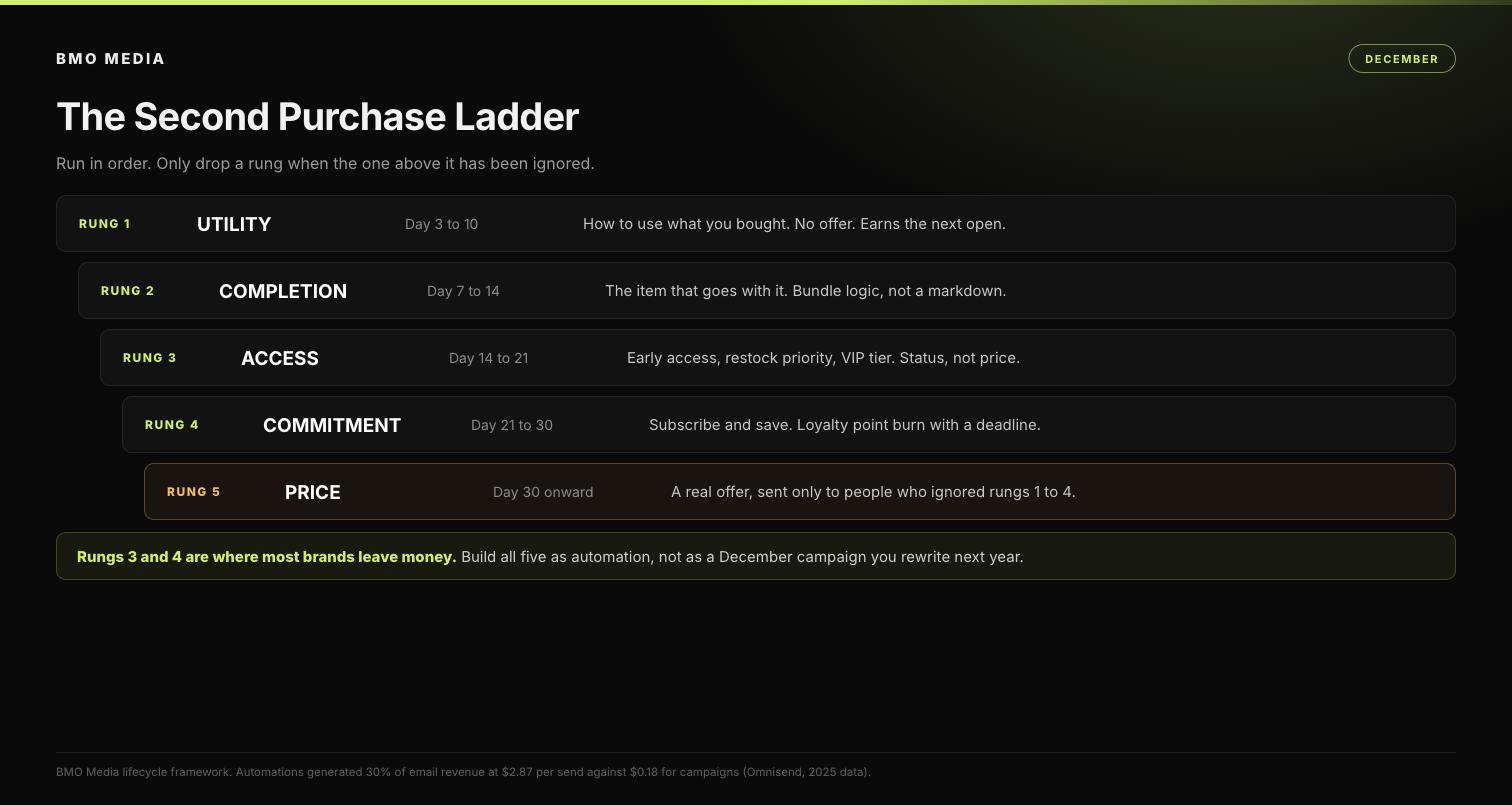
Rungs 3 and 4 are where most brands leave money. A loyalty program turns points earned during a discount event into a reason to return at full price, and a point balance with a stated expiry is one of the few non-price deadlines a customer accepts as legitimate. A subscription program does the same job permanently for consumables: it converts a one-time discount buyer into a recurring order without you having to win the second purchase decision again.
Build all five rungs as automation, not as a December campaign you rewrite next year. For Darc Sport, automations now drive 30% of total email revenue, and rebuilding the SMS automation sequences increased SMS-attributed revenue 80%, alongside a 12% increase in total orders and an 11% rise in conversion rate. Those are always-on assets. They worked in December because they were already running in October.
One more thing December is good for: recovering the carts the cohort left behind. Baymard Institute's 2026 roundup puts the average documented cart abandonment rate at 70.22%, averaged across 50 separate studies. A cohort that just bought from you abandons at a lower rate than cold traffic, and their abandoned carts in December are the highest-intent inventory in your account.
What does the January reactivation campaign need to do differently?
January is a cleanup month with a revenue opportunity inside it. Three things change.
First, returns arrive. Salesforce recorded $181 billion in global returns for the 2025 holiday season, 14% of all purchases and up 10% year over year. A win-back email that lands while a customer is mid-return reads as tone deaf. Suppress anyone with an open return or refund from promotional sends and route them into a service flow instead. Handled well, a return is a re-sell opportunity; handled by autopilot, it is a churn event.
Second, deliverability needs attention after November. You sent more mail in five weeks than in the previous five months. Engagement rates fell mechanically because you mailed deeper into the list. Before the January win-back goes out, rebuild your engaged segment on recency, warm back gradually, and accept that a smaller January list sending to real humans beats a bigger one sending to a spam folder. Omnisend recorded average email open rates rising to 30.7% in 2025, up from 26.6% the prior year, and click-to-conversion climbing from 5.9% to 9%. Those gains go to senders with clean lists.
Third, the offer sequence has to be ordered, dated and finite.
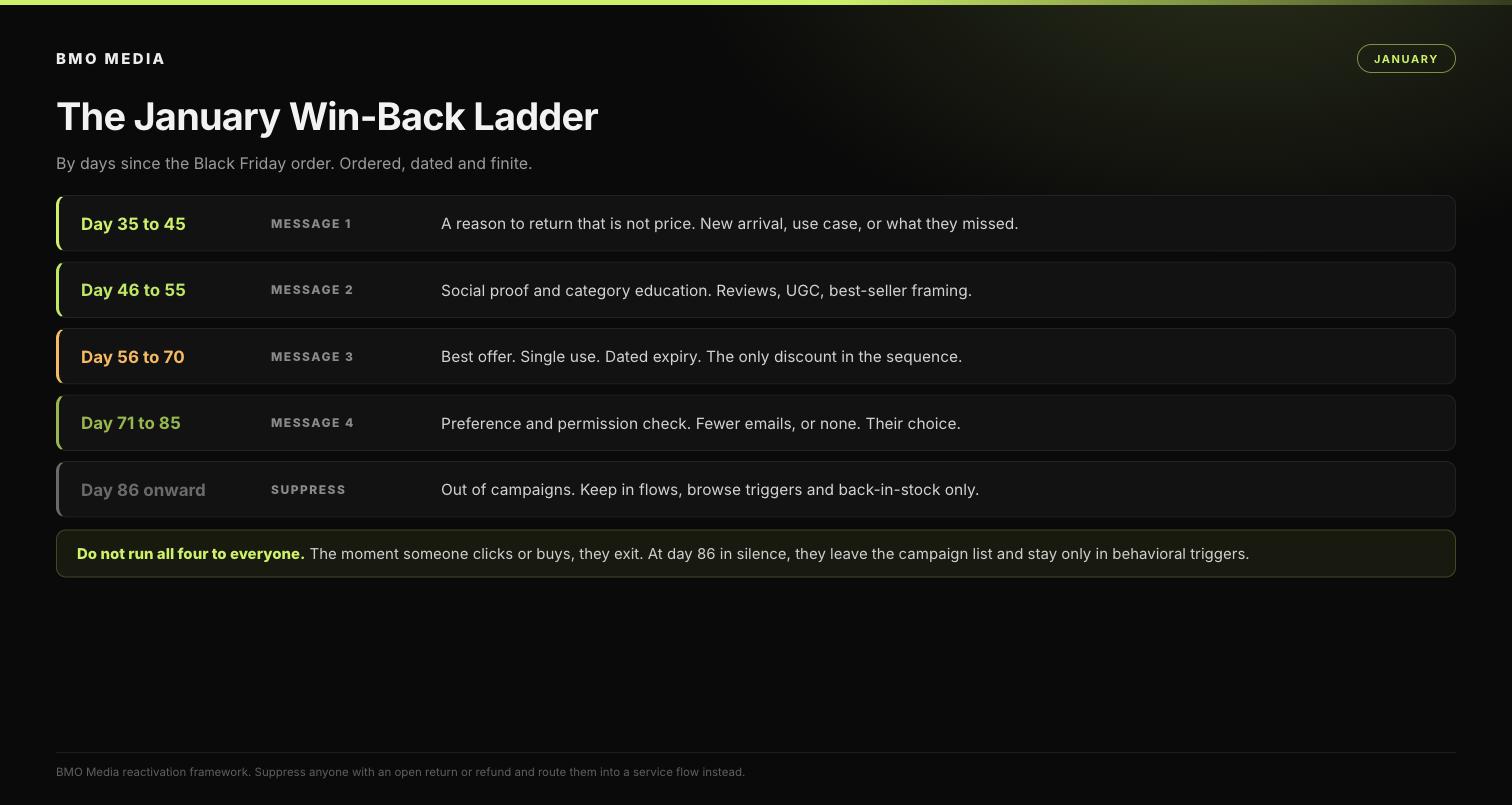
Do not run all four messages to everyone. The moment someone clicks or buys, they exit. The moment someone reaches day 86 in silence, they leave the campaign list and stay only in behavioral triggers. That is how you protect the sender reputation you will need again in November.
How do you measure post-Black Friday retention, and what counts as a good result?
Judge the cohort, not the month. Revenue in December tells you very little because it mixes new acquisition with cohort behavior. Cohort metrics separate them.
Table 5. The post-peak read-out, checked on the same dates every year
Metric | Definition | When to read it | What it tells you |
Second order rate, 90 days | Cohort customers with 2+ orders within 90 days | March 1 | Whether the cohort will pay back its acquisition cost |
Time to second order | Median days between order 1 and order 2 | Day 60 and day 90 | Whether your ladder timing matches the repurchase cycle |
Cohort revenue index | Cohort revenue at day 90 divided by day 1 revenue | March 1 | The multiplier the season actually earned |
Owned-channel revenue share | Email, SMS and push attributed revenue over total | Weekly | How much of the recovery you control |
Engaged profile count | Profiles with an open or click in the last 30 days | Feb 1 | The size of the list you can mail in Q1 |
Discount dependency | Share of cohort second orders using a code | March 1 | Whether you built a customer or trained a bargain hunter |
There is no universal benchmark for a good second order rate, and anyone quoting one without naming a category is guessing. Repurchase cycles differ too much between a coffee brand and a mattress brand for a single number to mean anything. The comparison that matters is internal: run the same calculation on a non-BFCM cohort from earlier in the year. If your November cohort's 90-day second order rate is materially lower than your September cohort's, you did not acquire customers in November. You rented traffic.
Owned-channel share is the other number worth watching in real time. During BFCM, Spoonful of Comfort took 46.1% of total revenue through email and SMS, and 64.91% of Cyber Monday revenue through those two channels alone. When two thirds of a peak day runs through channels you own, the following 60 days are yours to influence. When it runs through paid, you have to buy the cohort back.
If the whole system feels like more than your team can stand up before December, the shortcut is not a longer calendar. It is fewer, better-instrumented flows. Our guide to evaluating retention marketing agencies covers what to look for if you are outsourcing this, and the broader customer retention strategies playbook covers the year-round program this 60-day plan sits inside. For the peak-week half of the calendar, see the Q4 retention playbook for BFCM and our Black Friday marketing strategy breakdown.
Frequently asked questions
When should you start post-Black Friday win-back campaigns?
December 1, not January. The first message is a post-purchase utility email that goes out three to ten days after the order, while the product is arriving and attention is high. Waiting until January means the first thing the customer hears from you after taking a discount is a request for more money, at the point in the year when their card is most stretched. Start warm, escalate slowly, and reserve the actual offer for people who ignored everything else.
What is a good second order rate for a DTC brand?
There is no credible cross-category benchmark, because repurchase cycles range from two weeks to two years. Measure your BFCM cohort against a non-promotional cohort from the same year over the same 90-day window. If the BFCM cohort converts to a second order at a materially lower rate, the discount attracted buyers who were never going to return, and the fix is acquisition targeting, not more email.
Should you discount again in December and January?
Once, late, and to a narrow segment. Discount is rung five of five in December and message three of four in January. Klaviyo's BFCM 2025 data showed discount rates falling 10% year over year while brands offering the smallest discounts grew 14%. Sending a second markdown to a cohort that just bought on a markdown teaches them to wait, and the cost compounds every year you do it.
How often should you email the Black Friday cohort in December?
Two to four times a week for engaged buyers, and less for anyone who has not opened since Cyber Monday. Segment on recency, not on the whole list. December volume is fine as long as it is earned. The failure mode is not frequency, it is sending the same broadcast to a first-time discount buyer, a gift buyer and a five-time customer.
What do you do with people who bought once on discount and never opened another email?
Run them through the four-message January ladder, then suppress them from campaigns at day 86 while keeping them in behavioral flows such as browse abandonment and back-in-stock. Do not delete them. A suppressed profile that triggers a browse flow in April is still revenue. A profile you keep blasting is a deliverability liability that costs you the rest of the list.
Does a heavy January win-back damage deliverability?
It can, if you send it to everyone at once after a high-volume November. Rebuild your engaged segment on 30 to 60 day recency first, send the win-back in tranches starting with the most recently engaged, and watch complaint and bounce rates per tranche rather than in aggregate. A staged send to a clean list recovers more revenue than a single blast to a list that has already stopped opening.
Get the second order rate from your own cohort
Most brands cannot answer the question this post is built around: what percentage of last year's Black Friday buyers ordered again within 90 days. If you do not know that number, you do not know whether Black Friday made money.
We will find it for you. A free retention audit covers your cohort's second order rate, where the December and January sequence is leaking, and the three flows that will move it fastest. No deck, no pitch, just the numbers and what to do about them.
Get the next one
New DTC retention teardowns and benchmarks, straight to your inbox.
Frequently asked questions
When should you start post-Black Friday win-back campaigns?
December 1, not January. The first message is a post-purchase utility email that goes out three to ten days after the order, while the product is arriving and attention is high. Waiting until January means the first thing the customer hears from you after taking a discount is a request for more money. Start warm, escalate slowly, and reserve the actual offer for people who ignored everything else.
What is a good second order rate for a DTC brand?
There is no credible cross-category benchmark, because repurchase cycles range from two weeks to two years. Measure your BFCM cohort against a non-promotional cohort from the same year over the same 90-day window. If the BFCM cohort converts to a second order at a materially lower rate, the discount attracted buyers who were never going to return.
Should you discount again in December and January?
Once, late, and to a narrow segment. Discount is rung five of five in December and message three of four in January. Klaviyo's BFCM 2025 data showed discount rates falling 10% year over year while brands offering the smallest discounts grew 14%. Sending a second markdown to a cohort that just bought on a markdown teaches them to wait.
Share on
Enjoyed this read?
See how a tailored retention strategy could work for your brand.
Interested in working with us?
Request a complimentary audit and start building a stronger lifecycle foundation today.
Join the team
The retention brief
One email a month. Benchmarks, teardowns and what is actually working in DTC lifecycle right now.
Interested in working with us?
Request a complimentary audit and start building a stronger lifecycle foundation today.
Join the team
The retention brief
One email a month. Benchmarks, teardowns and what is actually working in DTC lifecycle right now.
Interested in working with us?
Request a complimentary audit and start building a stronger lifecycle foundation today.
Join the team
The retention brief
One email a month. Benchmarks, teardowns and what is actually working in DTC lifecycle right now.